

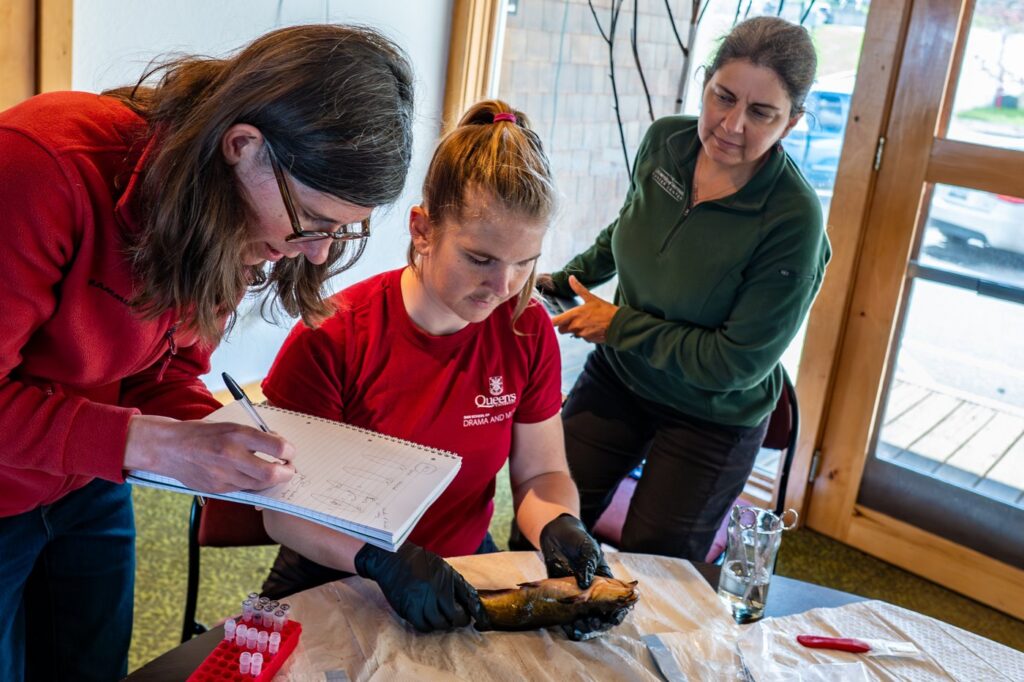
FREDERICTON – Scott Young, a seasoned fisherman with over four decades of experience navigating the lakes and rivers of New Brunswick, has frequently encountered brown bullhead catfish exhibiting dark spots. In May, Young collaborated with University of Cambridge researcher Zoe Clarke to collect samples of these spotted fish, aiming to confirm her hypothesis that these lesions might represent a type of contagious cancer previously identified hundreds of kilometers away.
Clarke anticipates that results from a DNA sequencing lab, expected within the coming weeks, will indicate that the spotted catfish discovered by Young over the years share a similar transmissible cancer with those initially identified in Lake Memphremagog, which lies at the Canada-U.S. border. “How the heck did this happen? Why is it here?” Clarke, a postdoctoral researcher affiliated with the University of Cambridge’s Transmissible Cancer Group, remarked. Clarke plans to dedicate substantial effort to researching these questions over the next few years.
Research conducted from 2014 to 2018 revealed that the raised black lesions observed on brown bullhead catfish in Lake Memphremagog starting in 2012 were indeed skin cancer. A recent study published by researchers from the University of Vermont uncovered that the melanoma affecting these catfish is transmissible, marking a significant discovery as it is the first instance recorded of contagious cancer in fish or freshwater ecosystems. In their study published in Nature, the researchers referred to this contagious cancer as “a puzzling biological phenomenon” and cautioned about its potential to severely impact host populations.
This melanoma in catfish represents only the fourth distinct lineage of naturally occurring transmissible cancer recognized in the animal kingdom, joining the ranks of cancers found in dogs, Tasmanian devils, and various shelled aquatic creatures such as clams and mussels. Dr. Julie Dragon, a co-lead of the study and an associate professor of microbiology and molecular genetics at the University of Vermont, explained that genome sequencing has shown the tumors to be clones of one another rather than distinct mutations. Unlike typical cancers, where tumors closely resemble the host's DNA with minor mutations, the tumors in these catfish were found to be genetically distinct, originating from a singular parasitic cell line derived from one catfish in the past and physically transmitting from fish to fish.
Scientists from the University of Vermont and researchers from Cambridge are now investigating the origin of this cancer, with Dragon mentioning that they do not believe it began in Lake Memphremagog. Confirmations have already indicated its presence in lakes across New Hampshire and Maine. Following Clarke's outreach efforts, a doctoral student alerted her in October to the existence of similar lesions on catfish in New Brunswick, prompting Clarke to schedule a field trip to the region almost immediately. Currently, she awaits sample results from the Hubbard Center for Genome Studies in New Hampshire, which, if found to match the New Brunswick specimens, would be crucial in piecing together the puzzle of the cancer's origins.
Clarke is planning to undertake a return trip to New Brunswick next year, intending to sample fish from the less populated areas along the Saint John River, even contemplating the rental of a camper van for the journey. The researchers encouragingly ask members of the public who encounter fish with notable lesions to send photographs and location information to Dragon via email and to freeze whole specimens for further testing.
Dragon highlighted the potential value of studying these diseased catfish to better understand how melanoma develops and progresses. In contrast to humans, who typically develop skin cancer through exposure to ultraviolet light that damages skin cell DNA, catfish reside in mud and feed primarily at night, a unique behavior that raises questions about the reasons for melanoma in these fish. “That is unusual, and we are looking into, why melanoma? But it also is an opportunity because we think these fish could provide a model for studying melanoma,” Dragon stated.
Concerns have been raised regarding the possibility of humans contracting cancer from catfish, but Dragon reassured the public that there is no evidence to support such a risk. Nevertheless, she noted that the U.S. Fish and Wildlife Service advises against consuming fish exhibiting visible lesions or growths.








