

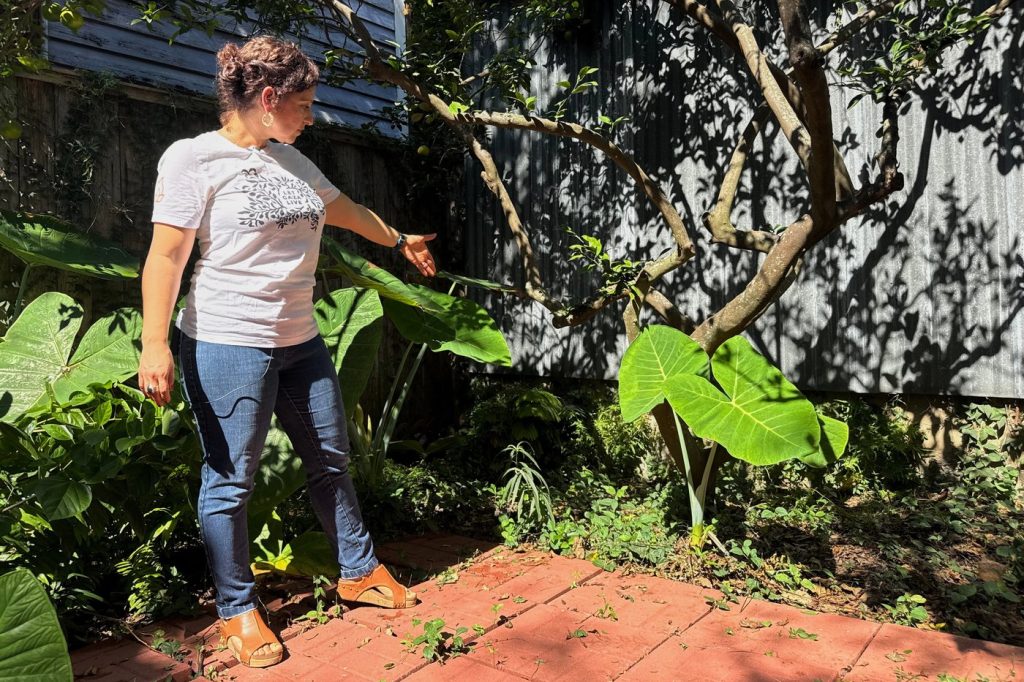
In an astonishing discovery, a New Orleans family uncovering their overgrown backyard stumbled upon a remarkable marble tablet inscribed with Latin characters, notably featuring the phrase "spirits of the dead." The unusual find prompted Daniella Santoro, an anthropologist from Tulane University, to ponder its significance. "The fact that it was in Latin that really just gave us pause," Santoro remarked. "I mean, you see something like that and you say, 'Okay, this is not an ordinary thing.'" Intrigued, she sought the expertise of her colleague, Susann Lusnia, a classical archaeologist.
Upon reviewing the images, Lusnia was astounded to identify the slab as a 1,900-year-old grave marker belonging to a Roman sailor named Sextus Congenius Verus. "When I first saw the image that Daniella sent me, it really did send a shiver up my spine because I was just floored," Lusnia recalled. Further research by Lusnia revealed that the tablet had been missing from an Italian museum for several decades.
Sextus Congenius Verus, who died at age 42 under unknown circumstances, spent over two decades serving in the imperial navy aboard a ship named after Asclepius, the Roman god of medicine. The gravestone describes him as "well deserving" and was commissioned by two individuals referred to as his "heirs," likely his shipmates, since Roman military personnel were prohibited from marrying at the time. The tablet originated from an ancient cemetery, approximately 20 graves containing military personnel, unearthed in Civitavecchia, Italy, during the 1860s. The inscription's details had been cataloged in 1910 but had subsequently fallen into obscurity.
Before World War II, the tablet was documented at the National Archaeological Museum in Civitavecchia, but the facility suffered extensive damage during Allied bombing. It took decades for the museum to be rebuilt, during which the tablet went missing. Museum staff confirmed to Lusnia that it had not been seen for many years. Notably, the recorded dimensions of the missing tablet—1 square foot (0.09 square meters) and 1 inch (2.5 centimeters) thick—matched the dimensions of the tablet discovered in Santoro's yard.
"You can't have better DNA than that," Lusnia stated, highlighting the strong evidence linking the found tablet to its historical origins. The FBI has reportedly engaged in discussions with Italian authorities concerning the tablet's repatriation; however, a spokesperson from the agency commented that they were unable to provide further details due to the government shutdown.
A revealing twist in the story emerged as media reports circulated about the discovery. Erin Scott O'Brien, the ex-wife of the previous homeowner who had lived at the property before Santoro, recognized the tablet immediately as a "cool-ass piece of art" that had been used as a garden decoration prior to being forgotten and eventually sold. O’Brien received the tablet from her grandparents, an Italian woman and a New Orleans native who had been stationed in Italy during World War II. "None of us knew what it was," she noted, expressing shock upon seeing the news coverage of the find.
The rediscovery of the tablet would likely bring immense joy to Sextus Congenius Verus himself. In Roman culture, grave markers held significant importance for maintaining legacies, even those of common citizens. "Now Sextus Congenius Verus is being talked about so much," Lusnia observed. "If there's an afterlife and he's in it and he knows, he's very happy because this is what a Roman wants—to be remembered forever."








