

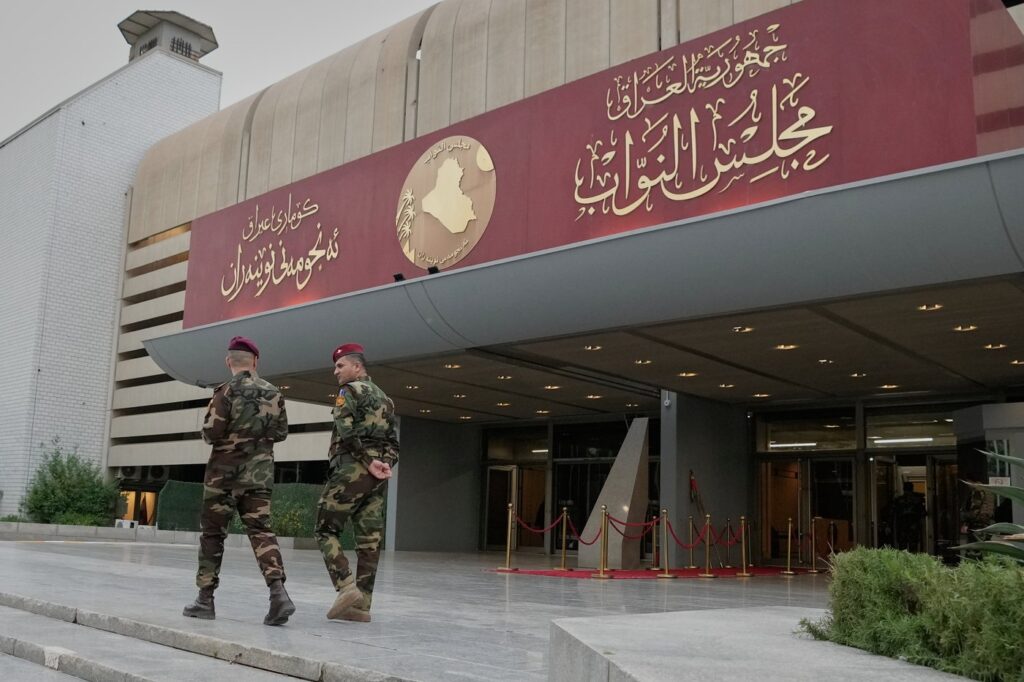
BAGHDAD (AP) — On Saturday, Iraq's parliament voted to elect Nizar Amidi as the new president of Iraq, five months following a parliamentary election that failed to establish a majority bloc. Amidi, an official from the Patriotic Union of Kurdistan party, outperformed a list of candidates that notably included Iraq's current Foreign Minister, Fuad Hussein, who was backed by the rival Kurdistan Democratic Party.
This election takes place amid significant turmoil in Iraq, primarily due to the ongoing U.S.-Israeli conflict affecting Iran. Iraq has found itself entangled in this geopolitical struggle, witnessing Iran-backed militias attacking U.S. bases, diplomatic facilities, and crucial energy infrastructure. Concurrently, the U.S. and Israel have executed airstrikes against these militias, which have sometimes resulted in casualties among Iraqi military personnel. The situation has been further exacerbated by Iran's closure of the Strait of Hormuz, heavily impacting Iraq’s oil exports, which are vital for its economy.
Amidi's election is noteworthy, given the longstanding political convention in Iraq — the president must always be Kurdish, the prime minister must be Shiite, and the parliamentary speaker is usually Sunni. The parliamentary vote to elect the president took place more than two months past the constitutional deadline, which stipulates that a president must be chosen within 30 days of the first parliamentary session following an election.
An engineer by profession, Nizar Amidi was born in the Dohuk province of northern Iraq. He has previously served as an aide to two former presidents, Jalal Talabani and Fouad Massoum. In the initial round of voting on Saturday, no candidate managed to acquire the mandatory two-thirds majority. However, Amidi led with a total of 208 votes, while the next highest candidate, Muthanna Amin Nader from the Kurdistan Islamic Union bloc, received only 17 votes. Due to the lack of a decisive majority, a second round of voting was required, where Amidi secured 227 votes compared to Nader's 15.
Per the Iraqi constitution, following the election of the president, he has 15 days to designate the nominee from the largest parliamentary bloc to form a government and take on the role of prime minister. Currently, the most dominant political faction is the Shiite Coordination Framework, a coalition of Iran-aligned parties. In January, this coalition announced its intent to nominate former Prime Minister Nouri al-Maliki, despite facing significant opposition from the United States.
The Coordination Framework now faces a crucial decision on whether to move forward with al-Maliki’s nomination or select an alternative candidate. Notably, the current Caretaker Prime Minister, Mohammed Shia al-Sudani, had emerged as al-Maliki’s primary competitor for the nomination before he withdrew from the race to facilitate the former prime minister's pathway to nomination.








