

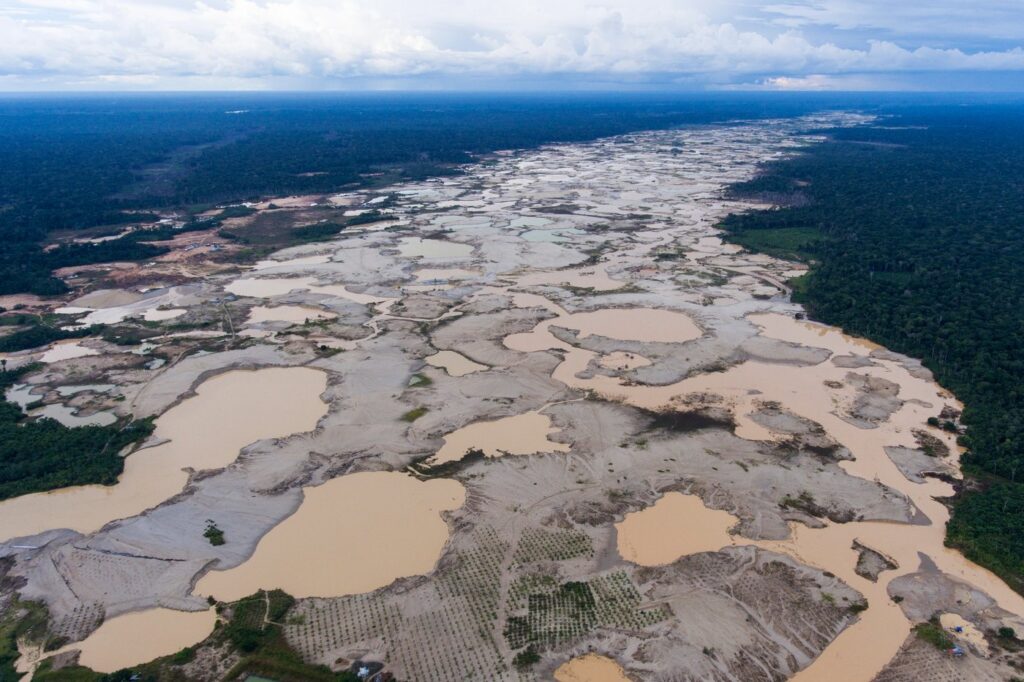
BOGOTA, Colombia (AP) – As Peruvians prepare to head to the polls on Sunday to elect a new president and Congress, the issue of illegal mining, a significant contributor to deforestation and mercury pollution, has notably been sidelined during the campaign. This neglect persists despite the alarming spread of illegal mining into the Amazon and Indigenous territories.
Experts point out that the lack of attention to illegal mining reflects a broader inability to tackle what has become the nation’s largest illicit economy, with detrimental effects on the environment, public health, and Indigenous communities. César Ipenza, an environmental lawyer, commented, “Political parties don’t understand that illegal mining has become the country’s main criminal activity and the one that moves the most money.” He noted that there either exists a lack of awareness about its implications or, in certain instances, political parties may be complicit in this economy.
According to the Peruvian Institute of Economics, illegal mining generated over $11.5 billion in 2025, along with more than 100 tons of gold exports, placing it on par with the formal sector and surpassing the drug trade in terms of revenue. Some candidates, including former ministers like Jorge Nieto and Alfonso López Chau, have put forth fragmented proposals involving gold traceability, financial intelligence, and protections for environmental defenders. However, these proposals fall short of establishing a comprehensive strategy.
Conversely, candidates from prominent conservative and populist parties, such as Keiko Fujimori, Rafael López Aliaga, and César Acuña, tend to prioritize issues like security and economic growth while avoiding a direct confrontation with illegal mining and its ties to corruption and territorial control in the Amazon. Notably, candidates like Ricardo Belmont and Carlos Álvarez have even chosen to omit the issue altogether in their plans.
Magaly Ávila, director of environmental governance at Proetica (a Peruvian anti-corruption group), noted that around 64% of party platforms do not adequately address illegal mining, with only about 5% doing so in a clear and explicit manner. An analysis from March by Peru’s Observatory of Illegal Mining confirmed that out of 36 registered political parties, merely 12 presented specific proposals on illegal mining. Many others provided only vague statements or neglected the issue entirely.
Despite past attempts by Peruvian authorities to curb illegal mining, implementation of these strategies remains limited. Various government entities contacted for their stance on illegal mining and protection for Indigenous communities did not respond in time for publication. Lawmakers have continually extended a provisional registry which allows informal miners to operate as they seek formalization, a system critics assert has been widely manipulated, allowing illegal mining to proliferate.
Concurrently, changes in legislation have diminished the capacity of judges and prosecutors to target organized crime, including networks related to illegal mining. Analysts believe these legislative modifications reflect political pressures from small-scale miners who have instigated protests demanding looser regulations, thereby complicating enforcement efforts. Julia Urrunaga, Peru program director at the Environmental Investigation Agency (EIA), suggested that the organized nature of these protests indicates the likely involvement of more powerful entities behind the scenes.
The surge in gold prices, which now hover around $4,500 to $5,000 per ounce, has exacerbated illegal mining activity, allowing it to extend from its origins in regions like Madre de Dios into other parts of the Amazon. Ipenza remarked, “The price of gold has reached historic highs, and that has obviously driven illegal mining to expand.” He emphasized that the state lacks the capacity to address this illicit activity effectively.
Most illegal mining operations utilize mercury for gold extraction, leading to the contamination of waterways and subsequently affecting the food chain through fish consumption. Mariano Castro, a former vice minister of environment, pointed out that in Amazonian river communities, fish constitutes 50% to 70% of the local diet, heightening the risk of mercury exposure, which has severe neurological implications. Experts have already identified contamination levels in several regions that exceed safety standards, presenting long-term health hazards.
As illegal mining persists, the expected expansion into the Amazon raises concerns about contamination, the involvement of transnational criminal organizations, and the direct impacts on Indigenous and local populations. Tabea Casique, a board member of AIDESEP (Peru’s largest Indigenous organization), remarked that the ongoing illegal mining compromises indigenous health, biodiversity, and traditional ways of life. She highlighted, “Most political parties are not taking this problem into account or presenting concrete proposals.”
Castro noted that the government’s efforts are far from sufficient, as lawmakers have weakened legal tools for prosecuting illegal mining and limited the classification of such operations as organized crime. The existing oversight gaps enable illegally mined gold to infiltrate legal supply chains, often through processing plants where it is laundered. Ipenza advocated for improved control mechanisms for small-scale processing facilities and stronger inter-agency coordination—encompassing customs, financial intelligence units, and prosecutors—to track gold movements and pinpoint illegal activities.
Analysts identify weak traceability systems as a critical flaw. Urrunaga emphasized, “There is no real way to trace mining production in Peru. Authorities hold fragmented pieces of information, but there is no system—and apparently no political will—to connect them.” She estimated that illegal gold exports reach over $12 billion per year and questioned, “How can this be happening in almost total impunity?”
Experts highlight that failing to take action will inevitably exacerbate this already spiraling crisis. Castro asserted that authorities cannot fulfill their obligation to safeguard citizens if they continue to normalize activities with profound detrimental impacts.








