

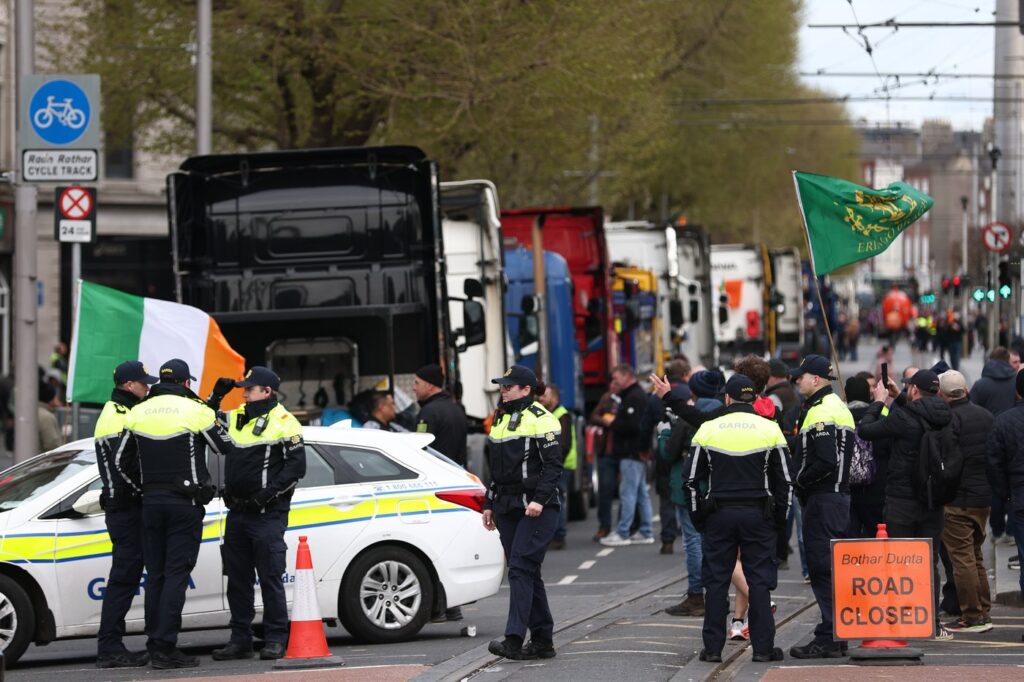
DUBLIN (AP) — On Saturday, police in Ireland took action to remove protesters obstructing access to the country’s only oil refinery, bringing an end to a fifth consecutive day of disruptive demonstrations caused by the soaring price of fuel. The ongoing protests have resulted in many gas stations running out of fuel, creating a potential crisis for transportation across Ireland.
Protesters, including truckers, farmers, and taxi operators, have set up blockades at crucial fuel depots and a major port, leading to significant disruptions in Dublin and beyond. Areas surrounding the capital saw parts of main highways closed as vehicles blocked traffic, exacerbating the situation. Authorities declared a heightened state of readiness, having put all police officers on notice for the weekend, while the military stood by to assist in the removal of roadblocks.
Since the start of the protests on Tuesday, the movement has gained traction, largely fueled by social media. Demonstrators are calling for price caps on fuel and reductions in excise and carbon taxes. Government officials, however, have expressed confusion regarding the protests, noting that the surge in fuel prices is driven by global market conditions stemming from conflicts in the Middle East, which have impacted oil exports.
Prime Minister Micheál Martin highlighted the precarious state of Ireland’s fuel supply on Friday, mentioning the potential for tanker trucks to be turned away from ports amid the global shortage. He expressed incredulity at the protests, calling their basis "unconscionable" and "illogical." Protesters like plumber Paddy Murray voiced their frustrations, stating that ongoing high fuel costs and overall living expenses made it difficult for them to conduct business.
Reports indicated that more than a third of the country's 1,500 service stations had run out of fuel by Saturday, with expectations that this figure would worsen if blockades continued. Reopening the Whitegate refinery in County Cork was seen as a necessary step to help stabilize the situation. By midday, police deployed specialized units to the refinery to clear demonstrators while military support awaited further instructions. Instances of pepper spray being used were reported, alongside footage showing police dragging a protester from a tractor.
In an effort to address the rising fuel prices, the government had previously implemented measures including temporary tax reductions and subsidies for diesel users, as well as support programs for low-income residents. However, these efforts quickly fell short as international oil prices continued to rise uncontrollably.
The protests had initially begun with slow-moving convoys restricting access to key areas in Dublin and blocking essential fuel supply depots that provide for half of the nation's needs. Some protesters even chose to sleep in their vehicles overnight, demanding government dialogue. Demonstrations extended beyond Dublin, with support from crowds in the streets and tractors proceeding through Cork.
The road leading to the Rosslare Europort, a key entry point for freight and passenger ferries, was also shut down, stranding cargo and raising the potential of the port reaching capacity imminently. Harbormaster Tom Curran warned that the situation was rapidly approaching a critical limit.
As the protests continue, the Irish government remains engaged in talks to seek a resolution, but the patience of both sides appears critically tested as the situation escalates.








