

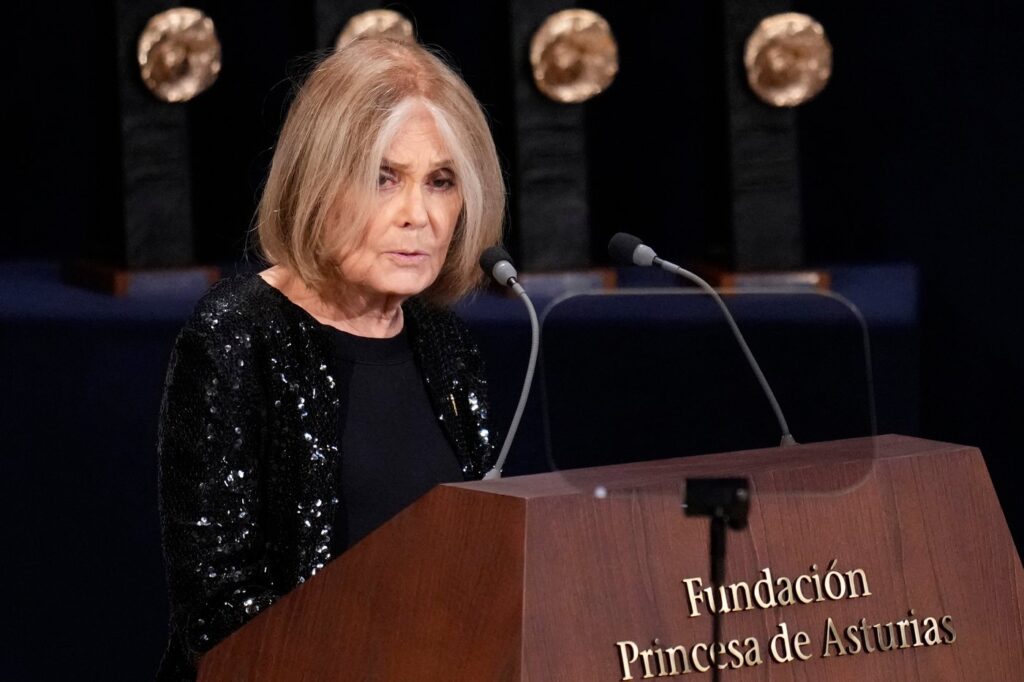
Gloria Steinem, the iconic author and activist who became a symbol of the U.S. women's movement, has passed away at the age of 92. Steinem was known for her distinctive appearance, characterized by streaked hair and large aviator glasses. She co-founded Ms. Magazine and spent much of her life traveling to speak at college campuses, community centers, rallies, and marches. Steinem died on Wednesday at her home in New York City, as announced on her and her foundation's social media pages.
The social media posts highlighted Steinem's remarkable ability to listen and empathize with others, allowing them to feel seen and heard. They emphasized her independent spirit, curiosity, and sense of humor. In recent years, she took joy in writing and engaging with the community, even hosting talking circles in her home. Steinem passed away shortly before the release of her anticipated memoir, which was scheduled for this fall. She had previously emphasized the importance of personal interaction in fostering empathy in a 2015 interview.
Steinem's Career Shift from Journalism to Activism
Steinem began her professional journey in journalism, gaining notoriety for her 1963 undercover reporting on conditions within Hugh Hefner's Playboy empire—a move she later regretted. However, a pivotal moment came six years later at a speak-out on abortion rights, where women shared their experiences boldly. This resonated with Steinem, who had herself undergone a secret illegal abortion at age 22, and transformed her career into advocacy. Steinem remarked that true democracy relies on equal control over our bodies, irrespective of gender or race.
Despite her rise as a prominent activist, she initially struggled with a fear of public speaking and preferred writing. However, with editors reluctant to cover the women's movement, she was compelled to take to the stage, despite her initial terror. This fear lingered throughout her life, as she admitted even to feeling scared before speaking engagements into her 90s.
Steinem's Enduring Visibility and Impact
Even into her 80s, Steinem remained a potent voice for women's equality and other humanitarian issues globally. Her advocacy spanned various causes, but she maintained that equality for women was of utmost importance. Steinem famously declared that being a feminist necessitates seeing the world in totality, rather than in halves. Her visibility was unabated and seen in numerous instances, such as attending her first fashion show at age 83 and leading a women’s talking circle at a play celebrating her legacy shortly after her 85th birthday.
In 2020, a feature film titled "The Glorias" was made about her life, and at 91, she collaborated on a picture book aimed at inspiring youth. Despite her accolades, Steinem expressed frustration about often being described by her looks, asserting that such attention undermined her efforts. She pointed out that the attention to beauty seemed to occur only after she became a public feminist.
Facing Hostility and Stereotypes
Steinem faced criticism from various quarters during her career, including from a female caller on a talk show who expressed hostility toward her work. Such hostility was common in the early years of the feminist movement, particularly when she co-founded Ms. Magazine, which many critics deemed frivolous at the time. Even then-President Richard Nixon ridiculed her and the magazine, which continues to be published today. Steinem utilized her wit to counter criticism, and famously remarked that she “couldn’t mate in captivity” when discussing her choice to remain single until later in life.
In recognition of her contributions to women’s rights, she received the Presidential Medal of Freedom in 2013 from President Barack Obama, who noted that her work opened up opportunities for countless women and reshaped their self-perceptions.
Early Life and Formative Years
Gloria Marie Steinem was born on March 25, 1934, in Toledo, Ohio. Her upbringing was marked by a nomadic lifestyle, as her father was a traveling antique salesman, and she did not attend regular school until later in life. After her parents' divorce in 1944, she assumed care for her mother, who battled mental health issues. Despite early ambitions in tap dancing, she found a passion for journalism after attending Smith College but was often relegated to less meaningful assignments due to her gender.
Steinem's life took a turn when she undertook an assignment posing as a Playboy Bunny in 1963, which she later lamented as a professional misstep that hindered her career. However, her writing took on a political tone in her 30s after she covered a pivotal abortion rights hearing. By founding key organizations alongside notable feminists such as Betty Friedan and Bella Abzug, she established her role in the women’s rights movement.
Steinem continuously advocated for change, co-founding Ms. Magazine in 1972 and promoting issues such as the Equal Rights Amendment and reproductive rights. Throughout her life, she never bore children but felt strongly about the importance of demonstrating the choices available to women.
In 2000, at the age of 66, she married David Bale, further shaping her narrative of independence and choice in a changing society. Even near the end of her life, she remained a critical voice for justice and equality, inspiring generations of women to embrace their identities and advocate for their rights.








