

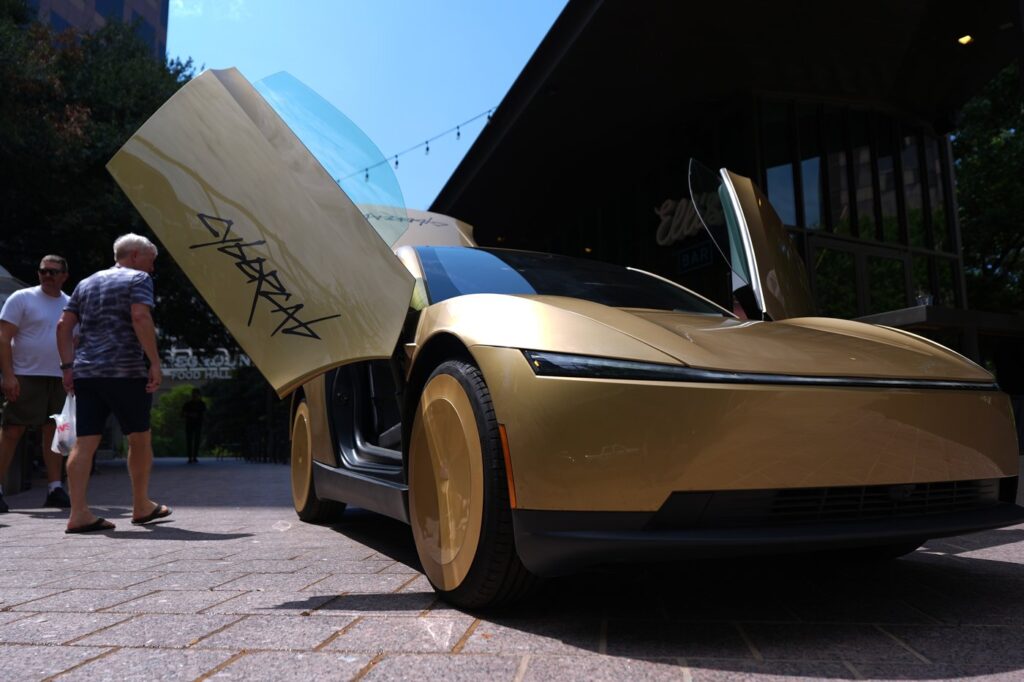
Elon Musk has launched dozens of self-driving Cybercabs in Austin, Texas, lacking traditional controls such as steering wheels and brake pedals. This significant step marks Tesla's ambition to establish its presence in the self-driving taxi market, competing against established leaders like Waymo. Following the rollout, Tesla shares experienced a notable rise of over 5%, as investors remain optimistic about the potential success of these futuristic taxis.
The gold-colored Teslas, which passengers cannot control in emergencies, were teased on social media platforms before the launch event. Musk shared an image of one of the Cybercabs against the Austin skyline, depicting his vision for the future of transportation. While the launch event was invitation-only, it highlighted Tesla's progress in a technology that has been met with both skepticism and excitement from the public.
Despite this forward momentum, Tesla is currently behind Waymo in both the number of deployed self-driving cabs and completed trips. To challenge Waymo’s dominance, Tesla must successfully demonstrate that its camera-only system can navigate complex urban environments safely, especially in scenarios involving pedestrians. In contrast, competing services like Waymo and Amazon's Zoox utilize additional technology such as radar and lidar for enhanced safety and navigation capabilities.
However, public sentiment remains a significant hurdle for Tesla. A Pew Research Center survey from February indicated that 70% of U.S. adults are "not too" or "not at all" comfortable riding in driverless vehicles. This cautious attitude can be attributed to concerns over safety and the overall acceptance of autonomous technology. As Tesla continues its rollout, it faces the challenge of changing public perception to foster trust in their innovative services.
Tesla's market position has faced challenges in the past as well, with significant declines in vehicle sales leading to diminished stock prices. Musk's controversial involvement in political matters and the subsequent backlash from protests and boycotts have contributed to the company's struggles. Last year, Tesla experienced its second consecutive annual decline in vehicle sales, allowing competitors like BYD from China to surpass it as the leading electric vehicle maker globally.
Austin has previously operated a self-driving Tesla “robotaxi” service since June of the previous year, which included traditional controls and required safety drivers to manage any potential issues. The service has since been extended to five other cities in Texas and Florida, featuring a mix of supervised and "unsupervised" robotaxis. Currently, reports indicate that Tesla operates more than 200 unsupervised vehicles, whereas Waymo boasts over 4,000 across 14 cities.
Public opinion remains divided on the safety of autonomous driving. In addition to the Pew survey, Gallup polling conducted in 2025 revealed an increase in skepticism about driverless cars compared to previous years. Many Americans now believe that human-operated vehicles remain the safest option for transport.
Furthermore, Musk’s reputation poses another barrier for public acceptance, with nearly 60% of U.S. adults expressing unfavorable views toward him according to another Pew Research poll conducted in January. Despite these challenges, Musk aspires to roll out full self-driving software to hundreds of thousands of Tesla vehicles, enabling owners to turn their cars into taxis when not in use.
Nevertheless, regulatory hurdles remain significant. Tesla has not yet secured approval to utilize its partial self-driving software across most of the European Union, and U.S. regulators have initiated several investigations into the safety of its technology. Issues under examination include the software's involvement in crash incidents under low-visibility conditions and questions about Tesla’s compliance with reporting requirements for accidents involving its vehicles.








