

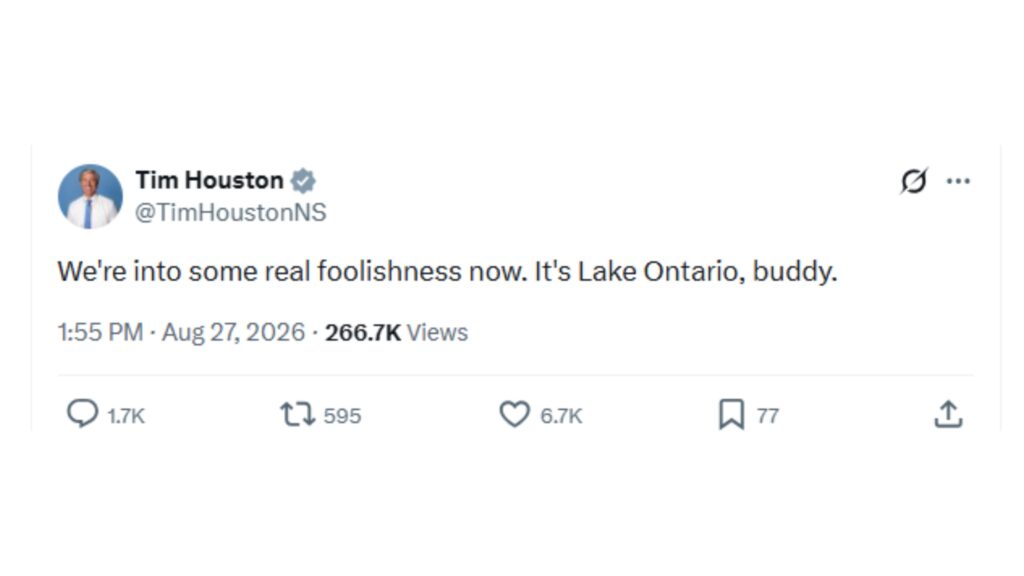
In an unprecedented executive order, President Donald Trump has declared that Lake Ontario will now be known as Lake America. This decision has sparked outrage across Canada, prompting responses from politicians at all levels, including Nova Scotia's Premier, Tim Houston.
Premier Houston expressed his discontent, stating, "We're in to some real foolishness now. It's Lake Ontario, buddy," in a post on X (formerly Twitter). Following this, he appeared on MS Now, where he criticized the move, saying, "The rhetoric's been going on for a couple of years at this stage, but the reality is, this is something that somebody does when they are trying to appear strong, but it's only evidence of weakness."
The reactions from Canadian leaders raise an intriguing question about the best approach during such heated moments: should politicians adopt a composed demeanor, or should they respond sharply, as Ontario Premier Doug Ford did in a recent lengthy critique of President Trump?
Two political scientists from Nova Scotia provided insights into this extraordinary period in Canadian history, discussing how both witty comebacks and calm statements are resonating with the public. Lori Turnbull, a political professor at Dalhousie University, explained that there is an expectation for leaders to stand up for Canada, especially after Prime Minister Mark Carney and his team recently suspended negotiations with the U.S. over new trade terms that were deemed "unfair" and "uneconomic." An Abacus Data poll indicated that 71% of Canadians supported the federal government's decision to halt talks.
Turnbull suggested that Houston's responses serve not only to communicate his stance to the citizens of Nova Scotia but also to express a collective frustration with Trump. "My feeling about it is when Houston's talking, he's talking to Nova Scotians, he’s talking to the people who he’s representing," she stated.
In contrast, Tom Urbaniak, a political science professor at Cape Breton University, noted that even though Houston and Ford share similar views, their approaches differ. Urbaniak pointed out that now it appears as if Ford is adopting a more direct and populist response, aligning with the sentiments of many Canadians. Ford's past incidents, like his public disagreement with Trump over a trade-related ad, highlight a “good cop, bad cop” dynamic, wherein Ford is more confrontational while Carney appears more restrained in his engagement.
Ford’s recent comments and actions, including banning American alcohol imports at the LCBO, have positioned him as a more critical player in the dialogue with Trump. The repercussions of such policies on American industries have not gone unnoticed, making Ford's role more significant in this geopolitical context compared to Houston's more composed rhetoric.
Urbaniak also reflected on Canada's historical context, wherein leaders have had to assert national strength against the U.S., citing incidents like the War of 1812. He emphasized the importance of leaders showing solidarity during tense situations, which is likely to resonate strongly with the Canadian populace in light of recent events.
Mark Carney's steady and professional demeanor has been underscored as well. His consistent messaging and control aim to portray Canada as a strong and united front, even as tensions rise with the U.S. Carney recently announced a substantial investment in Canadian manufacturing, reflecting a commitment to reinforcing local industries amidst foreign pressures.
The political responses from leaders like Houston, Ford, and Carney convey a unifying message that underscores the importance of teamwork and solidarity within Canada as it faces external challenges. It indicates a moment where responsiveness and solidarity are imperative as the nation navigates through a complex political landscape.








