

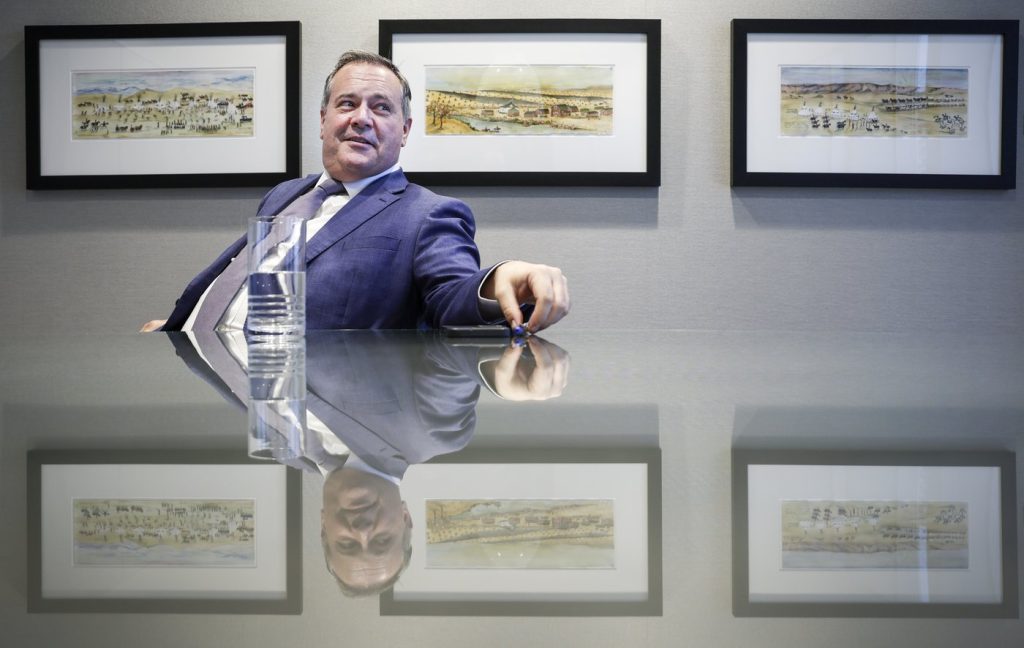
CALGARY — Jason Kenney, the architect behind Alberta’s recall legislation for politicians, recently clarified that the law was designed not as a political tool but as an "ultimate tool of accountability" in instances of illegal or unethical behavior by elected officials. In an interview on Thursday, Kenney, who served as Alberta's first United Conservative Party (UCP) premier from 2019 to 2022, addressed the current situation in which 14 members of the UCP caucus are facing recall petitions crafted by discontented citizens.
Kenney emphasized that the thresholds for instigating a recall are intentionally set high. “My government purposely set very high thresholds,” he remarked. “Frankly, we replicated the thresholds developed in British Columbia in 1991 under an NDP government to ensure there’s a really broad public demand for a byelection.” He reiterated that the recall mechanism should be used as a response to "absolutely egregious, illegal, grossly unethical" actions by politicians, rather than for mere policy disagreements.
In Alberta, constituents can only hold their Members of the Legislative Assembly (MLAs) and Members of Parliament (MPs) accountable through general elections every four years. Therefore, Kenney stated, "If you have policy differences, that’s where to settle that." He noted that his administration's goal was to create a careful balance in the use of recall petitions, emphasizing the need for substantial public backing to initiate the recall process.
Currently, the climate for the UCP is contentious, with not only these 14 members facing recall but also Premier Danielle Smith expected to be added to this list soon. According to a petitioner involved in the recall campaign against Smith, they have received preliminary approval to commence signature collection, pending a formal announcement. The core grievance among constituents involves claims that UCP politicians have been unresponsive to community concerns and have breached trust, particularly by using the Charter's notwithstanding clause to interrupt a provincewide teachers' strike in October.
UCP officials, including backbenchers and cabinet ministers, have refuted these allegations, citing specific initiatives in their constituencies aimed at demonstrating their commitment to constituent needs. A spokesperson for the UCP caucus remarked that the recall process is intended for significant breaches of duty and should not be misused for expressing policy disagreements. In line with this, Kenney reiterated that individuals dissatisfied with a political stance, especially regarding union negotiations, should express their discontent through the electoral process rather than attempting recalls.
Further, Kenney delved into the context of the notwithstanding clause, which he stated is tied to the 1982 repatriation of the Canadian Constitution—a measure requested by all premiers, including Allan Blakeney of Saskatchewan's NDP government. Kenney argued that the notwithstanding clause is essential in maintaining a balance between democratic principles and judicial independence, stating, “There would be no Charter of Rights without the notwithstanding clause.”
He attributed the rising reliance on this clause to judicial overreach, claiming it results from a decreasing reluctance among courts to adhere strictly to legislative interpretation. "This is an entirely predictable response to that," he contended.
According to the provisions of Alberta’s Recall Act, petitioners have a window of three months to gather signatures equal to 60 percent of the total votes cast within the constituency during the 2023 election. Should they achieve this threshold, a vote is conducted to determine if the politician in question retains their seat, with a byelection to follow in the event of a loss.








