

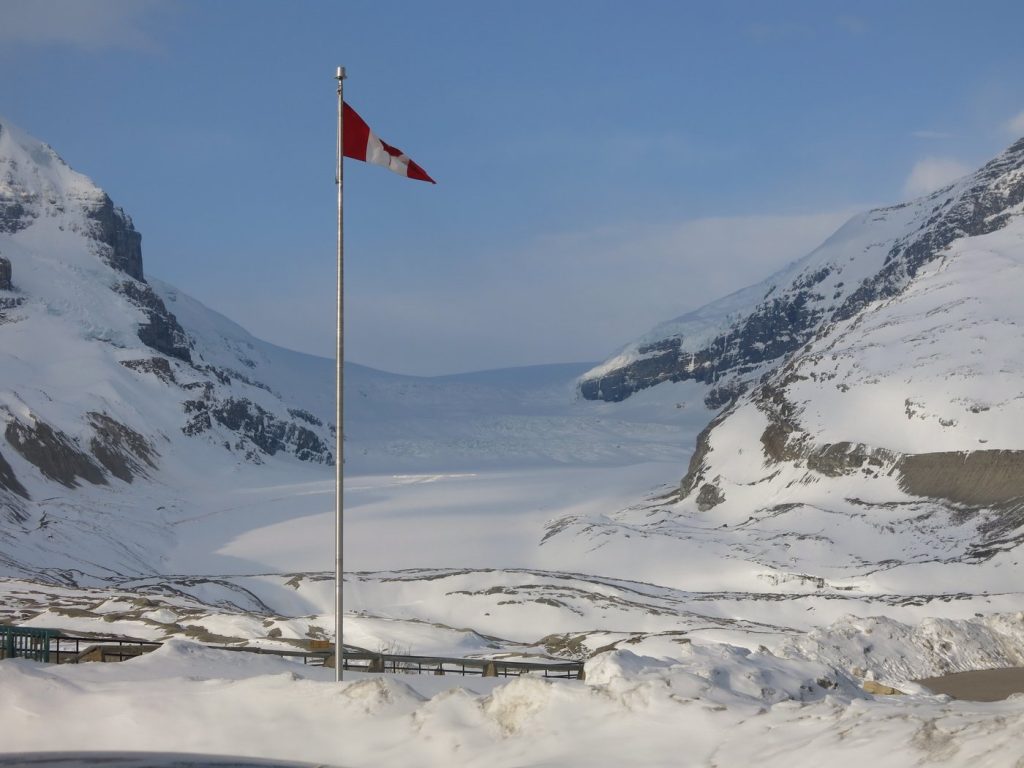
A new international study highlights the potential for saving thousands of glaciers in Canada's Arctic from total extinction, provided humanity takes significant action to curb global warming. The research indicates a dire future for glaciers worldwide, predicting that nearly 80 percent could vanish if global temperatures rise to an estimated 2.7 degrees Celsius by the end of the century.
The Swiss-led team of researchers behind this peer-reviewed study, published in Nature Climate Change, modeled glacier extinction rates across four different warming scenarios. Under the scenario of 1.5 degrees of warming, it is estimated that Canada's southern Arctic could lose about 34 percent of its glaciers. In contrast, if the current trajectory of approximately 2.7 degrees continues, up to 60 percent of these glaciers could be lost. At a catastrophic level of four degrees, nearly all glaciers in Western Canada and the United States would disappear, along with 81 percent of those in the southern Arctic.
This research places new emphasis on the sheer number of glaciers facing extinction, diverging from previous studies that typically focused on glacier mass, which helps in understanding future sea-level rise and water scarcity for communities dependent on glacier meltwater. A 2023 study published in the journal Science estimated that glaciers, excluding those in Antarctica and Greenland, could lose a quarter of their total mass at 1.5 degrees of warming, rising to two-thirds under four degrees.
In this latest study, the researchers utilized simulations to project the evolution of more than 200,000 glaciers worldwide, excluding Antarctic and Greenland ice sheets. They employed three models to determine when each glacier would shrink below the classification of a glacier under the four warming scenarios: 1.5 degrees, two degrees, 2.7 degrees, and four degrees. The study introduces the term “peak glacier extinction” to describe the year with the highest expected number of glacier disappearances between now and the century's end.
At 1.5 degrees of warming, approximately 2,000 glaciers are projected to vanish each year, peaking around 2041. Conversely, at four degrees, this peak shifts to the mid-2050s, with about 4,000 glaciers disappearing per year due to the accelerated melting of larger glacier masses. Current estimates suggest that the world is on track for approximately 2.7 degrees of warming if nations follow through on their existing climate policies—a scenario considered unlikely to meet international targets aimed at limiting warming to below two degrees and ideally to 1.5 degrees to avert significant climate impacts.
In Canada's southern Arctic, if global warming continues at the current pace, 60 percent of the region's 7,406 glaciers could be obliterated by century's end. Limiting warming to two degrees could preserve an estimated 1,362 glaciers from extinction, while maintaining a threshold of 1.5 degrees could save an additional 575 glaciers. On average across the various scenarios, about 78 glaciers in this region would disappear at the peak extinction year in 2081.
The northern Arctic also faces significant losses, though the predicted impact here is somewhat less severe. Under the current trajectory, approximately 30 percent of the region's 4,500 glaciers would be lost, compared to 23 percent and 19 percent for the two-degree and 1.5-degree scenarios, respectively.
The outlook is particularly grim for Western Canada and the United States, where about 96 percent of the region's 17,723 glaciers could vanish under the current warming path. Limiting temperatures to two degrees could reduce this to 82 percent, while a threshold of 1.5 degrees could save 75 percent of the glaciers. At a four-degree scenario, it is predicted that only 101 glaciers in this area would survive.
This alarming study underscores the importance of taking immediate and effective action to mitigate climate change impacts on glaciers worldwide, which serve not only as crucial water resources but also hold cultural significance and contribute to tourism.








