

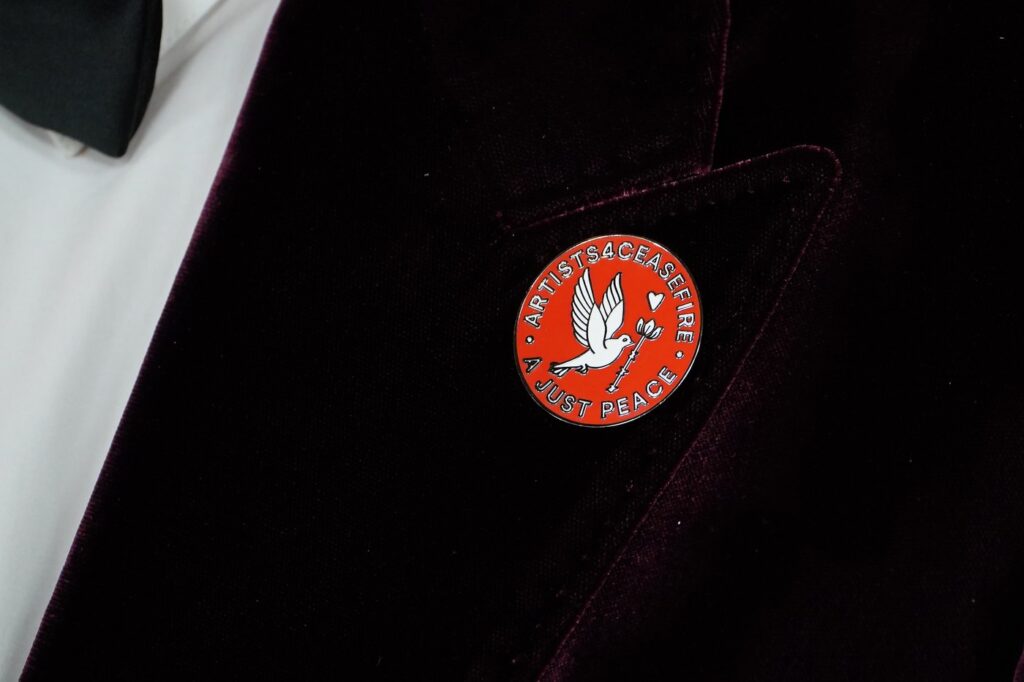
During Hollywood's prestigious awards season, a notable shift in political activism among artists was evident at the 2026 Academy Awards. While the focus was primarily on celebrating cinematic achievements, several attendees used the ceremony as a platform to voice their opposition to various political issues, particularly immigration policies under the Trump administration and advocacy for Palestinian liberation amid the ongoing conflict in Gaza.
Artists wore protest pins such as "BE GOOD" and "ICE OUT," although the level of visible activism was less intense compared to the previous month's Grammys. For the Oscars, the red carpet became a stage for messages promoting a ceasefire in Gaza and support for Palestinian rights. Javier Bardem, a prominent actor, expressed his stance saying, "No to war and free Palestine," while presenting the award for Best International Feature Film, donning a patch that echoed his anti-war sentiments from over two decades ago.
The growing trend of political engagement among celebrities was highlighted by Jess Morales Rocketto, Executive Director of the Latino advocacy group Maremoto. She described the current environment as a "return to form" for artists’ political voices, attributing this resurgence to outspoken comments made at other award ceremonies, particularly by actor Mark Ruffalo at the Golden Globes.
At the Oscars, attendees from the film "The Voice of Hind Rajab" showcased a new red "Artists4Ceasefire" pin, connecting their story about rescuing a Palestinian girl killed in Gaza to broader themes of collective struggle and liberation. They emphasized the importance of solidarity, with Saja Kilani, one of the film's stars, stating, "Our struggles are connected. So is our liberation."
The Oscars ceremony itself reflected a heightened political atmosphere compared to previous years, avoiding direct references to certain global conflicts but still illustrating the urgency of current issues. Paul Thomas Anderson, director of "One Battle After Another," remarked that he created his political drama as a way to express regret for the world being passed on to future generations.
Host Conan O'Brien added to the political commentary by humorously critiquing the U.S. healthcare system and other societal issues while acknowledging the significance of recognizing artists' contributions during times of crisis. He emphasized that the Oscars are more than just an awards ceremony, highlighting ideals of global artistry, resilience, and optimism.
The Best Documentary category featured works with strong social messages. David Borenstein, co-director of "Mr. Nobody Against Putin," spoke about the moral complexities faced by individuals in times of political turmoil, encouraging an awareness of personal responsibility in the face of societal challenges.
In addition to celebrity activism, various advocacy groups took advantage of the event's visibility to highlight their own causes. Free Press, for example, employed a mobile billboard to protest against corporate media consolidation in Hollywood.
Morales Rocketto expressed acknowledgment that individual actions, such as wearing pins, are just "droplets" in the larger ocean of systemic change. She emphasized the importance of stars using their platforms to speak out on pressing issues rather than merely focusing on superficial elements like fashion choices. This moment in Hollywood's awards season signified a growing willingness among artists to elevate social and political discourse within their spheres of influence.








