

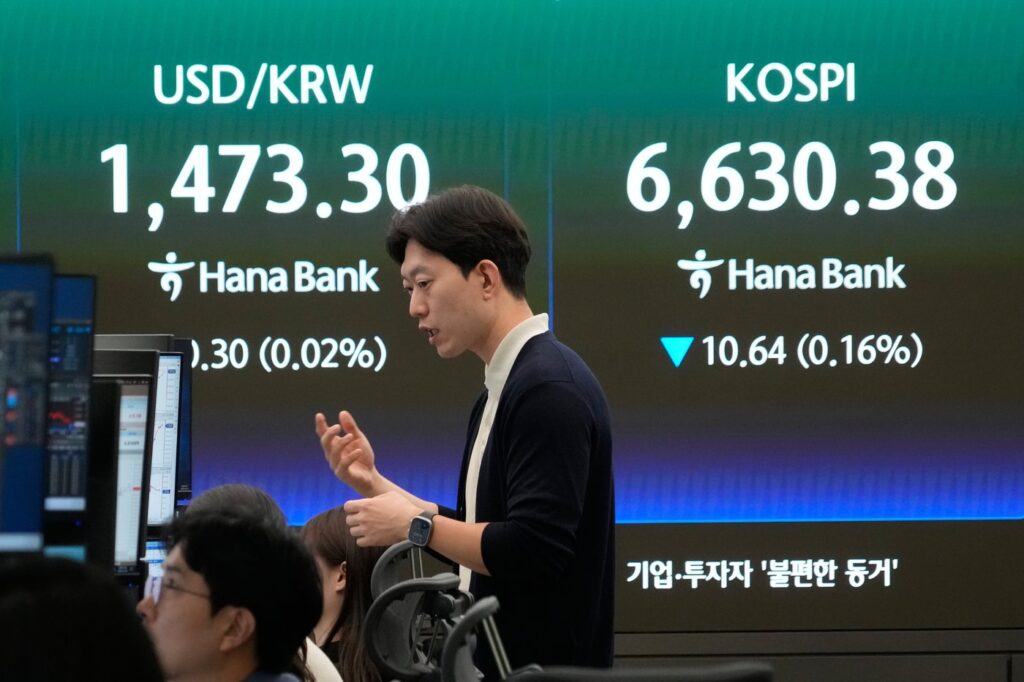
HONG KONG (AP) – Asian stocks largely advanced on Wednesday amidst declines on Wall Street, as oil prices increased due to uncertainties regarding the ongoing war in Iran. This was compounded by the announcement of the United Arab Emirates (UAE) planning to leave OPEC, signaling a notable shift in the global oil market dynamics. Despite these developments, U.S. futures showed a slight upward trend.
Japan's stock markets remained closed for a holiday, while other Asian markets observed positive movements. South Korea's Kospi rose by 0.8% to reach 6,690.90 points, and Hong Kong's Hang Seng index gained 1.5% to close at 26,050.90. Additionally, the Shanghai Composite index noted a 0.7% increase, trading at 4,107.51. Conversely, Australia's S&P/ASX 200 experienced a minor decline of 0.3%, settling at 8,687.00, while Taiwan's Taiex lost 0.6%, and India's Sensex saw a positive growth of 1.4%.
The price of Brent crude oil for June delivery rose by 1.1% to $112.47, while July contracts also saw a similar increase, reaching $105.50. Before the war commenced in late February, Brent crude was trading around $70 per barrel. Benchmark U.S. crude oil experienced a 1% gain, priced at $100.94 a barrel.
The imminent exit of the UAE from OPEC, effective Friday, has captured the attention of oil markets. OPEC collectively produces approximately 40% of global oil supply, with the UAE being one of its significant contributors. The UAE has shown its desire to increase its oil sales globally, stepping back from OPEC's production quotas that have historically limited its output.
According to ING Bank strategists Warren Patterson and Ewa Manthey, the UAE's departure implies a potential increase in overall oil production. They noted that the UAE has expressed frustration over its restricted output, which has kept it from operating at full capacity. However, they cautioned that before this production can be fully realized, a resolution to the Persian Gulf conflict is necessary to allow for unhindered energy transport through the strategic Strait of Hormuz.
In the meantime, ongoing U.S.-Iran negotiations for a comprehensive peace agreement remain sluggish. Analysts pointed out that oil prices will largely depend on the prospects for reopening the Strait of Hormuz, which historically facilitated the transit of roughly one-fifth of the world's oil. Currently, the waterway remains predominantly closed due to the war. While the UAE was OPEC's third-largest oil producer before the war, its exit could significantly impact OPEC's ability to manage and influence the global oil supply.
Investors are keenly awaiting further updates on U.S.-Iran peace talks, which have shown limited progress. Iran has proposed reopening the Strait of Hormuz in exchange for the lifting of U.S. blockades on its ports; however, the U.S. government appears to be favoring a diplomatic approach that does not compromise its stance on Iran's nuclear program.
Additionally, the Federal Reserve is expected to announce its decision on interest rates later today. On Wall Street yesterday, major indexes pulled back from previous record highs, with the benchmark S&P 500 declining by 0.5%, finishing at 7,138.80. The Dow Jones Industrial Average decreased by 0.1% to 49,141.93, and the tech-heavy Nasdaq composite lost 0.9%, closing at 24,663.80. Tech stocks, particularly those associated with artificial intelligence, faced the most significant declines, with companies like Broadcom, Nvidia, and Micron Technology each reporting notable losses.
In currency markets, the U.S. dollar appreciated slightly against the Japanese yen, trading at 159.68 yen, compared to the previous 159.62 yen. The euro, however, fell to $1.1707, down from $1.1712. The yield on the U.S. 10-year Treasury bond rose marginally to 4.36%.








