

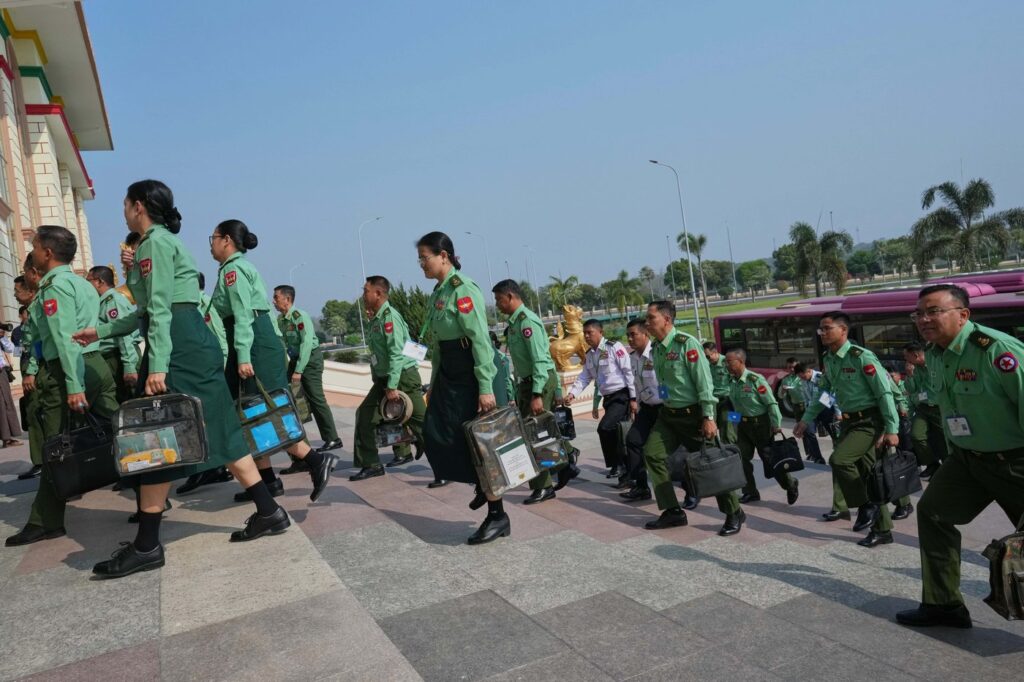
NAYPYITAW, Myanmar (AP) – Myanmar commenced its first parliamentary session in over five years on Monday, following a controversial election that excluded major opposition parties, ensuring the military's continued dominance in governance. The military had previously dissolved Myanmar's last parliament in February 2021, when it ousted the democratically elected government led by Aung San Suu Kyi. The military has since governed without a legislative body, presenting the recent elections of late December and January as a significant stride towards a return to democratic norms.
In the newly convened two-chamber parliament, military and allied politicians control nearly 90% of the total seats. The former ruling party, the National League for Democracy (NLD), along with other significant opposition groups, was either barred from participating or chose not to run due to conditions they deemed unfair. This lack of competition raises concerns about the legitimacy of the electoral process orchestrated by the military regime.
Delegates clad in traditional attire gathered in Naypyitaw, the capital, for the opening session of the 373-seat lower house. The venue, located within a heavily guarded complex, had recently undergone renovation after suffering damage from an earthquake the previous year. To ensure security, access routes were sealed off, and vehicles entering the area were thoroughly searched for explosives.
The 213-seat upper house is set to open on Wednesday, followed by 14 regional parliaments two days later. According to the military's constitution, a quarter of the total 586 seats across both houses are reserved for military representatives. The Union Solidarity and Development Party, aligned with the military, secured 339 seats, while 21 other parties claimed between one and 20 seats each.
This parliamentary session follows phased elections held in December and January in 263 out of Myanmar's 330 townships. Critics of the military government characterized the electoral process as a strategy to legitimize its rule amidst a backdrop of civil unrest and violence following the 2021 coup. The military's takeover triggered widespread opposition, plunging Myanmar into a civil conflict that remains ongoing.
Tom Andrews, a special rapporteur affiliated with the U.N. human rights office, has called on the international community to reject the outcomes of the elections and any subsequent power arrangements that emerge from them. The parliament's initial agenda will include the election of speakers for each house, followed by the selection of a president and two vice presidents.
Current military leader Senior Gen. Min Aung Hlaing is widely anticipated to assume the presidency; however, constitutional limitations prevent an individual from holding the presidency and the position of commander-in-chief of the armed forces simultaneously, raising questions about his potential relinquishment of military authority.
Aung San Suu Kyi, the former leader of Myanmar, is currently serving a lengthy 27-year prison sentence on charges widely regarded as politically motivated. Despite her party's overwhelming victories in the 2015 and 2020 elections, the NLD was compelled to dissolve in 2023 after refusing to conform to new military-imposed regulations.
Simultaneously, an opposition shadow parliament, known as the Committee Representing Pyidaungsu Hluttaw, held an online session on the same day, asserting its claim as the sole legitimate parliament of Myanmar. This shadow parliament comprises elected lawmakers prevented from assuming their seats following the military's coup in 2021, highlighting the ongoing struggle for democratic representation in Myanmar.








