

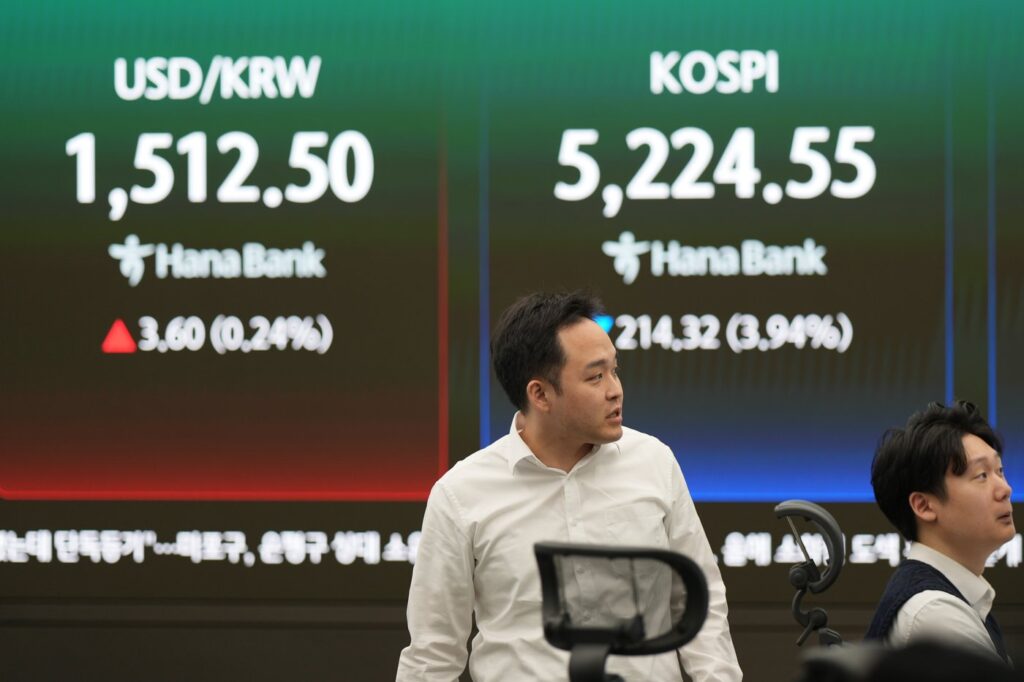
TOKYO (AP) — Asian shares experienced a downturn in morning trading on Monday as concerns about escalating oil prices and potential further military involvement of the U.S. in the conflict with Iran continued to weigh heavily on investor sentiment.
This decline in Asian markets mirrored steep losses on Wall Street last Friday, marking the end of a fifth consecutive week of losses, the longest losing streak seen in nearly four years.
Specifically, Japan's benchmark Nikkei 225 index fell 4.5% to 50,979.54. Australia’s S&P/ASX 200 recorded a loss of 1.2%, bringing it down to 8,417.00. Meanwhile, South Korea’s Kospi plunged by 3.2% to 5,264.32. Hong Kong's Hang Seng index also saw a decrease of 1.7%, settling at 24,519.63, while the Shanghai Composite index slipped 0.7% to 3,884.57.
Fears have intensified across Japan and the wider Asian region regarding access to the Strait of Hormuz, as the ongoing conflict with Iran poses a significant risk to oil shipments crucial for the area’s economy. The potential for disruptions has led to heightened anxiety about energy prices and economic stability.
Amidst these developments, crude oil trading witnessed notable fluctuations. Benchmark U.S. crude surged $2.28, reaching $101.92 per barrel, while Brent crude—the international standard—rose by $2.88 to $115.45 per barrel. Prior to the onset of the war, Brent had been priced at approximately $70 per barrel.
Investors are increasingly preparing for a prolonged conflict, which analysts predict could drive inflation across global markets, hindering economic growth in Asia. Xavier Lee, a senior equity analyst at Morningstar Research, noted, “Although we do not expect the conflict to be protracted, we anticipate heightened volatility in the near term.”
Oil prices began to rise again following a temporary easing that occurred when U.S. President Donald Trump extended a self-imposed deadline to “obliterate” Iran's power plants to April 6.
On Wall Street, the S&P 500 index dropped 1.7%, marking its worst week since the beginning of the conflict with Iran. The Dow Jones Industrial Average fell by 793 points, or 1.7%, slipping over 10% from its record high established the previous month. The Nasdaq composite experienced a steeper decline, decreasing by 2.1%.
Overall, the S&P 500 closed down 108.31 points at 6,368.85 last Friday. Simultaneously, the Dow Jones Industrial Average finished at 45,166.64 after a drop of 793.47 points, and the Nasdaq composite came to rest at 20,948.36 following a decline of 459.72 points.
In the bond market, the yield on the 10-year Treasury note peaked at 4.48% before retreating to finish last week at 4.43%. This marks an increase from 4.42% late Thursday, and a significant rise from the 3.97% yield before hostilities began.
In currency trading, the U.S. dollar slightly depreciated, changing hands at 159.97 Japanese yen, down from 160.32 yen. The euro traded at $1.1505, a drop from $1.1510.
Yuri Kageyama's reporting illustrates a turbulent time for Asian markets as geopolitical tensions continue to exert pressure on economic stability.








