

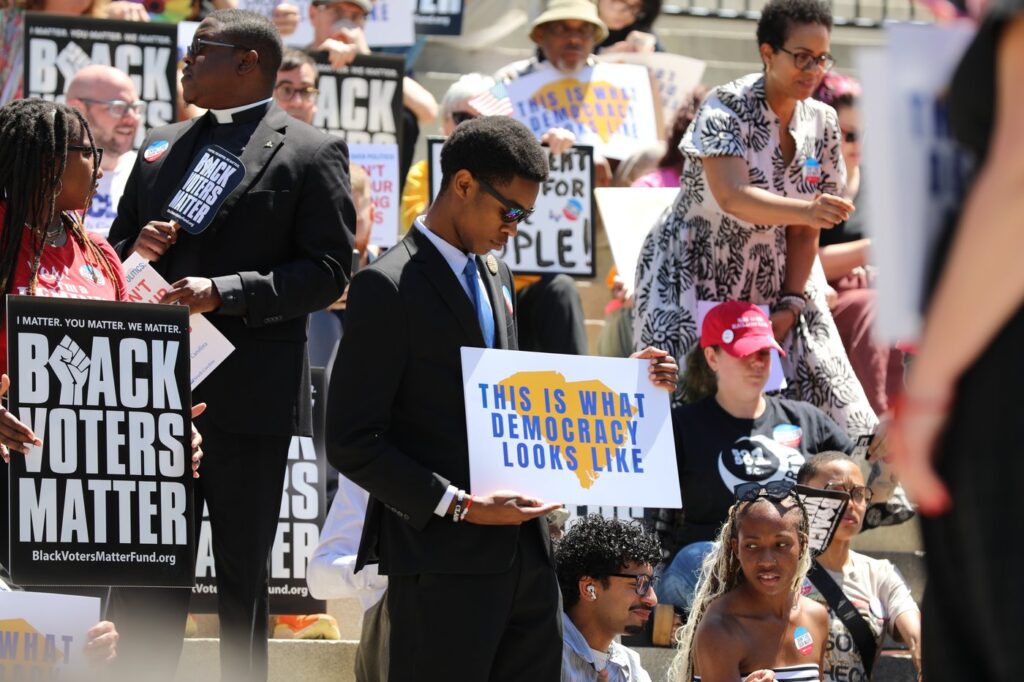
ATLANTA (AP) — The ongoing battle for civil rights in the United States has seen a resurgence in activism as a multiracial coalition of leaders and organizations rallies against a predominantly conservative and white alliance that is perceived to be dismantling the Voting Rights Act (VRA) and the electoral districts that have historically enabled Black and other nonwhite voters to select their representatives.
NAACP President Derrick Johnson emphasized the urgency of the situation in an interview, stating, “We have to respond as quickly as possible.” Johnson voiced concerns about the potential regression to a 1950s-like political landscape if the current efforts to curb voting rights are not effectively countered. The NAACP, established 117 years ago, is joining numerous groups in Alabama for a rally commemorating the Civil Rights Movement and the landmark 1965 Voting Rights Act, particularly events in Selma and Montgomery that mark pivotal moments in the struggle for equitable voting rights.
In contrast to the historic fights of decades past, this gathering aims to kickstart a renewed movement following a recent U.S. Supreme Court ruling that further diminished the VRA by prohibiting the consideration of race in the redistricting process. Civil rights activists are keenly aware of the challenges posed by a well-entrenched network of conservative lawmakers at the federal and state levels, especially across the Old Confederacy where a large majority of Black Americans reside.
Jared Evans from the Power Coalition for Equity and Justice lamented that the Supreme Court's past decisions, such as Shelby v. Holder in 2013 and the more recent Louisiana v. Callais, have severely undercut the legal footing established by the VRA. Evans articulated a strong call for what could be viewed as a "second Reconstruction period" in response to these regressions.
Georgia Senator Raphael Warnock, a senior pastor with deep ties to the historic Ebenezer Baptist Church, has vocalized that the current political landscape mirrors “Jim Crow in new clothes,” stressing the need for collective political, economic, and personal empowerment to combat the erosion of rights. He signaled that adversaries are acutely aware of the significance of voters’ voices and are actively attempting to diminish them.
Democratic leaders, including U.S. Representative Terri Sewell of Alabama, are urging for the reintroduction of pivotal voting rights legislation, namely the John R. Lewis Voting Rights Act, which aims to fully abolish partisan gerrymandering and reinstate pre-clearance mandates struck down by the Supreme Court. Sewell insists that a modern-day framework must be developed to expose the wrongdoing of state actors in the electoral context.
The Supreme Court’s ruling in Callais has opened the door for states to construct congressional districts without considering race, a move that critics argue disproportionately affects minority representation. Some Republican lawmakers, including President Donald Trump, have lauded this decision as a victory for equal protection, though activists contend it undermines the progress achieved through decades of civil rights advocacy.
As the battle for representation intensifies, many advocacy groups have mobilized to challenge new congressional maps. States like Alabama and Louisiana have reverted to single majority-Black districts, while Tennessee has dangerously manipulated district lines to dilute minority voting power. Even states like Florida and Texas acted preemptively to redistrict before the Callais decision was unveiled.
While historical ties lead many activists to focus primarily on congressional representation, Evans cautions that the fight will inevitably expand to encompass state legislative and local seats, potentially diminishing Black representation at all levels of governance.
Amid these developments, there is an acknowledgment that the issues transcend partisan divides, challenging the notion that this is solely a matter of regional conflict. Johnson posits that the opposing forces aim to restrict various rights contingent on one’s religious beliefs and identity, echoing the broader implications of electoral outcomes on economic and social policies.
Despite the complexity of galvanizing diverse organizations and voters around redistricting issues, activists find motivation in the current political climate. Johnson highlighted a recent organizing call in Mississippi that drew 8,000 participants, showcasing the heightened interest and engagement around these critical matters. As election cycles approach, there is a concerted effort to boost midterm turnout among Black voters who have been disillusioned by recent conservative maneuvers.
Historically, efforts to implement significant civil rights legislation, such as the 1954 Brown v. Board of Education decision, took many years and extensive advocacy to realize. Johnson reflects on the current state of the movement, noting the need for collaboration despite the absence of a centralized leadership structure, drawing parallels with the civil rights movement’s foundational tensions and successes. The ongoing struggle for voting rights remains a critical junction for American democracy.








