

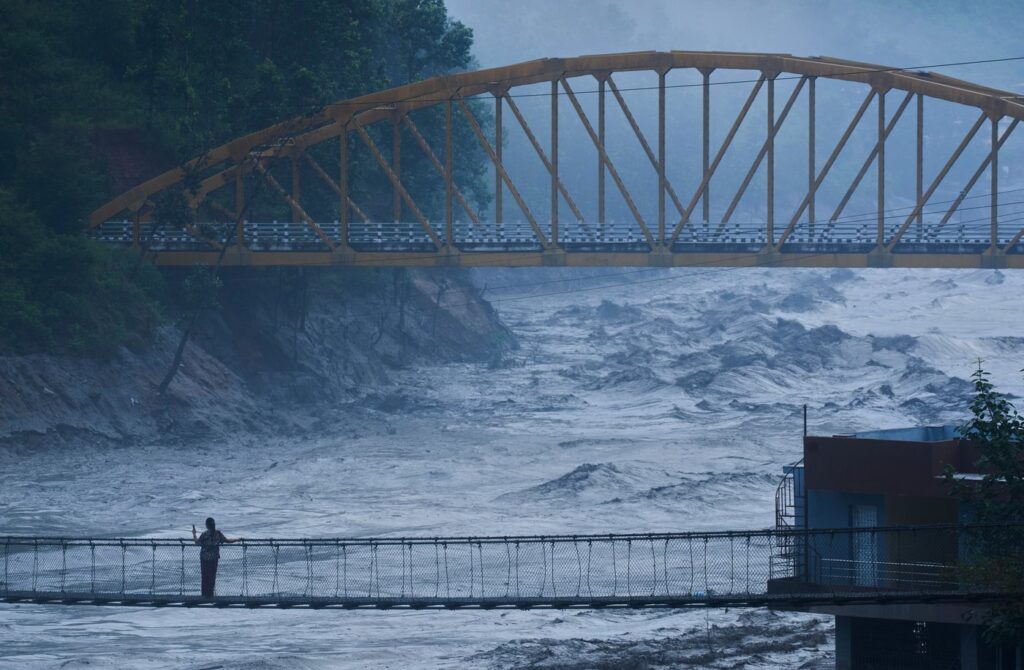
DHADING, Nepal (AP) — Authorities in Nepal have issued a flood warning on Sunday, urging residents in flood-affected districts to be vigilant as water levels in the Bhotekoshi River continue to rise. This warning follows a devastating flood event on Wednesday that claimed the lives of at least 800 individuals and left over 3,000 missing in both Nepal and Tibet.
On Sunday morning, flood warning notifications were sent to residents’ phones while rescue teams worked diligently to clear a major highway connecting Kathmandu to regions severely impacted by the floods. In Dhading, one of the hardest-hit areas, several residents started returning to their destroyed homes to salvage whatever items they could find.
Residents faced grim conditions, with some homes left skeletal after the floods swept away their walls. They sifted through the thick sludge and debris, searching for anything salvageable. One man surprisingly found his chickens alive and took them away in his truck. Sharmila Tamang, a local resident, expressed her despair: “Everything is finished. Nothing is left. Not even our home.”
Workers at a key power plant that sustained heavy damage due to the floods began assessing the impact on Sunday. This plant is crucial, as it provides electricity to over 20,000 people across four districts. In Galchhi, residents climbed to higher ground on a nearby bridge to witness the ferocity of the river, pointing out massive rocks that had been washed down during the recent floods.
The latest figures from Nepal’s disaster agency reported that the death toll had risen to 788, with 2,502 individuals still unaccounted for. Meanwhile, Chinese authorities reported 16 deaths and 546 missing on their side of the border. Notably, among the missing are numerous individuals from over a dozen countries who were either working or visiting the breathtaking Himalayan region, including 261 foreigners declared missing in Tibet, with a significant number being Nepalis.
Despite some homes surviving the flood, many remained without electricity on Sunday, with twisted power line poles dotting the landscape. Prithivi Highway, essential for transporting food and other supplies to Kathmandu, was partially operational, though repairs were still needed in several areas. The warning issued by the authorities came after they received updates from Chinese officials about increased water flow from upstream.
Residents expressed confusion and anxiety over the consistent flood alerts they received since Wednesday’s floods. Govind Shreshta, a local resident, shared his distress, stating, “Sometimes they say a flood is coming, and we have to run again to higher ground, even at night. There is also rain. It’s really difficult for me.”
The floods, triggered by a glacial collapse in the Himalayas, unleashed torrents of water that swept away buildings, vehicles, and even farm tractors, with entire villages engulfed in thick sediment. Geologists noted that the rockfall, which was significant enough to register as a magnitude 5.2 event, contributed to the disastrous flooding.
Nepal's Foreign Minister, Shisir Khanal, emphasized the disproportionate impact of climate change on Nepal, noting that, “Despite having only 0.1 percent contribution to global emissions, the people of Nepal have become major victims of climate change.” While scientists caution that it is premature to directly link global warming to this specific disaster, they highlight that rising temperatures could increase the likelihood of such catastrophic events, particularly in vulnerable regions like the Himalayas.
In a show of solidarity, Malaysia’s Prime Minister Anwar Ibrahim announced that his country would dispatch a search and rescue team to assist Nepal and provide aid. Malaysia pledged $1 million in financial assistance to support relief efforts for those affected by the catastrophic floods.








