

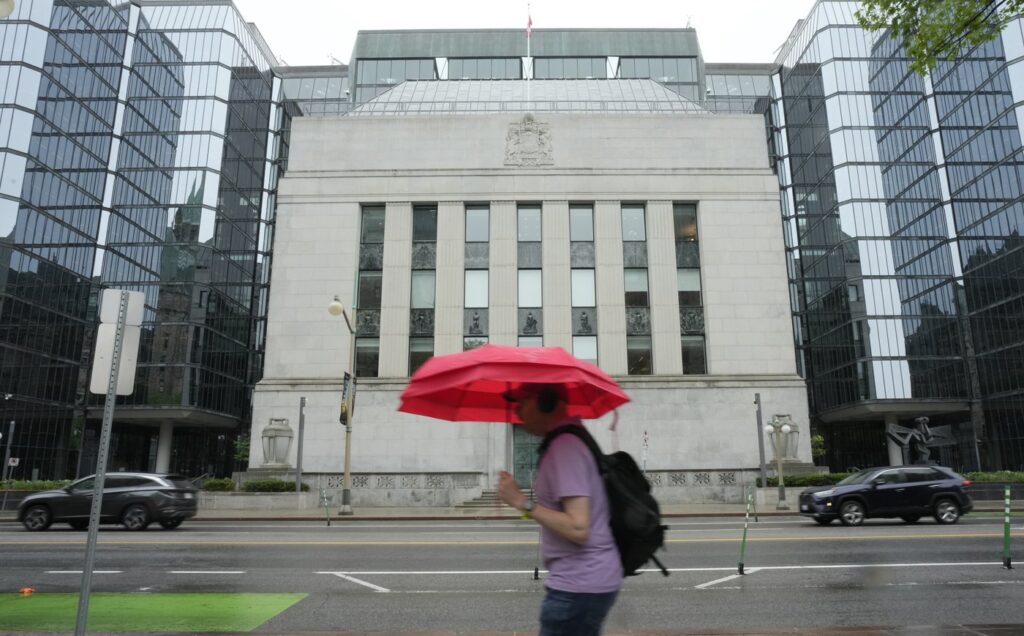
OTTAWA – The Bank of Canada is facing a challenging decision this week as rising tensions in the U.S.-Canada trade relationship create uncertainty ahead of its interest rate announcement on Wednesday. The central bank has maintained its benchmark interest rate at 2.25 percent for nearly a year.
Prior to the collapse of trade discussions between the two countries earlier this month, economists and financial markets largely anticipated that the Bank of Canada would remain on hold for the remainder of 2026 and well into 2027. However, the recent imposition of tariffs by the U.S. has shifted the economic landscape.
On August 22, the U.S. enacted 50 percent tariffs on about five percent of Canadian exports, prompting Canada to announce retaliatory tariffs set to take effect on September 8. Additionally, U.S. President Donald Trump has threatened to impose steeper tariffs on automobiles and auto parts starting January 1, 2027.
Despite the turmoil, most economists believe the Bank of Canada will maintain its current stance as it assesses how the economy and price levels respond to the renewed trade conflict. Tony Stillo, director of Canada economics at Oxford Economics, noted that the bank is generally reluctant to adjust rates in uncertain times, fearing the need to reverse any changes later.
As of Friday afternoon, financial markets assigned a 99 percent probability to a seventh consecutive hold on the policy rate, according to LSEG Data & Analytics. Over the spring, Bank of Canada Governor Tiff Macklem emphasized that if inflationary pressures tied to energy prices from the ongoing war in Iran began to spill over into other areas, the central bank might have to consider rate hikes. Conversely, he indicated that further tightening of trade restrictions could necessitate a decrease in the policy rate.
Recent GDP data from Statistics Canada revealed that the economy grew at the fastest pace in over three years in the second quarter, following a year of minimal growth. Most forecasts, including those from the Bank of Canada, predict that this growth rate will decelerate in the latter half of the year.
Doug Porter, BMO's chief economist, advised caution, stating, “I don’t want to overemphasize the negativity... but I think we do have to brace for a tough spell for a little while here.” He remains hopeful that trade representatives from Canada and the U.S. may convene soon to mitigate further escalation.
Should negotiations fail to resume, Porter anticipates the third quarter to resemble the early days of the trade war in 2025, marked by uncertainty around tariffs that significantly affected business activity. Stillo believes the tariffs alone won’t plunge the economy into recession; rather, it’s the uncertainty regarding the long-term trade relationship with the U.S. that could dampen growth.
Inflation rates have shown volatility in response to fluctuations in gas prices, settling at three percent as of July. While the central bank's preferred core inflation metrics have remained stable, any new tariffs from Canada on U.S. goods could potentially heighten inflationary pressures, though it remains unclear if these costs will be passed onto consumers in a weak demand environment.
In Oxford Economics’ baseline forecast, Canada’s economy is expected to continue growing through next year, though at a slightly slower pace due to the recent tariff measures. Stillo anticipates that if the economic slowdown proves more significant later this year, a reduction in the policy rate by up to half a percentage point might be necessary.
While immediate rate cuts are not expected from the Bank of Canada this Wednesday, Stillo suggests that Governor Macklem will likely signal a less aggressive stance towards rate hikes. This indication of an easing bias would emerge from a recognition that the central bank may need to lower rates if economic performance falls below expectations.
Porter concurs, stating that without the new tariff challenges, the strong second-quarter GDP figures would have suggested the possibility of forthcoming rate hikes. However, he echoes Stillo’s sentiment that the bank is likely to indicate a bias towards easing on Wednesday, as the risks to growth outweigh potential inflationary pressures.
“The trade battle really does darken the growth outlook," Porter said, emphasizing that unless the situation is resolved, it will remain a primary concern for monetary policymakers.








