

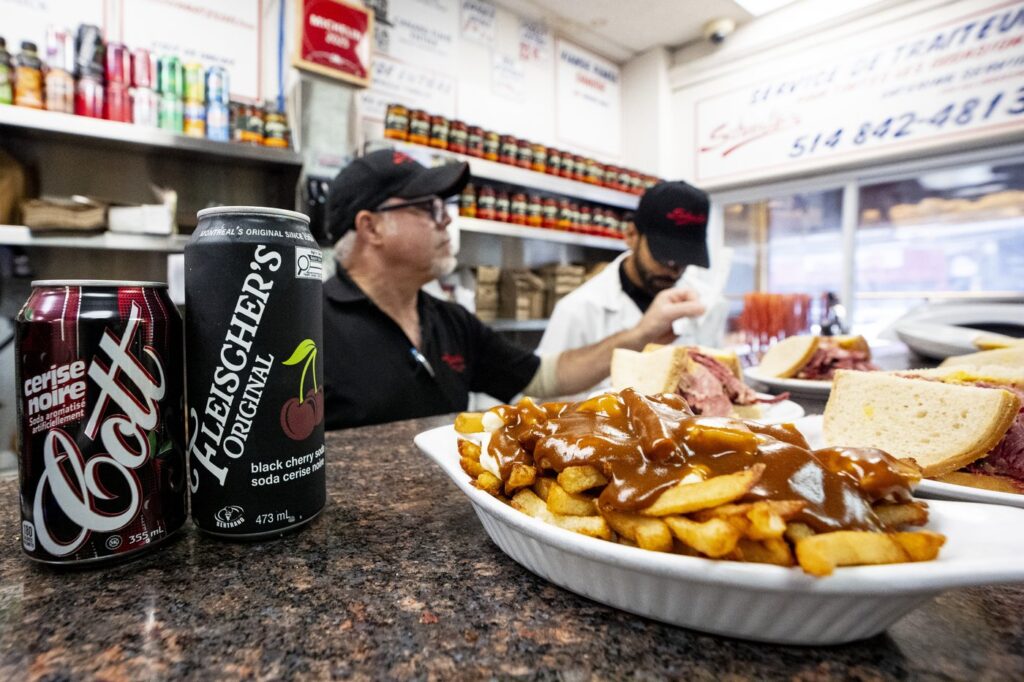
MONTREAL — On a typical summer day at Schwartz's Deli in Montreal, customers, both tourists and locals, line up at the door for their beloved smoked-meat sandwiches. However, a significant change has recently occurred at this iconic establishment regarding the drinks served alongside the famous sandwiches.
For decades, patrons could order a can of Cott's Black Cherry Soda, a once-local product that was part of Schwartz's history nearly a century ago. However, the production of this soda in Canada ceased after its acquisition by multinational beverage company Refresco in 2018. Due to various factors, including tariffs and rising costs, Cott's no longer produces the drink in Canada.
As a result of this supply disruption, Schwartz's Deli has turned to a local Quebec alternative: Fleischer’s Original Black Cherry Soda. This shift aligns with a growing trend among businesses looking to support local products amid challenges like tariffs and trade conflicts, particularly with the United States.
Customers at the deli have responded positively to the change. Liam Keenan, a visitor from Toronto, expressed his enthusiasm about the new offering. "It’s always good to support locally," he stated as he prepared to enjoy Schwartz’s classic trio: a smoked-meat sandwich, a pickle, and the new black cherry soda. Keenan, who had dined at Schwartz's before, noticed the different look of the canned drink but remarked that the taste remained excellent.
Frank Silva, the general manager of Schwartz's, explained that Cott's soda was beloved for its unique, local flavor, perfectly complementing the spices of the smoked meat. Yet, the discontinuation of Cott's canned beverage was partly due to American tariffs on aluminum, which increased production costs significantly. Silva noted that Cott's was popular primarily within Canada, leading to its discontinuation when manufacturing costs rose.
Following the depletion of Cott's stock in March, Silva welcomed the transition to Fleischer’s soda, despite the new option costing approximately twice as much per can. However, the larger size of Fleischer’s cans has allowed many customers to share the drink, which has boosted its attractiveness. Silva commented, "It’s a bigger can, and it’s local, it’s Canadian, so people are really getting into it."
Ann Thinghuus, a visitor from Vancouver, was one of the patrons enjoying the new Fleischer's with their smoked-meat meal. She found the soda to be refreshing and appreciated its Canadian branding, underscoring that supporting a Canadian business was particularly significant given recent events on the global stage.
Victor Lukoshius, a Montreal-born brewer who produces both beer and Fleischer’s soda in St-Hyacinthe, undertook the challenge of reviving black cherry soda two years ago upon learning of Cott's potential termination. He emphasized the importance of maintaining traditional flavors that accompany smoked meat in delis. Lukoshius is committed to sourcing his ingredients locally and printing cans in Montreal. Despite facing challenges due to tariffs and inflation, he decided to absorb some of the increased costs to keep the product available.
Saibal Ray, a professor at McGill University specializing in operations management, noted that the tariffs targeting aluminum have adversely affected the beverage industry as a whole, despite originally being aimed at sectors such as aerospace and automotive manufacturing. Cans can constitute up to a third of soda production costs, and with most cans made in the United States using Canadian aluminum, they are subjected to multiple tariff charges. Thus, it is not surprising that niche products like black cherry soda would be impacted.
At Schwartz’s, the demand for black cherry soda remains robust. Silva revealed that his new supplier struggles to keep up with the deli’s orders, indicating that customers still have a strong thirst for this particular beverage. "This morning, I ordered 100 cases, and he only had 87," he explained, demonstrating the ongoing popularity of the new soda.
Despite the uncertainties of trade negotiations and potential future tariffs, Silva is determined not to revert to Cott's Black Cherry Soda. He believes that even if Cott's were to return, customers would prefer the locally produced Fleischer’s option.








