

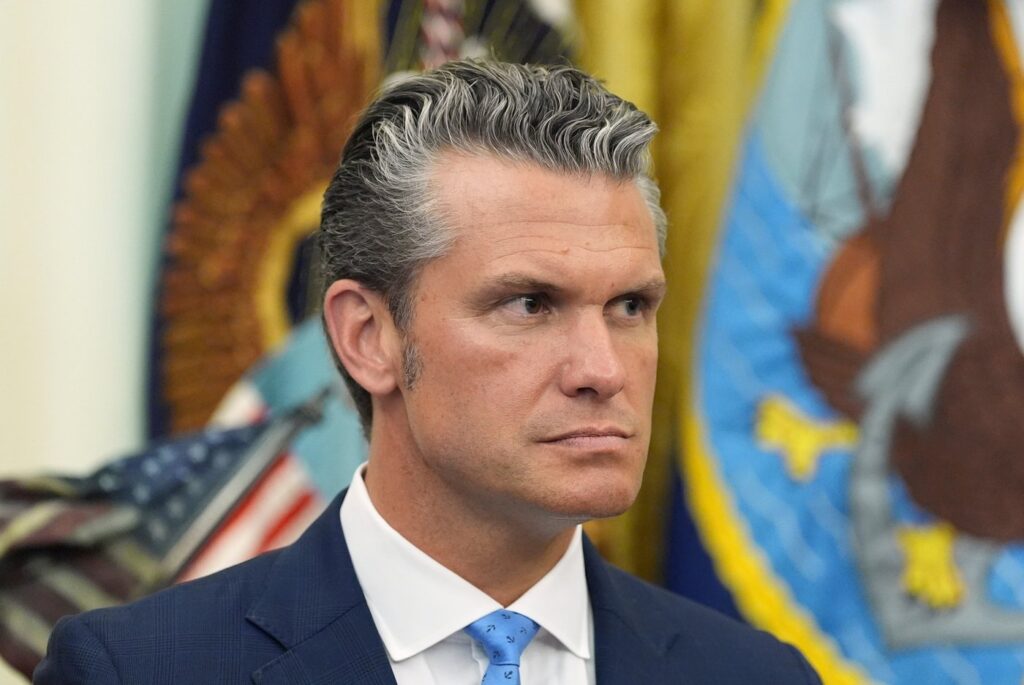
Scott Anderson, the Member of Parliament for Vernon-Lake Country-Monashee, has publicly criticized Pete Hegseth, the U.S. Defense Secretary, in response to Hegseth's mocking post about the Canadian military. Anderson's remarks highlight a broader sentiment of discontent among Canadians regarding the treatment of their military personnel.
Anderson's comments were a direct reaction to Hegseth's online attempt to belittle the Canadian Cadet Program by sharing a photograph of two young female cadet officers from the Cadet Training Centre in Vernon, British Columbia. The image included the caption "this is real" alongside a Canadian flag, which many interpreted as derogatory. Anderson expressed his disappointment, stating, "You, sir, are the Secretary of War for the strongest nation on earth, and with that title comes a level of responsibility and decorum." He criticized Hegseth for using his position to insult Canadian military personnel, particularly focusing on the two female cadets who were targeted.
In light of the backlash that Hegseth received, which included numerous comments belittling the physical appearance of the cadets, Anderson emphasized the inappropriate nature of targeting a youth program in an attempt to insult Canada's military. The incident has garnered significant attention in both Canada and the United States, leading to responses not only from Anderson but also from Canadian Prime Minister Mark Carney. Carney remarked that the statements made by officials from the Trump administration about Canada's military were "beneath their office," indicating a broader concern regarding diplomatic decorum.
The Pentagon has stood by Hegseth's post, as stated by Pentagon Deputy Press Secretary Jacob Bliss, who remarked that "the X post speaks for itself." This defense from the Pentagon comes at a time when tensions between Canada and the United States have been heightened, particularly following a breakdown in trade talks last month. As the two nations share a long history of peaceful coexistence, Anderson pointed out that respectful dialogue is essential to maintaining this relationship.
Anderson's social media post culled a mix of sentiment, as he pointed out that Canadians and Americans have coexisted harmoniously for over 200 years and that there is no reason this should not continue. He remarked, "Our economies, our continental defence, and our cultures are irretrievably intertwined, and yet we are two distinct nations," indicating that despite their ties, Canada deserves respect and recognition on the international stage.
In closing his statement, Anderson challenged Hegseth to engage in direct conversation if he wished to criticize Canadians in the future, emphasizing his readiness to address such matters. Furthermore, Anderson concluded his post with the same phrase used by Hegseth—“this is real”—next to a Canadian flag, suggesting a reclamation of the narrative against the backdrop of Hegseth's disparaging remarks.
The incident encapsulates ongoing discussions about national pride, military respect, and the responsibilities that come with positions of power, especially in the diplomatic arena between neighboring countries.








