

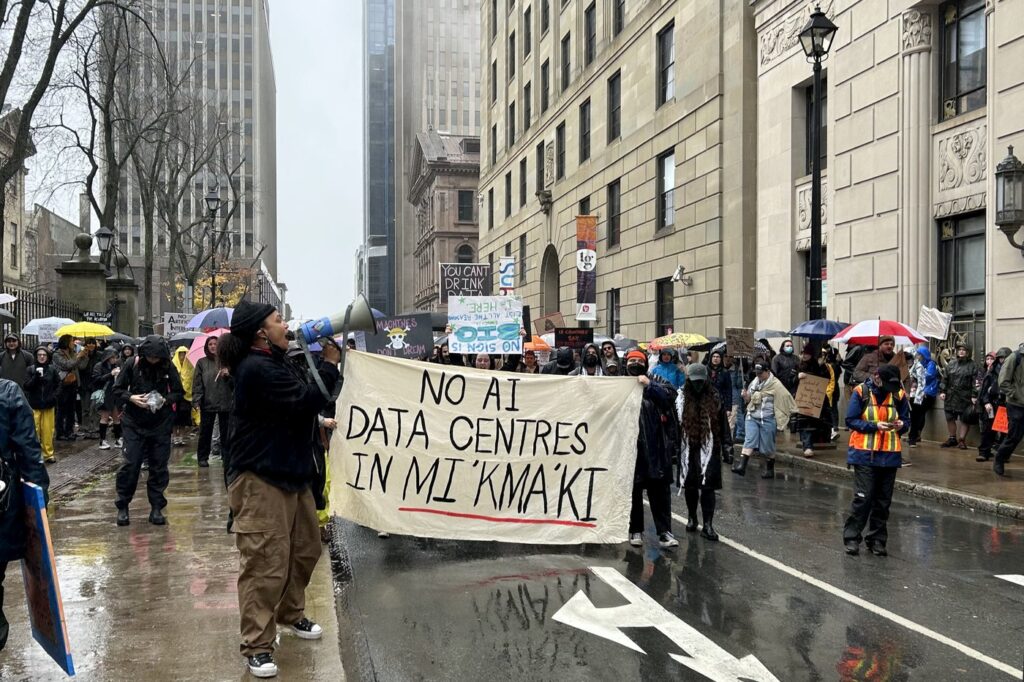
HALIFAX — On a rainy Saturday in downtown Halifax, nearly 1,000 Nova Scotians protested against a proposed artificial intelligence data centre set to be developed in southern Cape Breton. The demonstration began at noon, where protesters gathered outside the provincial legislature, occupying an entire block of Hollis Street before marching through the city's downtown area.
The rally was sparked by Everwind Fuels' announcement last month that it plans to lease a data centre to the U.S. AI firm Anthropic at Point Tupper, NS. The protesters demanded a moratorium on all large-scale AI data centre projects in the province, concerned about the implications of such developments for their communities and environment.
Ned Zimmerman, a tech worker from Dartmouth and one of the event's organizers, emphasized the social and environmental dangers posed by large-scale AI data centres, stating, “The push to integrate AI into everything raises a lot of concerns for society, and this is not the kind of thing that we want to see being imposed on our communities, our landscapes, our ecosystems, and our populations.”
The demonstration was part of a series of seven protests occurring across Nova Scotia on the same day. Everwind has touted the $10-billion project as the largest private investment in the province's history. Anthropic has secured a 20-year lease on an 18,600-square-metre facility, which will power its AI assistant Claude, set to be operational by 2027. This initial phase will draw 95 megawatts of electricity, with plans for a 325-megawatt expansion by mid-2028, raising the total energy demand to 420 megawatts.
Despite claims of substantial investment in the local economy, Nova Scotians expressed apprehension over the environmental impact and potential increases in power rates. A petition opposing AI data centre developments on Change.org has attracted nearly 28,000 signatures, reflecting widespread discontent regarding the project.
Everwind has stated it will bear the costs of the electricity infrastructure required for the data centre and has assured residents that their power rates will not be affected. Premier Tim Houston's office indicated that the project will only advance if it complies with provincial and federal guidelines, which include provisions for protecting water, the environment, and maintaining power rate stability.
Zimmerman criticized these guidelines as inadequate for a project of such magnitude, highlighting the lack of communication from the provincial government and alleging that Everwind had not adequately consulted with affected communities prior to the project's announcement. “It was kept closely under wraps... broader community consent and consultation was not engaged until the project was announced,” he remarked.
Although Everwind conducted two lengthy information sessions in Cape Breton just prior to the protest, many attendees left with unresolved questions. The company's engagement director affirmed that further consultations would be arranged.
Among the protesters was Rebecca Lawrence from Dartmouth, who expressed her concerns about the project being rushed without consideration for potential adverse effects. She specifically highlighted the projected noise pollution and the impact on the local water supply, noting that the data centre would use water from nearby Landrie Lake, which also serves the town of Port Hawkesbury. During its first phase, the facility is expected to consume an average of 100,000 litres of water per day, increasing to 500,000 litres during the second phase. “I think that one drop of drinking water wasted on generative AI is too much,” Lawrence stated.
In response to concerns, Everwind assured that the cooling system for the data centre would operate on a closed-loop basis, akin to a car’s radiator, with cooling fluid recycled or disposed of off-site, rather than being released into local waterways. Ashley Drodge, another protest organizer, raised issues regarding the absence of binding regulations for AI data centre developments and the lack of an environmental impact assessment for the project. She labeled the approach as “short-sighted, money in your pocket development.”
Nova Scotia's Minister of Environment, Timothy Halman, mentioned that the project requires industrial approval rather than an environmental impact assessment, which he asserted is the most suitable regulatory tool available to ensure safe construction and operation of such a facility. Mayor Houston has previously voiced uncertainty about whether new legislation is necessary to govern the data centre's operations but expressed a willingness to consider legislative changes should the situation warrant it.
Lawrence concluded her address to the premier by urging him to heed the concerns of Nova Scotians. “Nova Scotians are pretty vocal on the fact that we don’t want this... People from all across the spectrum are saying no to these data centres.”