

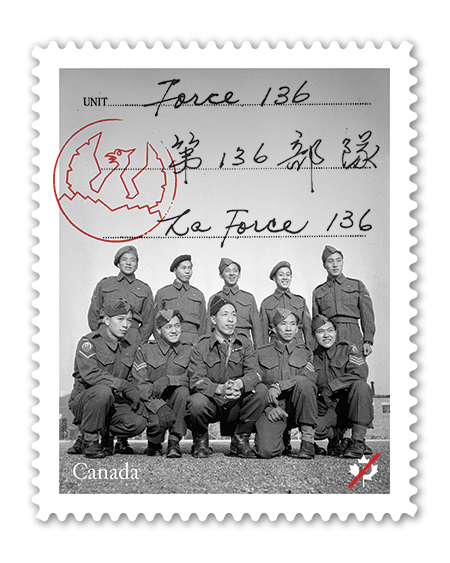
During World War II, Chinese Canadians faced significant discrimination and were initially barred from serving in the military. However, in 1944, they demonstrated their bravery and resilience by volunteering for perilous covert operations. Their contributions have been commemorated with a new Remembrance Day stamp issued by Canada Post, unveiled in Vancouver on November 3 and celebrated in a ceremony in Toronto.
The stamp honors the legacy of 150 Chinese Canadians who were recruited for their unique language skills and ability to blend into enemy territories for secret missions in Japanese-occupied Asia. These volunteers were part of Force 136, which was associated with Britain's Special Operations Executive, as well as Australia’s Services Reconnaissance Department. Those who enlisted underwent rigorous specialized training in various fields, including espionage, sabotage, guerrilla warfare, parachuting, and intelligence gathering.
Many Chinese Canadians viewed military enlistment as an opportunity to demonstrate their loyalty and commitment to Canada, particularly at a time when they were regarded as second-class citizens. The enlistment was also seen as a potential pathway to altering the discriminatory perceptions and treatment faced by immigrants in the country. Rick Wong, the son of Hank Wong who served in Operation Oblivion, remarked on the significance of his father’s decision to serve, emphasizing the extraordinary nature of their sacrifice during a period when Chinese Canadians were still subjected to the restrictive 1923 Chinese Exclusion Act.
Historians recognize that the contributions of Force 136 members extended beyond the battlefield, significantly advancing the Allied war effort and aiding in the broader fight for equality in Canada. Two years after the conclusion of the war, the Chinese Exclusion Act was repealed, paving the way for Chinese Canadians to gain full citizenship rights, including the right to vote.
The newly issued stamp features a historic black-and-white photograph depicting members of Force 136 awaiting repatriation in 1945. It is overlaid with the red phoenix insignia of Force 136, alongside its name presented in English, French, and traditional Chinese. This stamp serves as a lasting tribute to their courage, sacrifice, and pivotal role in challenging and overcoming societal barriers in Canada.
Sharifa Khan of the Chinese Cultural Centre of Greater Toronto highlighted the importance of Canada's recognition of immigrant contributions to the nation and their sacrifices during the war. She stated, “For Canada Post to recognize that immigrants built Canada and also fought in the war is so very important. That’s a legacy—these are stories that we’re going to tell to our next generation—and not just to Chinese [people] but to Canadians at large.”








