
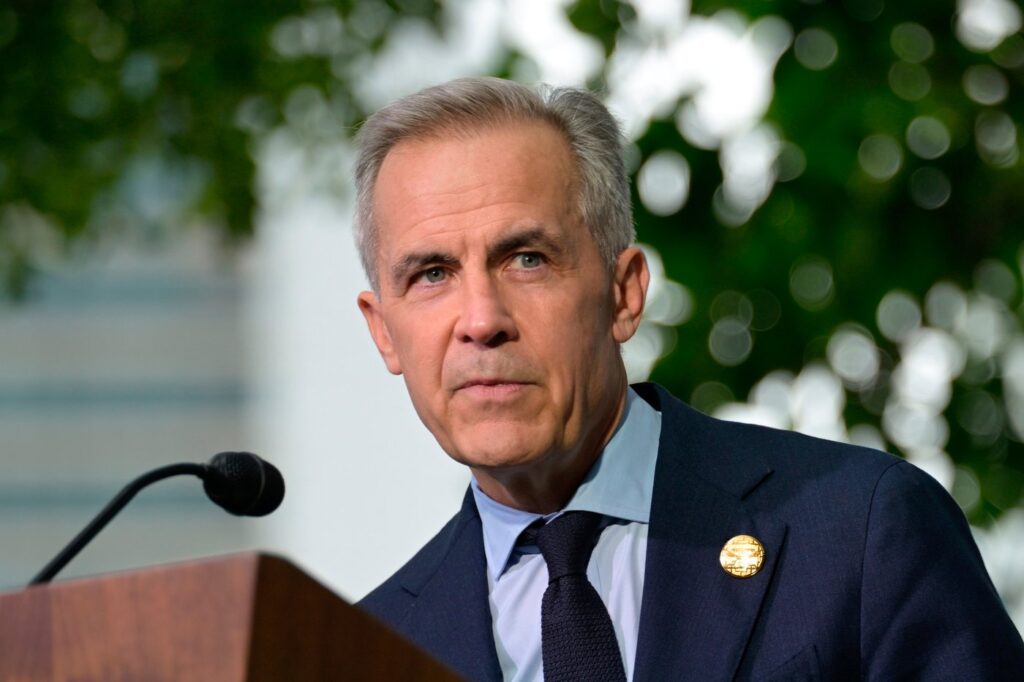
SHENZHEN, China (AP) — Canadian Prime Minister Mark Carney addressed the growing trade relations between Canada and China during a news conference in Shenzhen on Wednesday. He noted that these relations are not a top priority for U.S. President Donald Trump, emphasizing that Canada mainly exports commodities to China rather than sensitive technologies like advanced semiconductors.
Carney explained, "In my conversation with the president, he’s tried to understand where we are with China, where we’re going with China." He added that while he shouldn't speak for Trump, it is clear that Canada-China relations do not rank highly on Trump's agenda.
This statement comes amid criticisms from White House trade adviser Peter Navarro, who expressed concern over Canada's increasing willingness to deepen economic relations with Beijing, including the prospect of inviting Chinese automakers to Canada.
Canada and the U.S. share one of the world's largest trading relationships; however, recent tariffs imposed by Trump have strained these ties significantly. Following the collapse of negotiations in August, the U.S. slapped 50% tariffs on around $20 billion worth of Canadian goods, which triggered retaliation from Ottawa.
In light of these developments, Carney mentioned that he plans to meet with Trump later Wednesday after the president arrives in Shenzhen, where trade issues are expected to be a focal point of their discussion. "We have been making progress," Carney asserted regarding the potential for a trade deal with the U.S., specifying that it must be in the interest of Canadians.
While Carney has stated that negotiations with the United States remain his priority, he acknowledged that the outcome of these discussions could influence whether Canada seeks partnerships with European, Chinese, or Japanese automakers. His remarks underscore the precarious position Canada finds itself in regarding its trade strategy.
On Tuesday, in advance of the Asia-Pacific Economic Cooperation (APEC) summit, Carney met with Chinese President Xi Jinping. The two leaders reached an agreement to implement additional tariff cuts. Under this accord, China will grant additional tariff relief for Canadian exports valued at approximately 400 million Canadian dollars ($280 million), which includes products such as frozen pork cuts, fish, and seafood. In return, Canada will extend tariff exemptions for specific Chinese steel and aluminum products for an additional two years.
Carney clarified that Canada’s trade relationship with China is fundamentally different from the complex relationship between the U.S. and China. He highlighted, “We are exporting canola, we are exporting pork. We are exporting halibut.” He also pointed out the significance of other essential industries such as liquefied natural gas and oil, emphasizing that these commodities are not part of the cutting-edge technology sector.
Navarro reacted strongly to Carney's suggestion that Canada could pivot towards Chinese automakers if trade negotiations with the U.S. do not ensure an integrated North American auto industry. "Are you really threatening to play China off the U.S.? This is offensive in the extreme," Navarro commented on the social media platform X, further warning that Canada should be more cautious about the potential risks posed by China.
Carney's comments and Navarro's criticisms highlight the intricate dynamics of international trade relationships, particularly in the context of Canada’s strategic choices as it navigates its ties with both the U.S. and China.