

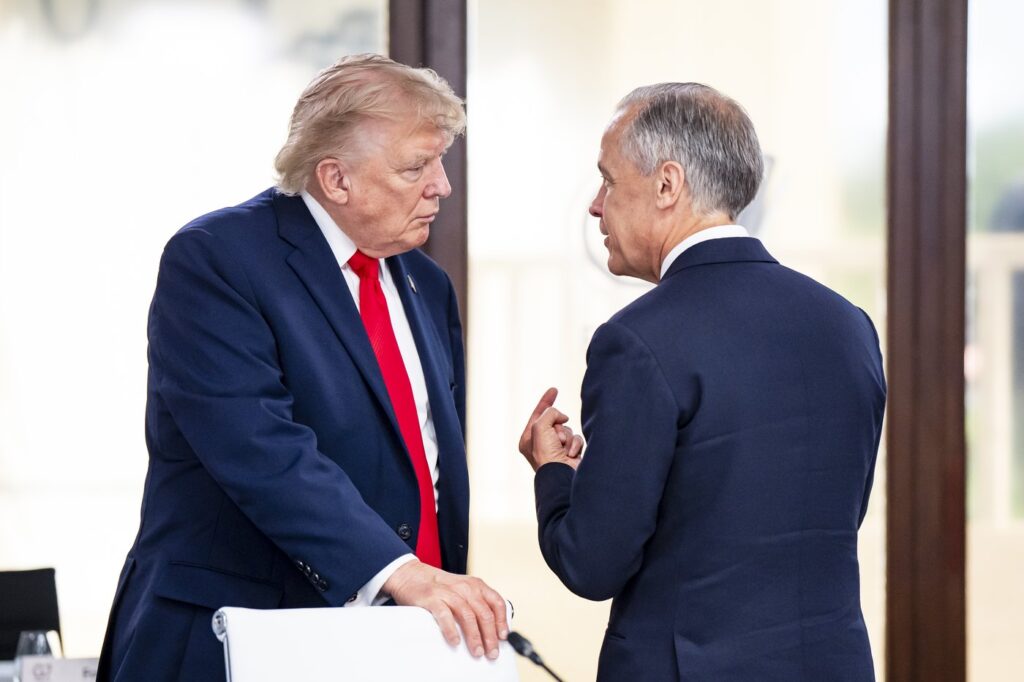
Mark Carney, Canada’s envoy to the United States, met with U.S. President Donald Trump in Shenzhen, China, during a crucial phase of trade discussions between Canada and both the U.S. and China. This meeting occurred on a Wednesday, lasting just under 20 minutes, as confirmed by Carney’s office. It coincided with a moment of intensified trade dialogues amidst the backdrop of the Asia-Pacific Economic Cooperation summit.
Carney’s meeting with Trump was attended by key U.S. officials, including U.S. Trade Representative Jamieson Greer, U.S. Commerce Secretary Howard Lutnick, Trump’s Chief of Staff Stephen Miller, and U.S. Secretary of State Marco Rubio. From Canada, attendees included Carney’s Chief of Staff Marc-André Blanchard and Foreign Affairs Minister Anita Anand. The discussions focused on achieving a mutually beneficial trade agreement aimed at creating jobs, enhancing affordability, and respecting Canada's languages, culture, and sovereignty.
In a news conference held prior to the meeting, Carney expressed confidence that Trump was not opposed to Canada's efforts to strengthen its trade relationship with China. He noted that Trump was actively seeking to understand Canada's direction regarding its trade ties with China. This is pertinent, especially as Canada and China recently agreed to lift restrictions on trade items such as Canadian pork and Chinese steel.
Carney highlighted that negotiations with China have been comparatively straightforward for Canada, a factor he attributes to the complexities surrounding Canada’s trade dealings with the U.S. He commented on the significant shift in the United States' trade objectives, stating that Canada’s priority remains on securing a favorable trade deal for Canadians, particularly in the export of primary commodities like iron and oil, rather than advanced technologies such as superconductors.
The diplomatic relationship between Canada and the U.S. has faced challenges since formal trade talks broke down in August 2022. Accusations of last-minute changes from both sides have colored the atmosphere of negotiations. Carney pointed out that Trump's administration aimed to limit Canada's trade pursuits with third countries, jeopardize its cultural and linguistic protections, and keep aggressive tariffs on vehicles, prompting retaliatory measures from Canada against U.S. products.
Despite these tensions, Carney remarked on the advancements made towards a trade deal, emphasizing his intention to engage Trump further at the summit. He reiterated Canada's position that any agreement must align with the best interests of Canadians. Furthermore, Carney indicated that the outcomes of talks with the U.S. could significantly influence Canada's approach to investments from China, suggesting that Canada might consider collaborations with Chinese automotive manufacturers if negotiations with the U.S. do not yield favorable results.
Looking forward, it has been noted that Democratic leaders in Congress have expressed that resolving the trade war with Canada will be among their top priorities when they assume the majority in January. This context further emphasizes the importance of ongoing negotiations and the intricate balance Canada must maintain in its international trade relationships.








