

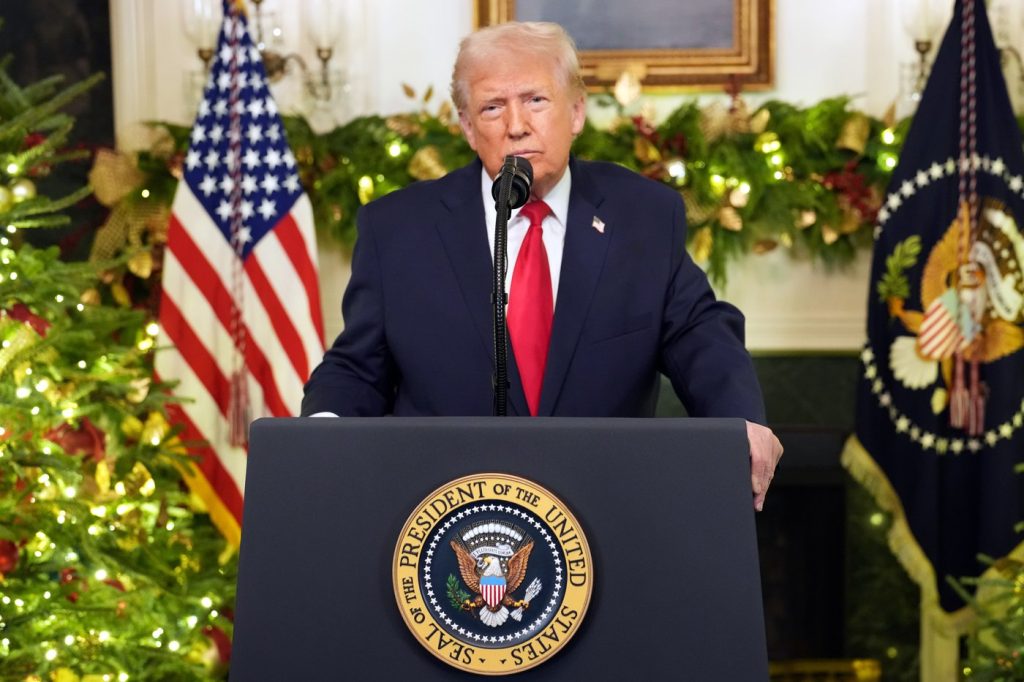
In a recent speech delivered from the White House, President Donald Trump provided a predominantly positive overview of the progress made during his administration. However, many of his claims seemed disconnected from the reality faced by everyday Americans struggling with rising prices and contradicting government statistics.
One of Trump's key assertions was about inflation, which he labeled an "inflation disaster" attributed to the Democratic party. He claimed that prices of essential items like turkey and eggs were on the decline and that “everything else is falling rapidly.” Nevertheless, this statement does not align with the actual inflation data. As of September 2025, the consumer price index stood at 3%, mirroring the figures from January of the same year, and only a slight increase from the 2.9% recorded in December 2024, the last full month of Joe Biden's administration. An AP-NORC poll conducted this month revealed that a significant majority of Americans reported experiencing higher than normal prices for groceries, electricity, and holiday gifts.
Further analysis indicates that inflation peaked during Biden's presidency at 9.1% in June 2022, primarily due to supply chain disruptions, excessive government spending, and the repercussions of Russia's invasion of Ukraine, which drove food and energy prices higher. Historically, Americans have faced significantly worse inflation, such as rates exceeding 13% in 1980 and estimates approaching 20% during World War I. Notably, inflation had begun to decrease at the beginning of Trump's presidency, but it surged following the imposition of tariffs announced by him in April 2017.
Trump also boasted about securing "$18 trillion of investment into the United States," describing it as record-breaking. However, this figure is questioned, as there is no substantial evidence to validate his claim. Both foreign entities and companies, alongside data from the White House, suggest that such a high figure is exaggerated and speculative. The White House's own investment statistics cite a much lower total of $9.6 trillion, which likely includes commitments made during Biden's presidency. Trump's previous vows regarding investment numbers have often come without detailed substantiation, and while he secured some agreements during an October visit to Japan and South Korea, it remains uncertain how many of these commitments will come to fruition in the long term.
Addressing his electoral success, Trump claimed that he was elected "in a landslide," winning both the popular vote and all seven swing states. While he did achieve a considerable electoral win with 312 electoral votes, framing it as a landslide is contentious. Comparatively, Barack Obama captured more electoral votes in both 2008 (365) and 2012 (332). Historical context shows that Trump's electoral performance pales against the significant victories of past presidents like Franklin Roosevelt in 1936 and Ronald Reagan in 1984. Although he did capture more popular votes than his Democratic opponent Kamala Harris, he did not achieve an outright majority, making his victory in the 2024 election one of the narrower margins in recent history.
In summary, while President Trump's address highlighted his accomplishments and offered an optimistic portrayal of economic conditions, many of his claims were met with skepticism, particularly concerning inflation, investment figures, and the characterization of his electoral success. This divergence between political rhetoric and economic reality raises questions about the true state of the American economy under his leadership.








