

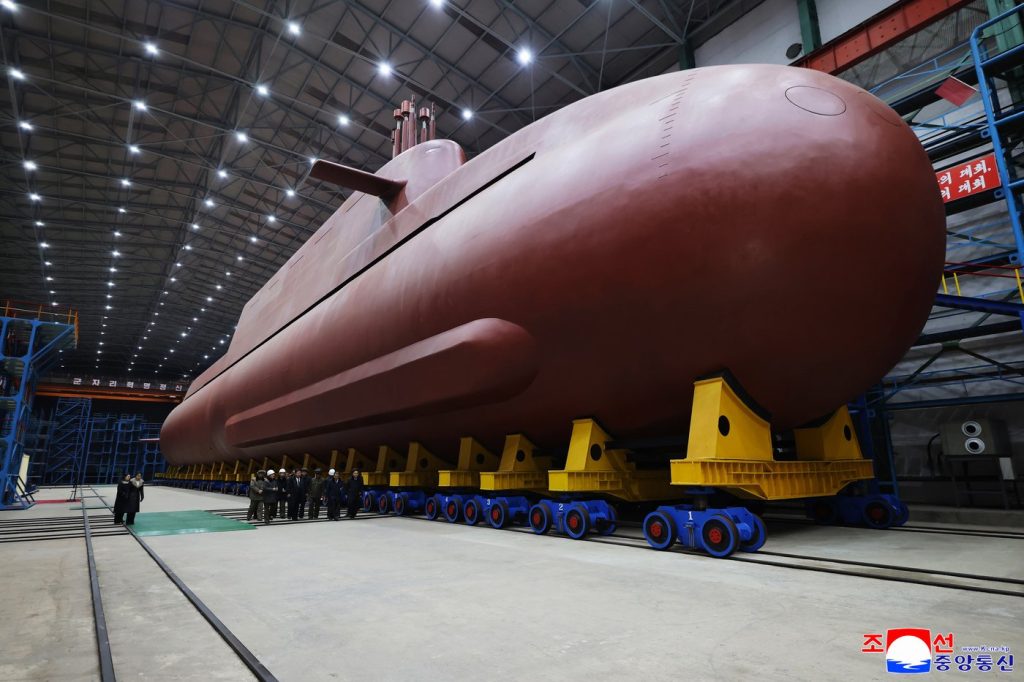
SEOUL, South Korea (AP) - On Thursday, North Korea showcased significant progress in the construction of a nuclear-powered submarine, as images released by state media highlighted a largely completed hull. During a shipyard inspection, North Korean leader Kim Jong Un criticized South Korea's efforts to obtain nuclear submarine technology, labeling them an "offensive act" that threatens the North's security and maritime sovereignty. The submarine being constructed is described as an 8,700-ton-class vessel, which Kim asserts is crucial for the modernization and nuclear capability of North Korea's navy.
Kim’s visit to the shipyard emphasized the importance of developing the submarine, which is aimed to be armed with nuclear weapons, referred to as a "strategic guided missile submarine" or "strategic nuclear attack submarine." He asserted that South Korea’s intention to acquire similar capabilities underscores the urgency for North Korea to advance its own naval nuclear capabilities. Completion of the submarine, according to Kim, would herald an "epoch-making" enhancement in North Korea's nuclear deterrent against perceived threats.
The specific timing of Kim's shipyard visit was not disclosed; however, the media release included photographs that depicted him inspecting a large burgundy-colored vessel adorned with anti-corrosion paint within an assembly hall, alongside senior officials and his daughter. This marked the first time state media presented images of the submarine since March, which primarily featured the vessel's lower sections. Analysts suggest that the showcasing of such a completed hull implies that many essential components, including the engine and potential reactor, are likely already installed.
Moon Keun-sik, a submarine expert from Hanyang University in Seoul, expressed that showcasing the entire submarine suggests readiness for water testing may be imminent. He speculated that North Korea could test the submarine at sea within a few months. The nuclear-powered submarine is among a range of sophisticated weapons that Kim highlighted during a significant political conference in 2021 in response to increasing military threats led by the U.S. Other military advancements on Kim's agenda include solid-fueled intercontinental ballistic missiles, hypersonic weapons, spy satellites, and multi-warhead missiles.
As North Korea has conducted multiple tests to develop these systems and recently unveiled a novel naval destroyer, concerns persist regarding its capability to build a nuclear-powered submarine. Such a vessel capable of stealthy operation and underwater missile launches would pose significant challenges for neighboring nations to detect and counteract. Nonetheless, questions arise about North Korea's ability to procure the necessary resources and technology amidst ongoing international sanctions.
Some experts posit that North Korea's recent alignment with Russia, including military support for President Vladimir Putin's activities in Ukraine, could potentially facilitate technological exchanges crucial for achieving its military objectives. While there are speculations that North Korea might have sought a reactor from a retired Russian submarine, Moon asserts that it is more plausible that North Korea designed its own reactor, possibly with Russian technological assistance.
Compounding these developments, South Korea is also pursuing its own nuclear-powered submarine capabilities. During a summit with then-President Donald Trump in November, South Korean President Lee Jae Myung sought U.S. backing for the initiative, reaffirming Seoul's commitment to boost defense expenditures to relieve American burdens. Trump subsequently indicated readiness from the U.S. side to share advanced technology to assist South Korea's nuclear submarine development. However, the specifics of where and when such a vessel would be built, and how Seoul would negotiate access to the requisite nuclear fuel and reactor technology, remain unresolved.
In parallel reports, the Korean Central News Agency (KCNA) mentioned that Kim supervised tests of new anti-air missiles fired into the sea. The South Korean Joint Chiefs of Staff acknowledged detecting North Korea’s missile launches from an eastern coastal location, with U.S. and South Korean intelligence agencies evaluating further details on the weapons involved. Tensions on the Korean Peninsula have escalated in recent years, especially as Kim has expedited his military nuclear program while fostering closer ties with Moscow following Russia's invasion of Ukraine. His administration has consistently rebuffed calls from Washington and Seoul for negotiations aimed at curbing nuclear and missile advancements, which stalled following a failed summit with Trump in 2019.








