

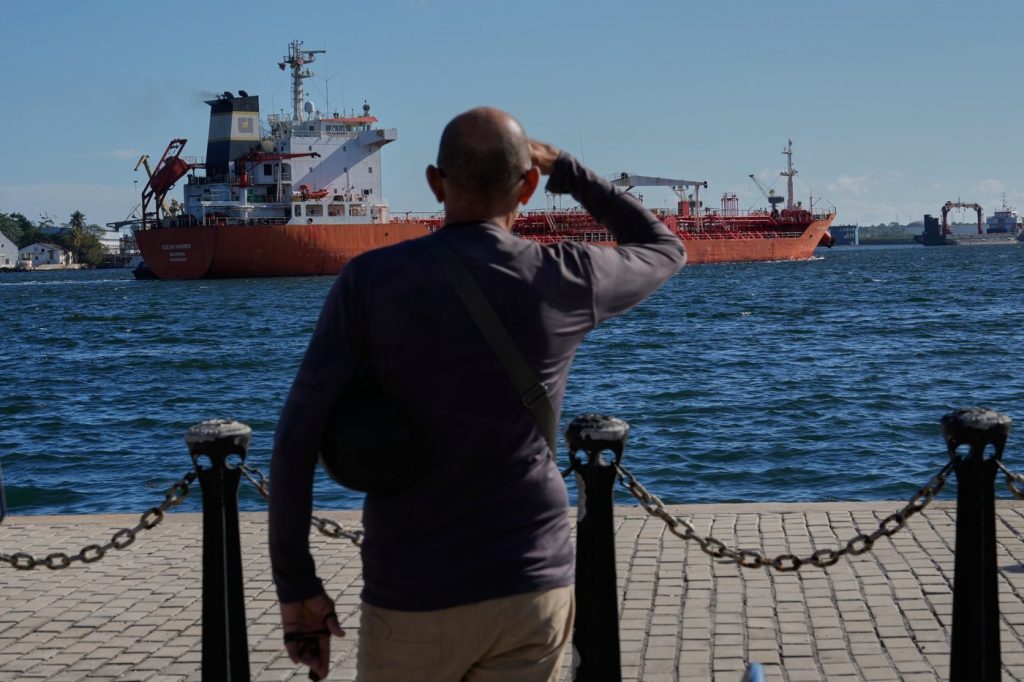
HAVANA (AP) — As U.S. seizures of Venezuela-linked oil tankers increase, concerns are growing in Cuba regarding the survival of the island's government and economy. Experts warn that a sudden cessation of Venezuelan oil shipments to Cuba could provoke widespread social unrest and mass migration, especially following the recent U.S. military operation that resulted in the capture of former President Nicolás Maduro.
“I’d be lying if I told you that I don’t want to leave the country,” said 16-year-old Cuban student Amanda Gómez. “We’re all thinking about leaving, from the youngest to the oldest.” This sentiment underscores a larger trend in Cuba, where harsh living conditions marked by severe blackouts, fuel shortages, and long lines at gas stations have already created significant distress among the population. The nation is currently facing its worst economic crisis in decades, and the loss of Venezuelan oil could exacerbate this situation.
Michael Galant, a senior research and outreach associate at the Center for Economic and Policy Research in Washington, D.C., expressed concern that the ongoing crisis may push Cuba to a breaking point. “This will take an already dire situation to new extremes,” he stated. Galant also suggested that the intent behind U.S. actions may be to instigate unrest within Cuba as a means of regime change. “This sort of besiegement of Cuba is very intentional. Will it work? The Cuban people have experienced suffering for a very long time,” he added.
Cuba's demographic crisis has led to a significant population decrease; from 2020 to 2024, the island's population dropped by 1.4 million. Experts attribute this mass migration largely to the worsening economic conditions. Economist and demographics expert Juan Carlos Albizu-Campos noted that while those with resources have already fled, increasing crisis conditions will likely push more people to consider emigration. “Fuel is a factor that affects everything,” he remarked, illustrating the ubiquitous impact of fuel shortages on daily life in Cuba.
At the Spanish embassy in Havana, Ernesto Macías, a 53-year-old doctor, voiced his concerns about the future without a stable government. “I wouldn’t want Cuba to be invaded or anything like that. I hope that it doesn’t happen, but I’m sure people will continue to emigrate because there is no other way,” he stated. The gravity of the situation is evident, as Cuba's gross domestic product has fallen by 15% in the last six years, and there was a reported 4% decrease in 2025 alone, according to President Miguel Díaz-Canel.
Historically, Cuba has relied heavily on Venezuelan oil, receiving an estimated 35,000 barrels a day before recent U.S. seizures. The situation is further complicated by a drop in oil supplies from other nations like Mexico and Russia, which are also essential to Cuba's deteriorating energy needs. Jorge Piñón, from the Energy Institute at the University of Texas at Austin, highlighted the potential for an indefinite electricity shutdown if Venezuela’s oil supplies are completely cut off. “We are envisioning a situation where mass protests could become a reality,” he warned.
Despite the possible for unrest, some experts, like Andy S. Gómez, are skeptical about a radical change in government. “They’re not well armed; their equipment is outdated,” he commented. Gómez believes that the Cuban military is likely to remain loyal to the ruling elite and that even if there were protests, they would not necessarily lead to significant political change.
U.S. actions have aimed to exert control over the global distribution of Venezuela’s oil products, with the recent seizure of a fifth tanker illustrating this approach. Although it remains unclear whether any of these seized vessels were destined for Cuba, disruptions in oil supply would severely impact an already fragile economy. In this context, Gómez noted that Cuba has only one "card to play" with the U.S.: mass migration, suggesting tight control from Cuban authorities over the situation.
With the ongoing crisis, many Cubans prioritize their immediate needs for food, electricity, housing, and employment over political concerns. As the economic situation deteriorates further, the potential for unrest looms, but the outcome remains uncertain as key government figures maintain their grip on power.








