

HONG KONG (AP) – Oil prices stabilized slightly, and Asian stock markets were witnessing predominantly lower trading figures on Tuesday, amid mixed signals regarding the de-escalation of the ongoing Iran conflict. The Nikkei 225 in Tokyo dropped 1.2% to 51,245.50, continuing to experience losses significantly since the war began on February 28, which has erased most of its gains achieved at the start of the year.
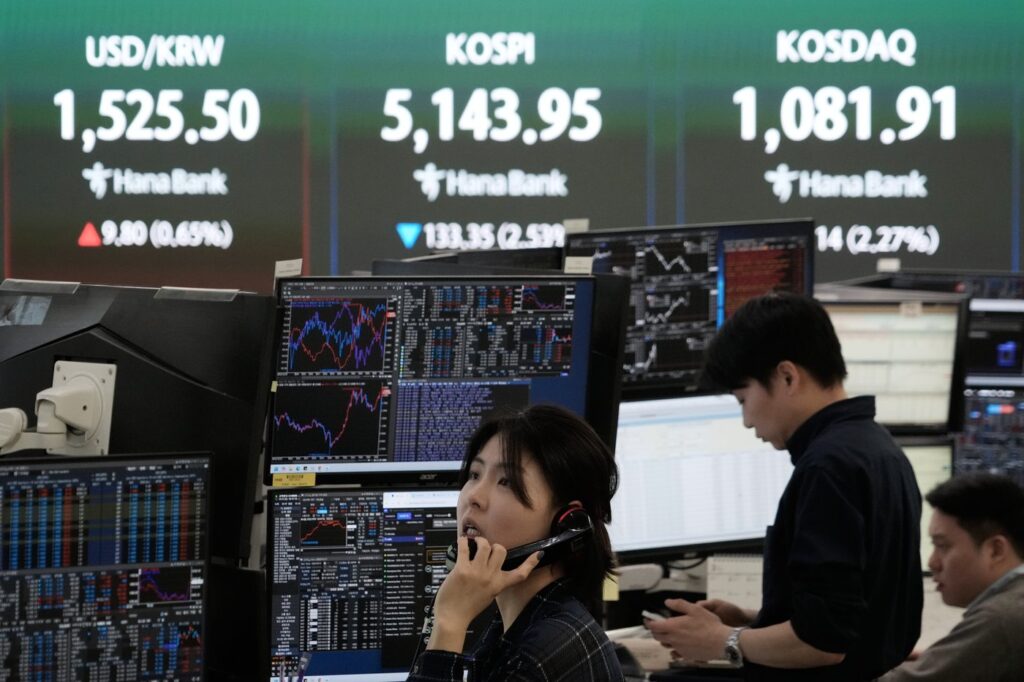
In South Korea, the Kospi index fell by 3.4% to 5,097.11. Meanwhile, Hong Kong's Hang Seng index recorded a decline of 0.5%, settling at 24,624.55, and the Shanghai Composite index decreased by 0.4% to 3,908.28. Conversely, Australia’s S&P/ASX 200 managed to rise by 0.7%, while Taiwan's Taiex saw a drop of 2.2% during the session. On the U.S. front, futures showed signs of resilience with an increase of nearly 1% early on Tuesday.
As the Iran war stretches into its fifth week, regions across the Middle East continue to experience escalating attacks, and a definitive conclusion to the conflict remains elusive. Brent crude futures were recorded as slightly lower at $107.36 per barrel, a dip of less than 0.1%. At the same time, benchmark U.S. crude prices edged up 0.1% to reach $102.94 per barrel. It is noteworthy that oil prices have surged dramatically in March, with Brent crude prices soaring by over 40% since the commencement of the Iran war.
On Tuesday, an alarming incident was reported where a drone struck a Kuwaiti oil tanker in Dubai waters, causing a fire outbreak. U.S. Gulf allies have expressed their concerns to the White House regarding the weakening of Iran, urging President Donald Trump to sustain military engagements in the area. Trump noted that U.S. negotiations were underway with Iran’s parliamentary speaker; however, Iran has vehemently denied the existence of any such discussions.
Disruptions in maritime traffic at the Strait of Hormuz, a critical channel through which nearly one-fifth of the world’s oil typically transits, highlight ongoing challenges for global energy supplies. U.S. Secretary of State Marco Rubio emphasized that President Trump possesses “options available” in response to Tehran’s threats of control over the strait, after reports surfaced suggesting that Iran had established a de facto “toll booth” in the area.
On Wall Street, stocks reflected mixed performance as well on Monday, with the S&P 500 declining by 0.4% to close at 6,343.72. The Nasdaq composite lost 0.7%, dropping to 20,794.64, while the Dow Jones Industrial Average increased by a slight 0.1% to reach 45,216.14. A significant fluctuation was observed in Sysco, a food distribution company, whose shares plummeted by 15.3% following its announcement of acquiring supplier Jetro Restaurant Depot in a substantial $29 billion deal.
In the commodities market, early Tuesday trading showed that gold and silver prices had increased, with gold rising by 0.7% to $4,587.80 per ounce, while silver prices climbed by 2.4% to $72.25 per ounce. The U.S. dollar also experienced slight fluctuations, trading at 159.61 Japanese yen, down from 159.71 yen previously, and with the euro priced at $1.1472, showing a marginal rise from $1.1465.








