

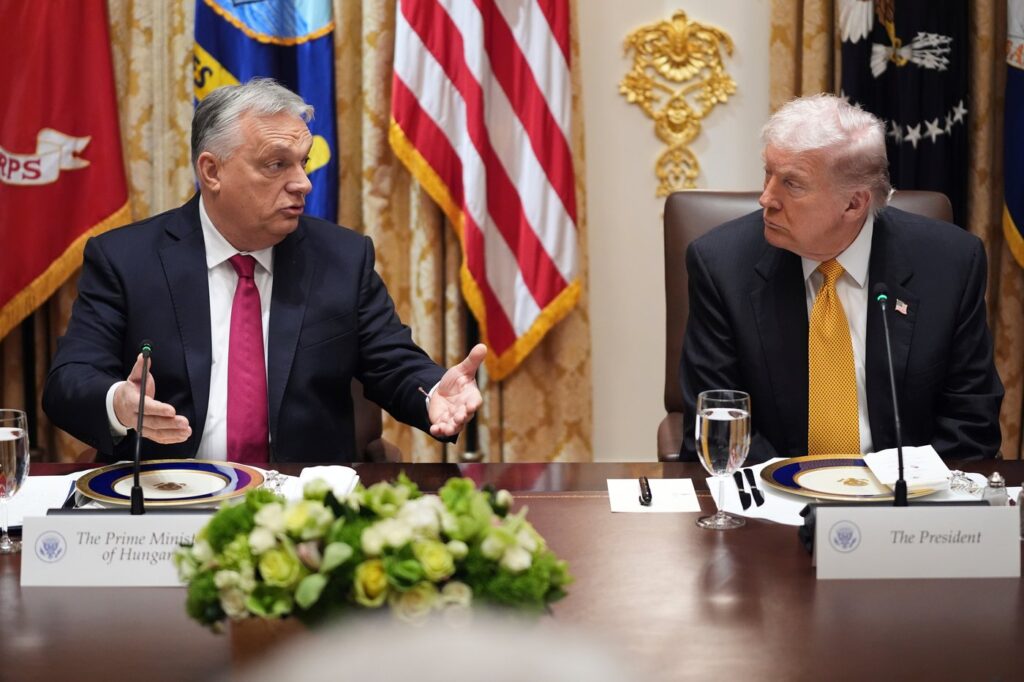
WASHINGTON (AP) — In Hungary, President Donald Trump, along with his senior officials, strategically utilized social media and an election-eve visit to Budapest to bolster the reelection campaign of the country's far-right Prime Minister, Viktor Orbán. This tactic is part of Trump's broader approach to exert political influence on a global scale, impacting elections in Latin America, Asia, and Eastern Europe.
In Argentina, the Trump administration intervened to stabilize the country's financial markets by providing $20 billion in assistance. However, Trump later threatened to withdraw this support if the electoral outcomes did not align with his preferences. Similarly, in Honduras, he publicly endorsed conservative candidate Nasry Asfura for the presidency and also pardoned a former president from the same political party while Hondurans were gearing up for the elections.
Throughout his second term, Trump has showcased a unique form of international political engagement that diverges from the traditional U.S. policy of non-intervention in foreign electoral matters. His critics argue that this approach reduces the integrity of diplomatic relationships, as illustrated by David Pressman, the former U.S. ambassador to Hungary, who noted that Hungary's stance on essential issues, such as Ukraine, now appears filtered through a U.S. political lens rather than expressed as an independent foreign policy.
The upcoming elections in Hungary serve as a critical test of Trump's political influence abroad. With Orbán being one of Trump's earliest European supporters, their relationship has persisted even during Trump’s political setbacks. Trump’s endorsement comes with personal sentiment; he has expressed his admiration for Orbán's leadership, stating, "I love Hungary and I love that Viktor," during a recent rally attended by Orbán supporters in Budapest.
Trump has built a reputation as a kingmaker within the Republican Party, asserting that world leaders actively seek his endorsement. He revels in his ability to influence outcomes, famously stating, "I love it when I give endorsements and people win." His selections often reflect mutual policy perspectives, aligning him with like-minded leaders such as Orbán and others like Japanese Prime Minister Sanae Takaichi and the radical Argentine President Javier Milei.
Events like the Conservative Political Action Conference (CPAC) have become platforms for promoting foreign allies. Notably, during a CPAC event in Warsaw, then-Secretary of Homeland Security Kristi Noem encouraged Polish voters to support a conservative candidate, hinting at potential implications for U.S. military presence in the region. In Hungary, Trump sent a video message to CPAC attendees urging them to support Orbán, emphasizing the prime minister's strong leadership and commitment to national sovereignty.
The Trump administration's support for Orbán has been particularly pronounced, with multiple endorsements on social media. Trump's call to "GET OUT AND VOTE FOR VIKTOR ORBÁN" and promises of economic support underscores the unprecedented nature of his involvement in foreign elections, a strategy that contrasts sharply with past administrations that employed more subtle means of influence.
While other U.S. presidents have engaged in foreign policy with varying degrees of intervention, Trump's explicit involvement in foreign elections is unparalleled. Experts argue that his approach reflects a departure from historical norms, allowing for a more overt and personal form of diplomacy. Critics like Senator Tim Kaine have described this as an extension of the "Trump Corollary" to the Monroe Doctrine, signifying a renewed U.S. focus on interventionist principles in foreign politics.
In recent instances, Trump has adopted a dual strategy of offering both support and potential sanctions depending on electoral outcomes. For example, in Argentina, he hinted that U.S. financial generosity would be contingent upon Millei's success. This pattern of carrot-and-stick diplomacy signals Trump's hands-on approach in shaping international electoral landscapes.
As the elections in Hungary approach, knowledge of Orbán's leading position in independent polls juxtaposes Trump's historical influence, raising questions about the effectiveness of his endorsement. The dynamics of U.S. political influence in global elections continue to evolve, and the outcomes of these international races will reflect the current standing of Trump's political capital on the world stage.








