

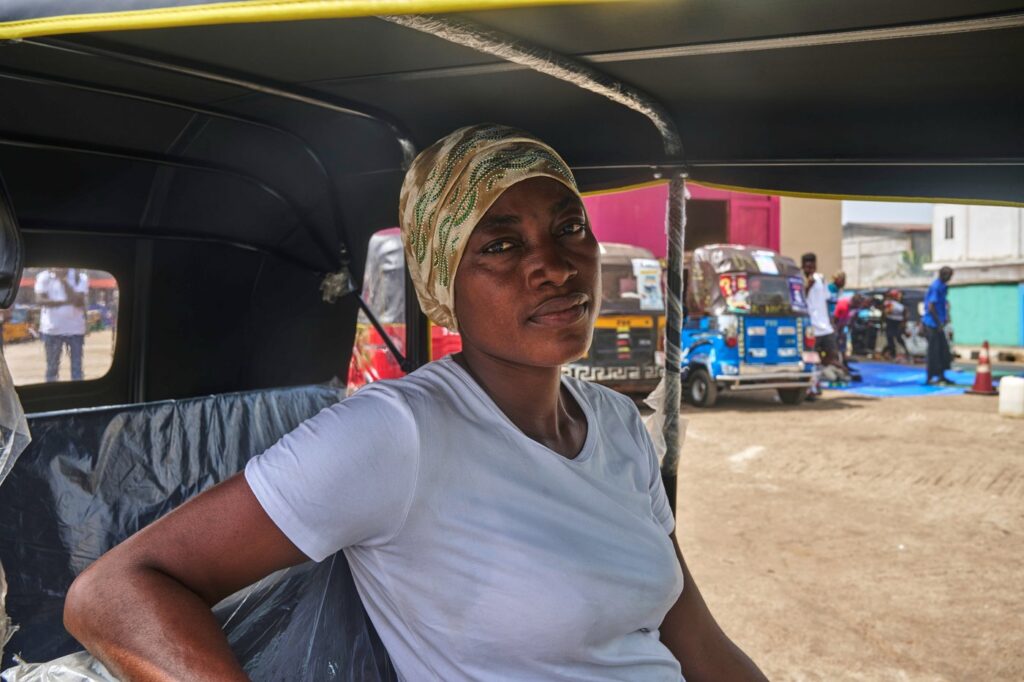
FREETOWN, Sierra Leone (AP) — As the late afternoon sun descends on Freetown’s main transit park, Hawa Mansaray arrives in her motorized three-wheeled vehicle, taking a moment to step away for a break and pray. Mansaray represents a small but growing group of women entering the male-dominated commercial transport sector in Sierra Leone's capital. The auto-rickshaws, locally known as kekeh, serve as a crucial mode of transportation, historically driven predominantly by men.
“I have done different jobs since I came to Freetown, but kekeh has done more for me,” said the 27-year-old single mother. The popularity of rickshaws has surged in Sierra Leone, helping to alleviate the pressures on a fragile public transport system as the West African nation works to recover from the 1991-2002 civil war. Freetown’s population has ballooned to over 1.5 million—approximately three times its size during the city's infrastructure planning and construction—resulting in increased demand for commercial motorcycles and auto-rickshaws.
Despite the rickshaws often being rickety and running at minimal speeds, they offer commuters easy accessibility, maximum ventilation, and relative comfort, which makes them a preferred option even as their safety is sometimes questioned. The rise of female drivers is not just a shift in transportation; it also serves as a symbol of women’s capability. However, social stigma still surrounds women taking up certain jobs, as highlighted by Marfoh Mariama Samai, a women’s rights advocate with Plan International Sierra Leone. “When a young woman ventures into a certain type of job, they are stigmatized,” Samai said.
Sierra Leone grapples with one of the lowest levels of access to financial services in Africa, further complicating recovery for marginalized groups like women and rural residents. Consequently, many women are limited to petty trading, a situation that fosters a reliance on their husbands. “When the man gives you the money, he makes all the decisions,” Samai added, illuminating the patriarchal norms prevalent in some parts of Sierra Leone. She encourages more young women to pursue opportunities in the transport sector.
Mansaray understands these challenges intimately. Hailing from Kailahun District, where the civil war began, she was born amidst conflict and had to leave school after primary education. As an adult, following her separation from her husband, she turned to various small businesses to provide for herself and her child. Although driving rickshaws was initially not part of her plans, she became interested after observing women like her succeeding in the field and later paid for training.
Now working under a company that requires her to deliver daily returns of 350 leones (approximately $14), Mansaray earns an average daily wage of 175 leones (around $7), which is substantial by local standards. “I will advise my fellow women who aren’t employed to come into the game,” she suggests. Similarly, Alimatu Kamara, another female rickshaw driver, shared her journey from years of unemployment to her new role in the transport sector. Although she enjoys her newfound job, she faces challenges, including aggressive behavior from male riders and safety concerns at night.
“Some women can panic,” Kamara noted, emphasizing the need for determination to continue in such a demanding environment. Nonetheless, she is ambitious, aiming to expand her business by purchasing more rickshaws. “We can’t just sit, waiting for office jobs. With jobs like kekeh, you can even make more money,” Kamara asserts.
The Sierra Leone Kekeh Riders Union comprises over 1,000 registered members in western Freetown, yet only about 20 of them are women, according to Mustapha Thoronka, the union's district chairman. He acknowledged the improvement in female representation and endorsed efforts to train and assist female drivers, including advocating for access to loans. “Whatever men can do, women can do better,” Thoronka said, expressing hope that women involved in this business can secure financial independence and support for their families.
Commuter Mariama Barrie expressed her preference for female drivers, stating they tend to be more careful than their male counterparts. The increasing presence of women in the kekeh sector serves as a motivational message, particularly for women who remain passive. “If you know how to ride, take kekeh… rather than sitting and waiting for handouts,” Barrie advised, highlighting the empowerment that comes from engaging in this line of work.








