

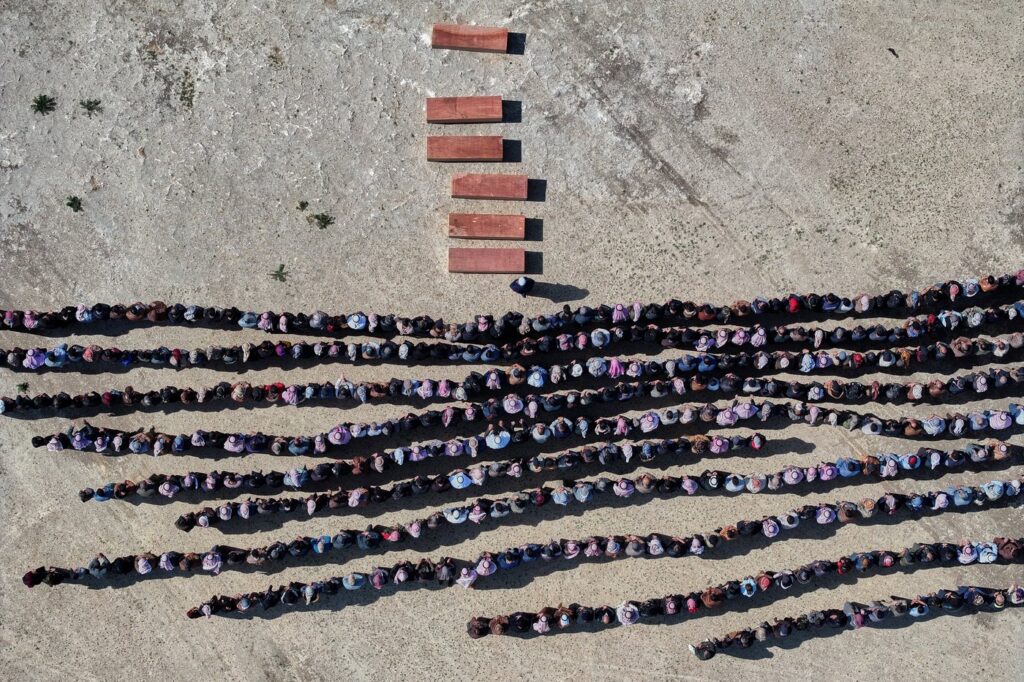
DEIR EL-ZOUR, Syria (AP) – A devastating recent wave of Israeli airstrikes has led to unimaginable tragedy for a Syrian family in Lebanon, as Hamad al-Jalib buried his wife and four of their five children on Saturday in Deir el-Zour province, northeastern Syria. This sorrowful event followed a series of assaults on Beirut that left over 350 people dead, marking one of the deadliest days in the ongoing conflict.
The family had fled their home in Syria six years prior, seeking safety in Lebanon. Their return was far from what they had anticipated. The coffins containing the remains of al-Jalib’s loved ones, along with that of his pregnant daughter-in-law, were transported in wooden boxes on a bus from Lebanon. Mourners stood by, crying and offering condolences as the burial procession took place in al-Sour town. Al-Jalib’s grief was compounded by the fact that one of his daughters has not yet been found; she is believed to be trapped under the rubble.
On Wednesday, Israel conducted roughly 100 airstrikes across Beirut, targeting sites linked to the militant group Hezbollah. According to the Israeli military, these strikes were meant to be a response to ongoing tensions and conflict between Hezbollah and Israeli forces following missile attacks launched by Hezbollah against Israel. More than a month of intense warfare has led to over 1,950 deaths and more than 6,300 injuries, with at least 315 of those casualties being Syrian nationals.
Hamad al-Jalib survived the attack because he was away when the strike hit the Ain Mreisseh neighborhood, where he lived with his family. He recalled rushing back after hearing of the strikes, only to witness the destruction, with smoke billowing from a nearby building. “The Israeli attack killed my girls; they are innocent, just sitting at home,” he lamented, noting that his children were having lunch when the attack occurred.
The process of retrieving the bodies was arduous, taking rescue teams three days to recover his family members from under the collapsed building. Al-Jalib detailed the ages of his deceased children: his daughter was 10 years old, while his other daughter was 12; his sons were aged 17, 14, and 13. In addition to his family, three other Syrian relatives were also victims of the Ain Mreisseh strike.
Despite many Syrian families having returned to their homeland since the fall of former Syrian President Bashar Assad in December 2024, the ongoing violence and economic instability have deterred many others. Al-Jalib's brother, Jomaa, was nearby when the strike occurred and remembered the chaos and fear as he fled from the scene. He reached the building only to find it already began to collapse, leaving him unable to help the family members trapped inside.
The casualties from these strikes, along with other incidents across Lebanon, exemplify the brutal impact of this ongoing conflict where innocent lives continue to suffer the consequences. The United Nations refugee agency spokesperson, Dalal Harb, noted that the family killed in Ain Mreisseh was not registered with the UNHCR, emphasizing the precarious status of many Syrian refugees in Lebanon, of which approximately 530,000 are registered, with many more likely unregistered.
In the aftermath of their burial, mourners gathered to pray over the fresh graves of the al-Jalib family, a stark reminder of the lingering sorrow and devastation caused by the ongoing violence in the region. The events have served to highlight the tragic loss of life and the heart-wrenching stories of families caught in the crossfire of geopolitical conflict.








