

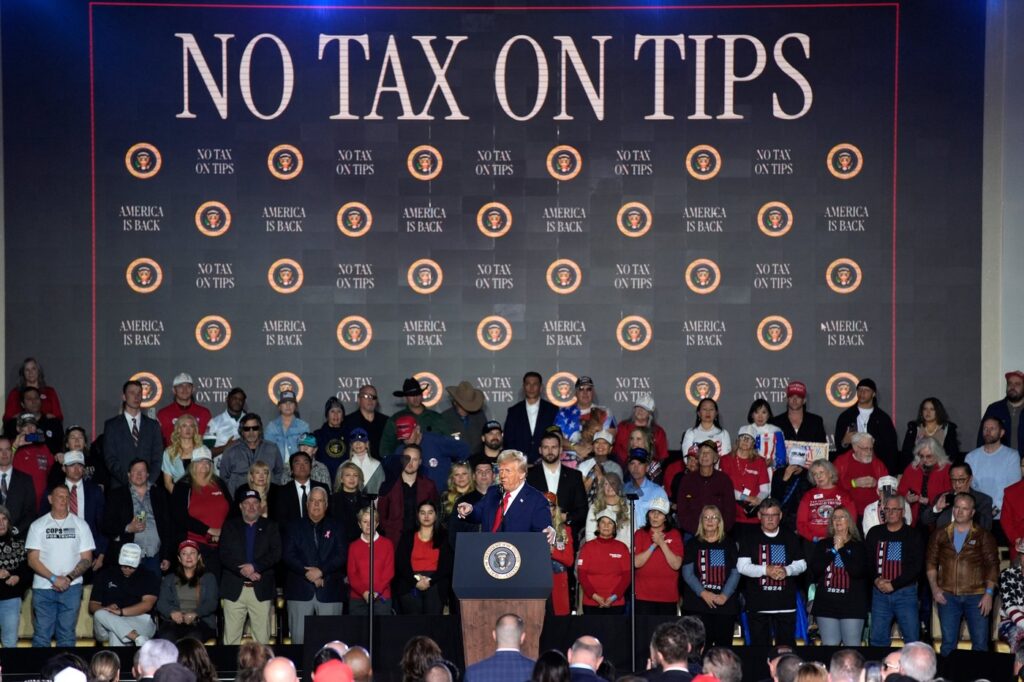
As the tax-filing deadline approaches, millions of Americans are set to take advantage of new federal income tax breaks related to tips and overtime wages, introduced under a comprehensive tax law signed by President Donald Trump. However, it’s important to note that many individuals may not benefit from the same deductions when completing their state income tax forms. This discrepancy arises because states have the discretion to decide whether they will align with federal tax modifications, and many have opted not to do so.
In states that do not conform to these federal tax changes, workers who qualify for federal tax deductions concerning tips and overtime will still be liable for state taxes on these earnings. Consequently, as the tax-filing deadline approaches, which falls on Wednesday for the federal government and most states, it is crucial for taxpayers to understand the intricate details regarding state income tax rates and available deductions.
A total of 41 states impose taxes on wages and salaries. Typically, individuals are required to fill out two separate tax forms: a federal income tax form followed by a state income tax form. The sequence is significant as most states utilize figures from the federal tax form as a basis for state tax computations. Notably, eight states—Alaska, Florida, New Hampshire, Nevada, South Dakota, Tennessee, Texas, and Wyoming—do not levy any income tax. Meanwhile, Washington state specifically taxes income derived from capital gains but not from wages and salaries, whereas Missouri imposes taxes on wages and salaries without taxing capital gains.
Most states continue to tax both tips and overtime wages. Approximately six states are aligning with Trump's tax law by providing tax breaks for tips, overtime wages, and loan interest for new vehicles manufactured in the U.S. Residents in Idaho, Iowa, Montana, North Dakota, and Oregon can access all three of these tax deductions. Colorado allows deductions for tips and auto loans but does not extend this to overtime wages. Conversely, Alabama provides only the auto loan deduction.
Several states have laws that automatically apply federal tax changes to state income taxes unless state officials specifically decide to opt-out. For instance, Colorado officials have opted out of the overtime tax deduction. However, in the majority of states, these tax breaks are available only if state legislatures actively update their laws, such as was done in Idaho.
Arizona presents a unique situation regarding tax deductions. The state’s income tax forms list deductions for tips, overtime wages, auto loans, and deductions for older residents, following a November executive order by Democratic Governor Katie Hobbs. She anticipated that the Republican-controlled legislature would subsequently pass a bill to incorporate these tax breaks into state law. However, Arizona's legislative framework remains unchanged, as Hobbs vetoed two tax-break bills that contained provisions along with Trump's corporate tax breaks. Additionally, lawmakers have not succeeded in passing a third attempt to establish these deductions.
This unusual scenario has led to concerns, with Adam Chodorow, a tax law professor at Arizona State University, stating that many individuals will likely deduct tips and overtime wages despite lacking a legal entitlement to do so, as they are being instructed by state government to pursue these deductions. There remains a possibility for Arizona to enact a law permitting these deductions post the tax-filing deadline, potentially even retroactively.
Tax breaks for tipped workers and overtime earners faced setbacks in South Carolina and Wisconsin this year. South Carolina extended the deadline for tax refunds to October 15 to allow time for the Republican-controlled legislature to consider opting into the federal tax deductions; however, legislation to do so passed the House but failed in the Senate. Similarly, Wisconsin's Republican-led legislature approved bills to facilitate the tips and overtime deductions, but they were vetoed by Democratic Governor Tony Evers.
Meanwhile, citizens in certain states must await tax deductions that are set to take effect in the future. States including Georgia, Indiana, and Michigan have instituted laws permitting tax deductions for tips and overtime wages beginning with the 2026 tax year, meaning these deductions will not be accessible for individuals currently filing their 2025 tax returns. In a potential reversal, Oregon is considering legislation that could eliminate the auto loan deduction and some corporate tax breaks for the 2026 tax year. Additionally, other states may still choose to opt in or out of these tax deductions as they prepare for the 2026 tax year.








