

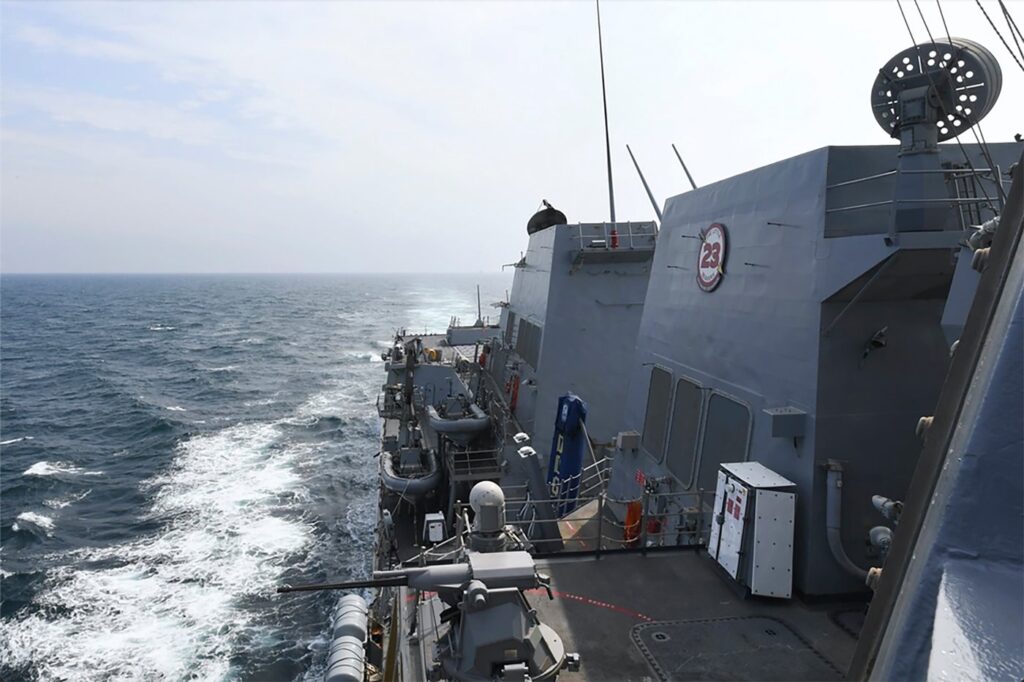
In 2011, President Barack Obama announced the U.S. would pivot away from conflicts in Iraq and Afghanistan to focus on countering the rise of China in the Asia-Pacific region. However, fifteen years later, the United States remains embroiled in conflicts in the Middle East, particularly due to rising tensions with Iran over its nuclear and missile programs. This shift in focus has led to the redeployment of military assets from the Asia-Pacific, raising concerns about the U.S. strategic interests in the region.
The ongoing Iran conflict has prompted President Donald Trump to postpone a significant trip to China, intensifying fears that U.S. attention is diverting away from Asia during a critical time as Beijing seeks to strengthen its regional leadership. Critics argue that the wars in the Middle East hinder Trump’s ability to effectively address crucial economic issues during an upcoming summit with Chinese President Xi Jinping, as a distracted U.S. may embolden China to act aggressively in the Taiwan Strait.
According to Danny Russel from the Asia Society Policy Institute, the U.S. must not get drawn into endless Middle Eastern conflicts at this juncture. He stresses that maintaining a focus on Asia is essential for American national interests, which have been undermined by poor decisions. Others, like Matt Pottinger, who previously served as deputy national security adviser, defend the administration’s approach, arguing that addressing issues stemming from countries influenced by China is necessary and should be managed sequentially.
NATO Secretary General Mark Rutte echoed similar sentiments, warning that conflicts may extend beyond the Indo-Pacific. He suggested that China might leverage its allies to distract the U.S. if it decides to take action against Taiwan, highlighting the global interconnectedness of conflicts.
Recently, U.S. Senator Jeanne Shaheen, the leading Democrat on the Senate Foreign Relations Committee, led a bipartisan delegation to Taiwan, Japan, and South Korea. During the visit, concerns about energy costs due to the Iran war and the relocation of U.S. military assets were discussed. Shaheen reassured regional leaders of the U.S. commitment to maintaining stability in Asia, emphasizing that “failure is not an option,” especially as China continues its agenda to assert control over Taiwan.
Kurt Campbell, a former deputy secretary of state, expressed concern that the U.S. military’s presence in the Indo-Pacific, built over years, might not fully recover even after the conflict in Iran concludes. As the Iran war drags on, it is anticipated that U.S. resources and focus will increasingly drift away from Asia, adversely impacting future arms sales to the region. Zack Cooper from the American Enterprise Institute noted that the military's depletion of munitions in the Middle East, which already pulls attention and resources, poses further risks for U.S. interests in Asia.
Amid these tensions, ex-Senator Shaheen noted the challenges the U.S. defense industry faces in replenishing its weapon stockpile. While efforts are in progress to strengthen defense capabilities, timelines for weapons deliveries have already begun to slip. On a more hopeful note, she emphasized the importance of regional partners like Taiwan, Japan, and South Korea enhancing their own defense strategies.
Obama's strategic rebalancing toward Asia intended to capitalize on the region's growth potential while confronting China’s rising dominance. His remarks underscored a shift from prolonged military engagements; however, attempts at trade agreements such as the Trans-Pacific Partnership fell through, hindering progress. Trump’s administration instead focused on tariffs and strict policies aimed at China, which Biden has largely maintained, along with stressing the importance of regional alliances to counter Chinese power.
By late 2025, Trump’s national security strategy had narrowed the U.S. approach in Asia to military deterrence over Taiwan and surrounding territories critical for economic interests, particularly regarding advanced semiconductor manufacturing from Taiwan. The intention was to ensure military readiness across strategic locations in proximity to China.
Despite an aim for a reduced focus on the Middle East, the emergence of the Iran conflict has once again shifted U.S. priorities and resources back to that region, highlighting the persistent challenge of balancing global military commitments with strategic interests in Asia.








