

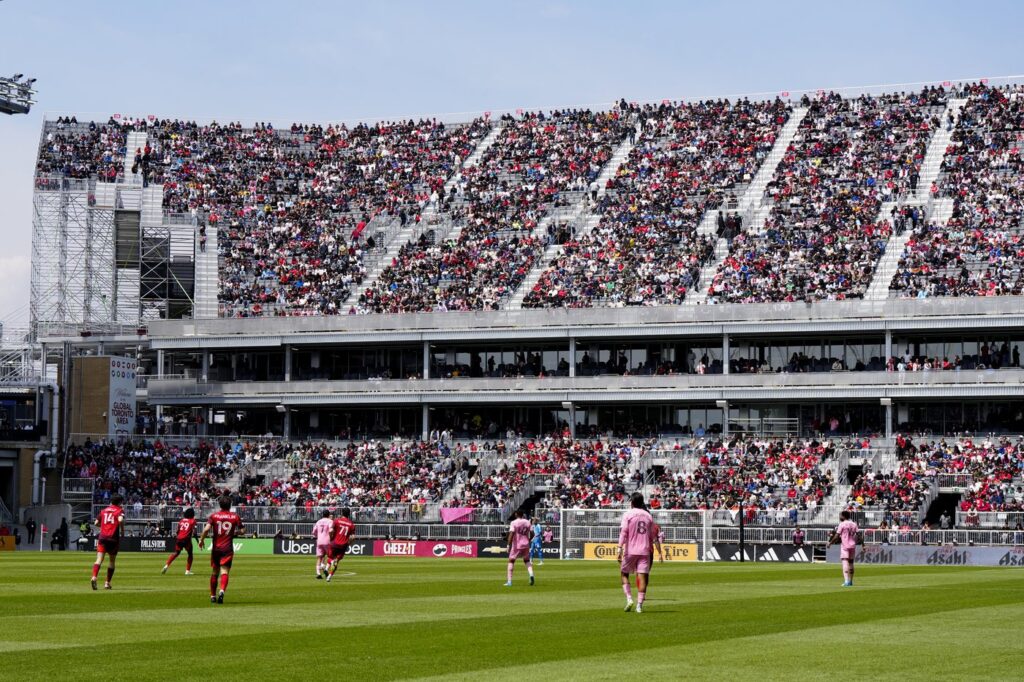
As the FIFA World Cup approaches, with thousands of soccer fans set to converge in Toronto and Vancouver next month, Rogers Communications Inc. is proactively enhancing the cellular infrastructure in these cities. The company has allocated $27 million for upgrades in cellular capacity at the host venues and surrounding areas, comprising $22 million specifically for improvements to the 5G+ network at BMO Field in Toronto and an additional $5 million for network enhancements in critical areas across Vancouver.
Rogers’ upgrades are designed to benefit all users, regardless of their mobile carrier. However, certain enhancements will provide exclusive benefits to Rogers customers. Throughout the tournament, Canada will host 13 World Cup matches—7 at B.C. Place in Vancouver and 6 at Toronto’s BMO Field, which will be temporarily renamed Toronto Stadium for the event. BMO Field has increased its capacity by adding 17,756 temporary seats, bringing the total to 45,736, while B.C. Place can accommodate approximately 54,000 fans.
With expectations of heightened attendance, Rogers acknowledges a surge in wireless traffic, necessitating expanded cellular capacity to ensure uninterrupted service. Neel Dayal, Rogers’ senior director of partnerships and innovation, highlighted the need for reliable network access, particularly as fans strive to share their live experiences on social media. He emphasized the minimal tolerance for network failures during such significant moments.
Ericsson’s head of thought leadership Americas, Peter Linder, also commented on the critical nature of mobile connectivity for fans today, with digital tickets often stored on smartphones. He indicated that significant network demand spikes occur during key moments when fans capture video, thereby stressing the importance of a robust network for both fans and venue operations, which rely on secure connectivity for payments and logistics.
In preparation for the World Cup, Rogers has deployed a dedicated team of 30 members who invested almost 40,000 hours planning and installing network infrastructure in Toronto. This included enhancements to the in-stadium wireless systems, effectively adding the equivalent of 16 new cell towers in downtown Toronto. Additional spectrum for 5G+ has been introduced to enhance overall speed, while extra infrastructure has been set up outside the stadium and at fan zones, hotels, and crucial transport hubs like Pearson International Airport and Union Station.
During the tournament, portable mobile towers, known as Cells on Wheels and Cells on Light Facilities, will be strategically placed in high-traffic downtown areas of both cities to bolster connectivity. In Vancouver, Rogers continues to enhance its 5G+ capabilities at B.C. Place, further building on a previous $10 million investment in preparation for the Taylor Swift Eras Tour stop scheduled for December 2024. The company has also improved network access at fan zones, hotels, and SkyTrain stations.
Linder emphasized that ensuring seamless connectivity extends beyond the confines of the match venue, noting that many activities occur around the stadium, including tailgating and waiting in lines. He observed that improvements made in anticipation of the World Cup were a continuation of efforts to enhance the overall infrastructure observed during major events like the Swift tour, which served as a significant stress test on Rogers’ network capabilities.
In looking back at the preparations for the Taylor Swift concerts, Rogers enhanced upload speeds at venues by 2.7 times and improved download speeds by 3.8 times. Vice-president of consumer wireless, Shelly Fernandes, remarked on the success of the upgrades, which allowed concertgoers to share their experiences with friends and family in real-time, highlighting the evolving expectations of fans at major events.
This year's World Cup promises to be monumental, featuring 48 nations and a total of 104 matches across 16 host cities in Canada, the United States, and Mexico, making it the largest tournament to date.








