

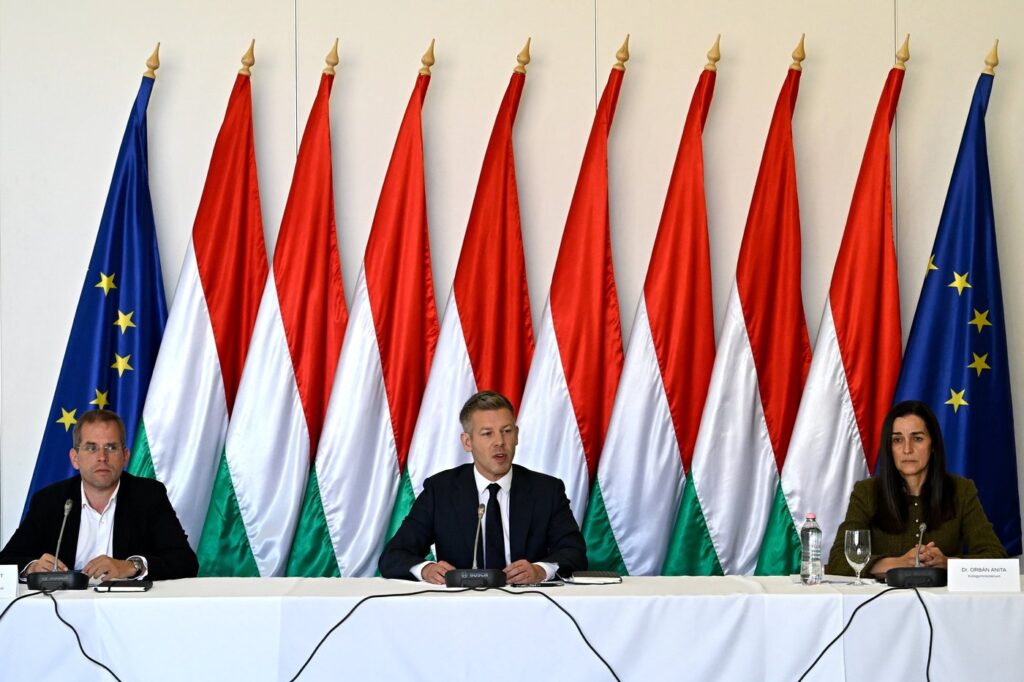
BUDAPEST (AP) — Hungary has summoned the Russian ambassador following a significant drone attack near its border with Ukraine, indicating a notable change in diplomatic tone under the new Prime Minister, Péter Magyar. This shift contrasts sharply with the previously warm relations between Hungary and Moscow during the tenure of former Prime Minister Viktor Orbán.
The Russian ambassador, Evgeny Stanislavov, is scheduled to meet with Hungarian Foreign Minister Anita Orbán at the foreign ministry around noon on Thursday. This meeting comes in response to strikes that targeted the Transcarpathia region of Ukraine on Wednesday, an area that is home to a substantial Hungarian minority.
During a press conference in Ópusztaszer, southern Hungary, on Wednesday, Prime Minister Magyar condemned the Russian attack, stating, “The Hungarian government strongly condemns the Russian attack on Transcarpathia.” He added that he plans to inquire from the ambassador about when Russia and President Vladimir Putin intend to bring an end to what has become a prolonged and bloody war lasting over four years.
As of now, the Russian government has not issued any public comments regarding the summons from Hungary. The recent drone assault was described as a massive daytime barrage, with Ukrainian President Volodymyr Zelenskyy reporting that Russia fired at least 800 drones targeting approximately 20 regions within Ukraine, including Transcarpathia. The attack resulted in at least six fatalities and left numerous individuals injured, including children. Zelenskyy noted that the duration of this attack marked one of the longest sustained assaults by Moscow in the ongoing conflict, which has now entered its fifth year.
President Zelenskyy characterized the Hungarian government's summons of the Russian ambassador as an “important message” and expressed gratitude to Prime Minister Magyar for his strong condemnation of the attacks. He emphasized that “Moscow has once again shown itself to be a common threat not only to Ukraine, but also to neighboring countries and Europe as a whole.”
Since defeating Orbán in a historic election in April, Prime Minister Magyar has committed to dismantling much of the legacy that accrued during Orbán’s 16 years in power, with a keen focus on addressing issues of alleged corruption. This recent summons of the Russian ambassador signals a dramatic reversal after Hungary previously maintained close relations with Russia, even in the wake of the full-scale invasion of Ukraine in 2022.
In March, Ambassador Stanislavov took to Facebook to publish an open letter to Magyar, where he dismissed accusations of Russian interference and claimed that the embassy aimed to preserve normal bilateral relations, develop mutually beneficial cooperation when possible, and protect the interests of both Russian and Hungarian citizens. In his remarks, he suggested that there was no reason to instill fear among Hungarians over “imaginary Russian threats.”
This evolving diplomatic stance reflects Hungary’s burgeoning recognition of the threats posed by Russia, not only to its own national security but also to the stability of the European region at large.








