

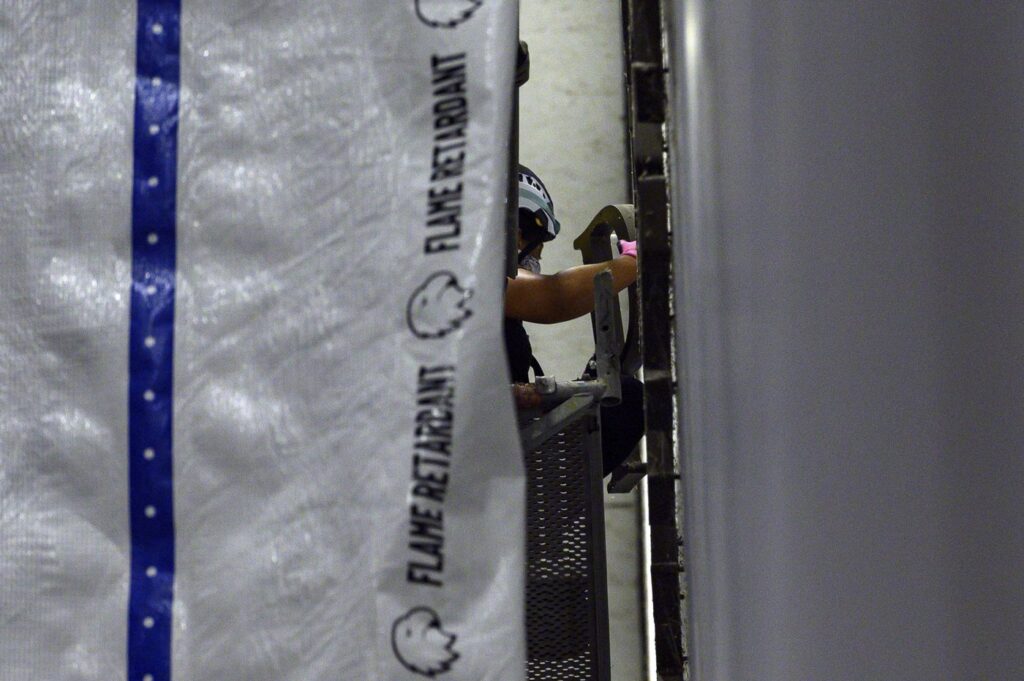
On Saturday, workers commenced the removal of President Donald Trump's name from the facade of the John F. Kennedy Center for the Performing Arts in Washington, D.C. This action followed a court-ordered deadline that required the removal of Trump’s name by Friday. The removal process began early Saturday morning, hours after a judge had initially demanded compliance with the ruling.
On Friday, scaffolding was erected around the specific section of the building featuring Trump’s name. Late that evening, the Kennedy Center sought an extension from the court, requesting additional time until noon on Saturday to fulfill the order due to severe thunderstorms that had caused disruptions. The Kennedy Center assured the court in its filing that the removal work was “currently ongoing” and would conclude by early Saturday morning.
By Saturday morning, workers began covering the scaffolding with tarps before starting the actual removal of Trump's name. They concluded their work around 3:30 a.m., though the tarps remained in place, making it unclear whether all letters had been successfully taken down. The atmosphere outside the Kennedy Center was notable, as dozens of spectators had gathered on the plaza on Friday to document the occasion, cheering and chanting “take it down.” Representative Joyce Beatty, a Democrat from Ohio and an ex-officio board member who had previously initiated a lawsuit to have Trump’s name removed, was seen among the crowd.
Earlier in the day on Friday, a judge declined a request to pause the deadline for the name removal, and an appeal lodged by the Kennedy Center to extend the ruling was also rejected that evening. Throughout Trump’s first term in office, he largely overlooked the Kennedy Center’s operations; however, upon returning to office for a second term, he exerted considerable influence over the venue, including appointing a new board of trustees that named him chairman. Subsequently, Trump’s name was added to the building.
U.S. District Judge Christopher Cooper, who presided over the case, ruled that only Congress had the authority to make changes to the Kennedy Center’s name. He further inhibited the administration from undertaking planned major renovations on the cultural and arts venue set to begin in July, which were expected to last two years. The Kennedy Center administration argued that these renovations were urgently required, claiming that critical structural issues, such as rusted beams and parking garage ceilings at risk of collapse, made immediate intervention essential.
Despite the ongoing legal battle regarding Trump’s name, the Kennedy Center has made efforts to comply with Judge Cooper's initial decision. A memo distributed to staff on June 4 mandated that all email signatures, letterhead, and other formal documents should now reflect the name as “The John F. Kennedy Center for the Performing Arts” or simply “Kennedy Center.” Furthermore, the center's website has been updated to omit Trump’s name entirely, and communications to members, including ticket packages for the upcoming Mark Twain Award for American Humor ceremony, have been sent without any reference to Trump.
As this situation develops, the Kennedy Center continues to navigate the complexities of honoring a landmark decision while addressing the operational and structural needs of the building.








