

On June 12, 2023, the United States, United Kingdom, and a coalition of over a dozen Western and Asian nations reaffirmed their condemnation of China’s extensive claims in the South China Sea, asserting that these actions are illegal according to a pivotal 2016 arbitration ruling. This statement came as a collective response to continued tensions in the region, marking the anniversary of the July 12, 2016, ruling delivered by an international tribunal in The Hague under the United Nations Convention on the Law of the Sea.
The arbitration ruling determined that there is no legal backing for China's broad maritime claims in the South China Sea, which Beijing justifies based on alleged historic rights. The nations involved firmly reiterated their commitment to this ruling, emphasizing its finality, legal binding nature, and its significance as a milestone in international maritime law.
China has categorically rejected the 2016 ruling and has not participated in the arbitration process initiated by the Philippines in 2013. This lack of participation followed a tense standoff in 2012, during which China effectively took control of a disputed shoal. Despite the tribunal's decision favoring the Philippines, China maintains its expansive claims over the majority of the South China Sea, a crucial trade route that has increasingly become a flashpoint for regional conflict.
The joint statement from the coalition voiced strong opposition to any destabilizing actions, highlighting concerns that such behaviors threaten peace and stability in the region. "We reaffirm the Arbitral Tribunal's decision that there is no legal basis for China’s expansive maritime claims in the South China Sea," the nations declared. This group includes not only the U.S. and U.K. but also countries such as the Philippines, Japan, Australia, New Zealand, Canada, Germany, Italy, Estonia, Latvia, Lithuania, Romania, and Slovenia.
The coalition's statement also condemned the use of coast guard, military, and maritime militia forces by China to harass other nations’ lawful operations at sea. They stressed the importance of maintaining freedom of navigation and overflight as established by the 1982 United Nations Convention on the Law of the Sea (UNCLOS), which all parties are urged to adhere to in resolving territorial disputes peacefully.
In a response issued by its embassy in Manila, China described the 2016 ruling as "illegal, null and void," stating that it would not change the historical arguments for China’s sovereignty in the region. The statement echoed Beijing's determination to protect its maritime rights and interests despite international criticism.
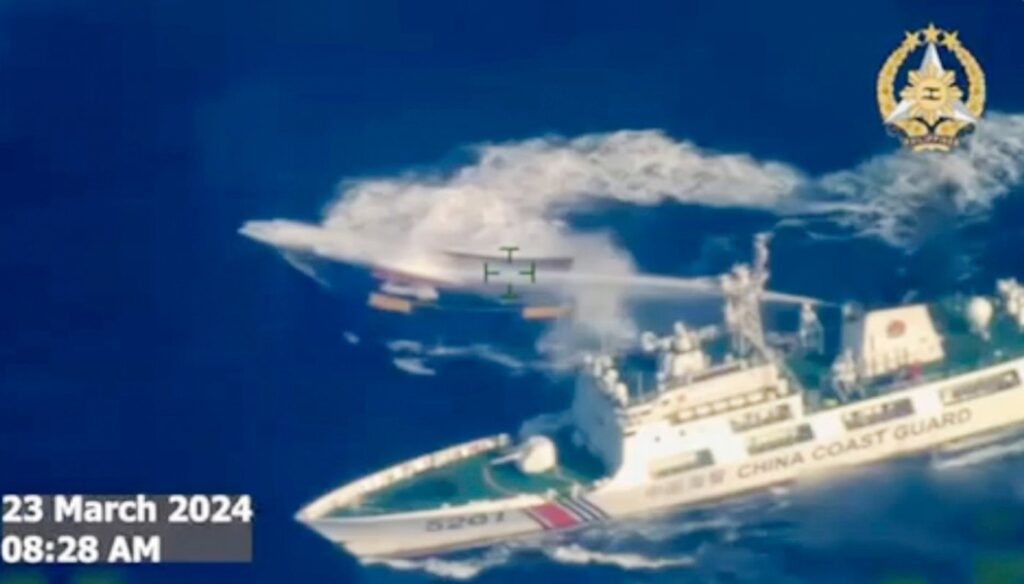
Tensions within the South China Sea have intensified in recent years, particularly between Chinese, Philippine, and Vietnamese forces, as well as their respective fishing fleets. There have been numerous incidents involving Chinese coast guard vessels employing powerful water cannons, military-grade lasers, and other aggressive tactics against Filipino forces and fishermen, contributing to volatile encounters at sea and in the air.
The United States has consistently urged China to comply with the arbitration ruling and safeguard freedom of navigation in the area. Both the Biden and Trump administrations have reaffirmed the commitment to defend the Philippines, signaling a readiness to intervene if Filipino forces or vessels come under attack in the disputed waters.








