

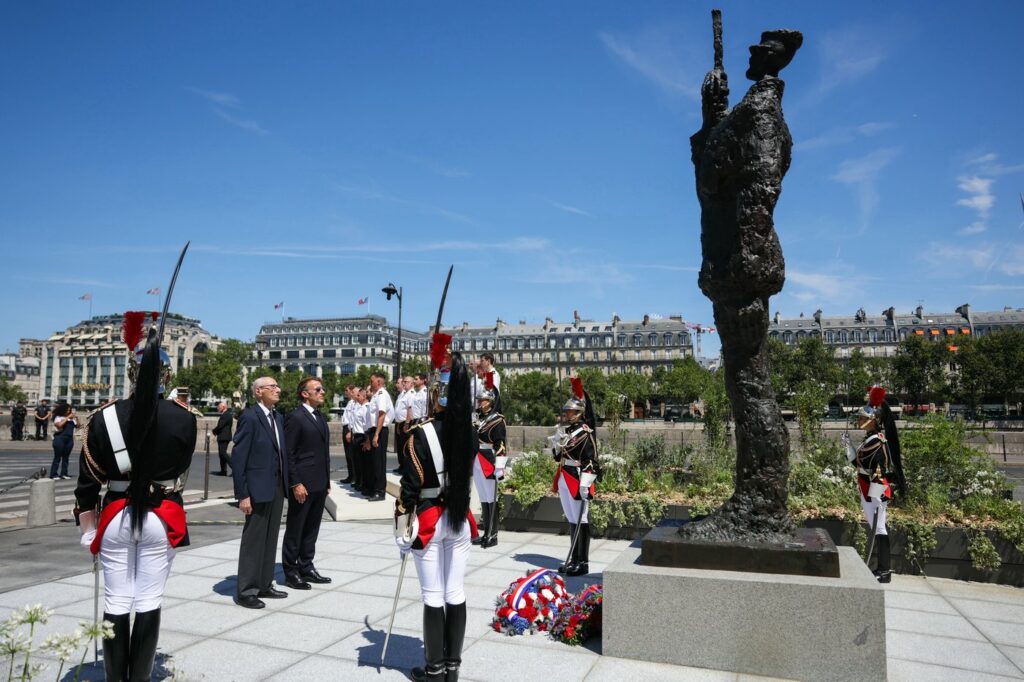
On Sunday, French President Emmanuel Macron condemned the resurgence of antisemitism in France during a ceremony that unveiled a statue of Capt. Alfred Dreyfus. This moment is notably significant as it marks 120 years since Dreyfus' exoneration by France's highest court, where the statue is now situated. Dreyfus was a pivotal figure in the 19th century, wrongfully convicted of treason, which highlighted the entrenched anti-Jewish sentiments in French society.
The ceremony took place amidst heightened security concerns, with police evacuating approximately 300 individuals from the Paris suburb of Sarcelles after a suspicious vehicle, containing a military weapon, was found near a synagogue. Sarcelles has a notable Jewish demographic, and as a result of the incident, a terrorism investigation has been initiated by the prosecutors. French Interior Minister Laurent Nunez stated that the vehicle harbored a "long military weapon," although it remains uncertain whether it posed a direct threat to the Jewish community.
France boasts the largest Jewish population in Europe and has witnessed a spike in antisemitic incidents, including threats, vandalism, and violence, particularly following the Hamas attacks on Israel on October 7, 2023, and the subsequent conflict in Gaza. Both Israeli Prime Minister Benjamin Netanyahu and U.S. Ambassador to France, Charles Kushner, have criticized Macron for allegedly exacerbating antisemitism due to his decision to recognize Palestine last year.
During the Dreyfus statue unveiling, Macron reflected on the persistent nature of antisemitism in France, asserting that the "old demons" have never fully dissipated. He urged for ongoing vigilance against acts that discriminate based on identity. Dreyfus, who was of Jewish descent, was wrongfully adjudged guilty of treason in 1894 after being falsely accused of passing military secrets to Germany, resulting in a life imprisonment sentence. The case saw prominent figures, including the novelist Emile Zola, come forth to challenge the military's decision, arguing that Dreyfus was unjustly made a scapegoat.
On July 12, 1906, the Court of Cassation cleared Dreyfus of all charges, a pivotal moment in French legal history. In a significant move, Macron has declared July 12 a national day of commemoration for Dreyfus' innocence, effective this year. Following his exoneration, Dreyfus re-enlisted in the French army and served during World War I, ultimately passing away in 1935.
Among the attendees of the ceremony was Charles Dreyfus, the 99-year-old grandson of Alfred Dreyfus. He expressed his sorrow over witnessing the resurgence of antisemitism in contemporary France, a reality he found unimaginable at his age. However, he noted that his heart was also filled with "deep joy" at the sight of his grandfather's statue, which depicts Dreyfus with a broken sword—symbolizing both his struggle and resilience against injustice.
This ceremony not only served as a remembrance of Dreyfus and an acknowledgment of past injustices but also as a call to action against the rising tide of antisemitism in France today, highlighting the ongoing relevance of Dreyfus' story in the collective consciousness of the nation.








