

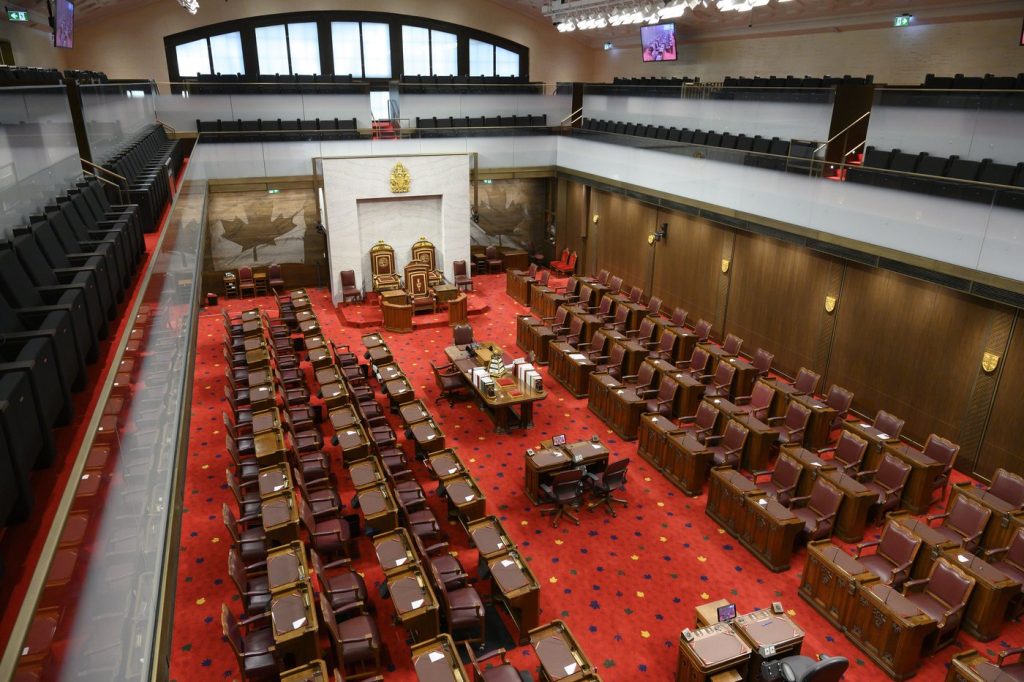
OTTAWA 0 Prime Minister Mark Carney recently made his inaugural appointments to the Canadian Senate, appointing four new senators, including his principal secretary Tom Pitfield and Conservative MP Richard Martel, both of whom will fill vacancies from Quebec. In a significant shift, Carney announced the removal of non-partisan criteria for appointments, indicating plans to revamp the independent appointments advisory committee established by the previous Prime Minister, Justin Trudeau.
The Senate, made up of 105 seats, includes 24 each from Ontario and Quebec, along with six from British Columbia, Alberta, Saskatchewan, Manitoba, and Newfoundland and Labrador. Additionally, New Brunswick and Nova Scotia each contribute ten senators, while Prince Edward Island contributes four, and each of the three territories has one senator. Presently, the Senate comprises 97 members, with eight vacancies, two of which will be filled by the swearing in of Pitfield and Martel. Newly appointed senators Geeta Tucker from Manitoba and Rodney Ouellette from New Brunswick are also now listed among the Senate members.
Unlike the House of Commons, the Senate is no longer strictly divided by political parties. Currently, 12 Conservative senators represent the only link to a political party, while the rest are either unaligned or belong to various groups, such as the Government Representative's Office, the Independent Senators Group, the Canadian Senators Group, and the Progressive Senate Group. The independent group is the largest, with 40 members, followed by the Canadian Senators Group with 18 members. Notably, the Conservative caucus had 41 senators in 2016.
Senators play a vital role in the legislative process, debating and voting on bills when Parliament is in session. They not only propose new legislation but also review and amend bills received from the House of Commons. For a bill to become federal law, it must receive approval from both houses of Parliament. Additionally, senators collaborate in committee meetings to discuss and evaluate various issues.
While there are no direct term limits for senators, they are required to retire at the age of 75, although their tenure can extend significantly based on their appointment age. For instance, Senator Patrick Brazeau, appointed in 2009, could serve for up to 40 years, with his mandated retirement date set for 2049. Senators are appointed by the Governor General based on recommendations from the Prime Minister, with eligibility criteria involving Canadian citizenship, age requirements, residency, and financial thresholds set for real estate ownership.
Since 2016, an independent advisory board for Senate appointments has been in place, providing non-binding recommendations to the Prime Minister regarding potential candidates. Current reports indicate there are 28 vacancies on this board, with Carney promising to announce changes to it later in July.
Under Trudeau's leadership, the Senate underwent several transformative changes. After Prime Minister Harper ceased appointments in 2013 amid attempts to reform the Senate, Trudeau took office with numerous vacancies. His administration aimed to diminish patronage appointments by establishing an independent advisory board to recommend nominees based on merit rather than party affiliation. Trudeau's approach led to an increase in qualified independent senators, with his administration appointing 100 individuals to the Senate, 80 of whom remain active members.
However, removing political parties from the Senate's operations has had notable consequences. Former Senate clerk Gary O'Brien commented on the complexity it introduced into the legislative process, noting that without a partisan alignment, deciding on amendments has become more cumbersome. Nonetheless, he acknowledged positive outcomes, such as achieving gender parity within the Senate, which occurred in late 2020. Political science professor Lori Turnbull highlighted that this independence has resulted in senators being more likely to propose amendments, adding unpredictability to the legislative agenda and complicating the passage of bills through the Senate.
In his recent changes to the Senate's structure, Carney emphasized a renewed focus on selecting applicants with expertise in Canadian strategic industries and regulatory frameworks, sidelining non-partisan criteria established by Trudeau. The implications of these adjustments on the Senate's future dynamics and its relationship with political parties remain to be seen.
This report was published on July 12, 2026.








