

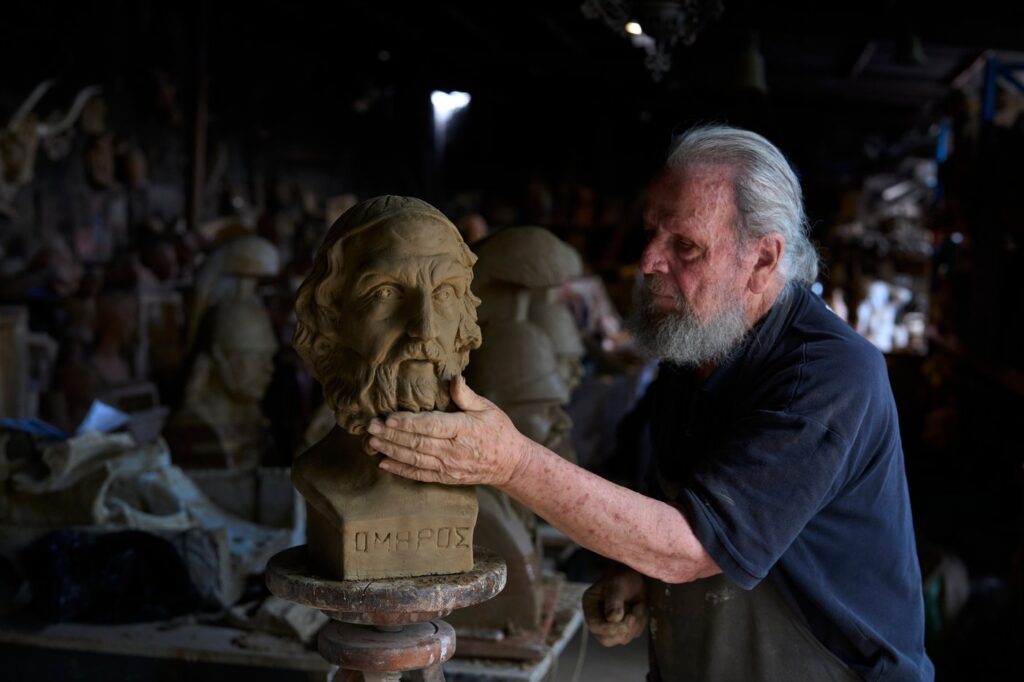
ATHENS, Greece (AP) — Christopher Nolan's much-anticipated film “The Odyssey” opens on Friday, and it arrives amid global excitement as well as some controversy regarding casting choices. Given that Homer's epic is a fundamental part of Greek education, many Greeks are keen to share their viewpoints on the adaptation.
In Greece, where “The Odyssey” is taught in all schools, conversation about adaptations often centers on their fidelity to the source material. However, many Greeks believe the epic's longevity is due not to strict preservation but to continuous reinvention. Filippos Mantzaris, who teaches the text to seventh graders, emphasizes that every new interpretation is a valuable creation. “What we want children to understand is that every new creation is exactly that — a new creation,” he stated.
The film features Matt Damon as King Odysseus, following the trajectory of Homer’s narrative: the king's arduous journey home from war, through divine obstacles and fierce monsters, ultimately confronting suitors overrun his palace. Students in Mantzaris' class engage passionately with these themes, discussing moral complexities such as revenge and the hero's dual nature, examining whether Odysseus’ actions are justified. These lessons encourage students to identify their own attributes with those of Odysseus, creating a relatable framework for understanding their heritage.
Comments from students like 12-year-old Kyriakos Agapiou reflect this understanding, noting that the reading has taught him, "That everything is possible and we should never give up." Nikos Varelas, a farming scientist, shared that he and his young son attended a stage adaptation after bonding over youth versions of both “The Iliad” and “The Odyssey.” “It is our duty as parents, as Greeks,” he articulated, highlighting the cultural significance of these narratives.
Actor Manos Pintzis, who portrayed Odysseus in a local production, argues that exposing children to the story through theater can deepen their understanding of mythology in ways that reading alone cannot achieve. "When the child sees all of this unfolding before their eyes—that becomes a valuable step toward learning," he elaborated, advocating that children should willingly engage with the material.
While the casting choices in Nolan's film have drawn scrutiny in the United States, particularly for the role of Helen of Troy played by Black actress Lupita Nyong'o, the controversy is less pronounced in Greece. Americans like Elon Musk have criticized Nolan's decisions, claiming that these choices undermine the story’s authenticity without having seen the film. Conservative commentators like Matt Walsh have echoed similar sentiments about identity politics in adaptations of beloved narratives.
Christopher Nolan, when asked about the backlash, claimed that such dialogues are part of the process, noting that "these conversations that happen before people see the film— they're always irrelevant.” He aims to make the film accessible while questioning traditional portrayals of ancient narratives, inviting audiences to reconsider their assumptions through a new lens.
Contrary to the concerns raised abroad, Greeks are accustomed to seeing foreign actors portray their historical figures. Notable examples include Gerard Butler as King Leonidas in “300,” Brad Pitt as Achilles in “Troy,” and Colin Farrell as Alexander the Great. Nolan’s adaptation continues this tradition, featuring a stellar cast, including Damon, Nyong'o, Anne Hathaway, Robert Pattinson, Zendaya, and Charlize Theron, accompanied by narration from rapper Travis Scott.
In the face of criticism from the small nationalist party Niki regarding the film's multi-ethnic casting and the Greek government’s financial support of approximately 6 million euros ($6.9 million) for the film, Culture Minister Lina Mendoni defended creative freedom. She firmly stated, “It is not the state’s role to dictate to a creator how they should artistically interpret a work or a myth.”
Ultimately, Christos Tsagalis, a professor at the Aristotle University of Thessaloniki, expressed that the merit of any new interpretation of “The Odyssey” rests with the audience’s judgment, focusing on whether it captures fundamental truths from the timeless tale. As Homer’s works have been retold and reinvented through the ages, they continue to resonate universally across cultures. Tsagalis remarked on the shared nature of these stories, stating, “I think it’s wonderful that something that is created at a specific point in time by a given people is shared by so many people across the globe.”








