

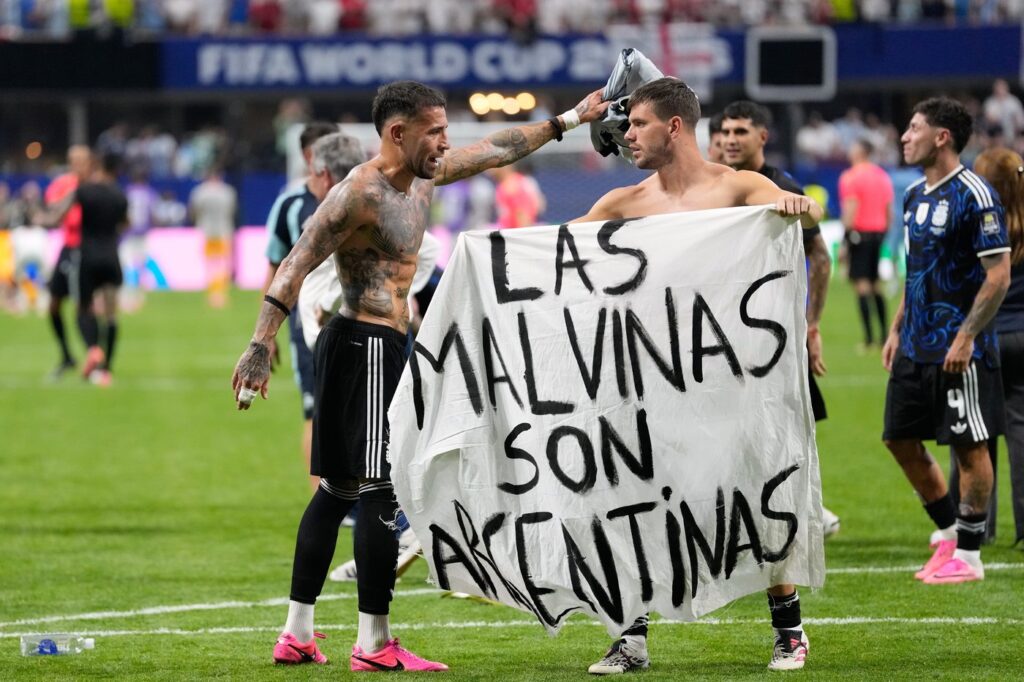
The British government has called upon FIFA to investigate Argentina's national football team following an incident where players celebrated a World Cup semifinal victory against England by displaying a banner asserting their claim over the disputed Falkland Islands. The banner, which read "Las Malvinas son Argentinas" ("The Malvinas are Argentine"), was presented to the players by fans during the post-match festivities.
Argentina triumphed over England with a score of 2-1 during the World Cup semifinal held on Wednesday in Atlanta. This display of national pride comes in the context of the long-standing territorial dispute between Argentina and the United Kingdom over the Falkland Islands, known as Islas Malvinas in Argentina. The islands were invaded by Argentina in 1982, leading to a ten-week war that ultimately resulted in British control.
U.K. Business Secretary Peter Kyle condemned the players' actions as "entirely inappropriate," expressing his expectation that FIFA conducts a thorough investigation into the matter. FIFA's disciplinary code addresses political messaging at stadiums, explicitly prohibiting any messages deemed "not appropriate for a sports event," which includes those of a "political, ideological, religious or offensive nature." Potential fines for such violations range from $5,000 to $20,000.
FIFA was approached for comments regarding the incident on Thursday. Similar disciplinary actions have been taken in the past; for instance, a South Korean player faced a ban for displaying a banner about a territorial dispute with Japan during the 2012 London Olympics. The player, Park Jong-woo, had raised the banner that proclaimed "Dokdo is our territory" as a celebration after a match against Japan.
During a press interaction, Argentina player Lisandro Martínez commented on the emotional implications of the banner, acknowledging its significance for veterans of the Malvinas conflict. "We couldn’t let the Argentine people down," said Martínez, who has been playing in England with Manchester United for the past four years.
Argentina-England Soccer Rivalry
The rivalry between Argentina and England extends beyond football, deeply intertwined with political tensions related to the Falkland Islands. This British overseas territory, home to approximately 3,500 residents, is situated around 8,000 miles (13,000 kilometers) from the U.K. and 300 miles (480 kilometers) from Argentina. Argentina claims that the islands were unlawfully seized from them in 1833, while Britain maintains its territorial history dates back to 1765, having sent a warship to the area to displace Argentine forces.
The conflict in 1982 resulted in the deaths of 649 Argentine troops, 255 British servicemen, and three islanders, leaving a lasting impact on both nations. This war coincided with the 1982 World Cup, where Argentina and England both participated. British television networks declined to air Argentina's opening game against Belgium due to the political sensitivities stemming from the conflict. Argentine player Leandro Paredes remarked on the emotional weight of the banner, acknowledging it as a painful chapter in history for all involved.
Politics in Soccer
Minister Kyle reiterated the need for separation between politics and football, emphasizing that one of the foundational principles of the World Cup is to maintain this distinction. "That is now a matter for FIFA," he stated. Questions surrounding FIFA's political neutrality have surfaced during this World Cup, particularly after FIFA President Gianni Infantino appeared to yield to pressure from U.S. President Donald Trump, allowing a player who received a red card to participate in a subsequent match.
Infantino's anticipated presence alongside Trump and Argentine President Javier Milei at the World Cup final adds another layer of complexity to the discourse surrounding FIFA's role and responsibilities as governing body of soccer.
Previous Cases
Argentina's football federation previously faced repercussions for similar political expressions. In June 2014, players showed the same "Las Malvinas son Argentinas" slogan during a warm-up match in Buenos Aires ahead of the World Cup in Brazil, resulting in a fine of 30,000 Swiss francs ($37,000) following the tournament.
Additionally, FIFA penalized Serbia for displaying a political banner regarding Kosovo during the 2022 World Cup, illustrating its commitment to regulating political messaging in soccer events. The Serbian federation was fined 20,000 Swiss francs ($24,800) for a banner depicting a map including Kosovo, which declared independence in 2008, alongside the slogan "No Surrender."








