

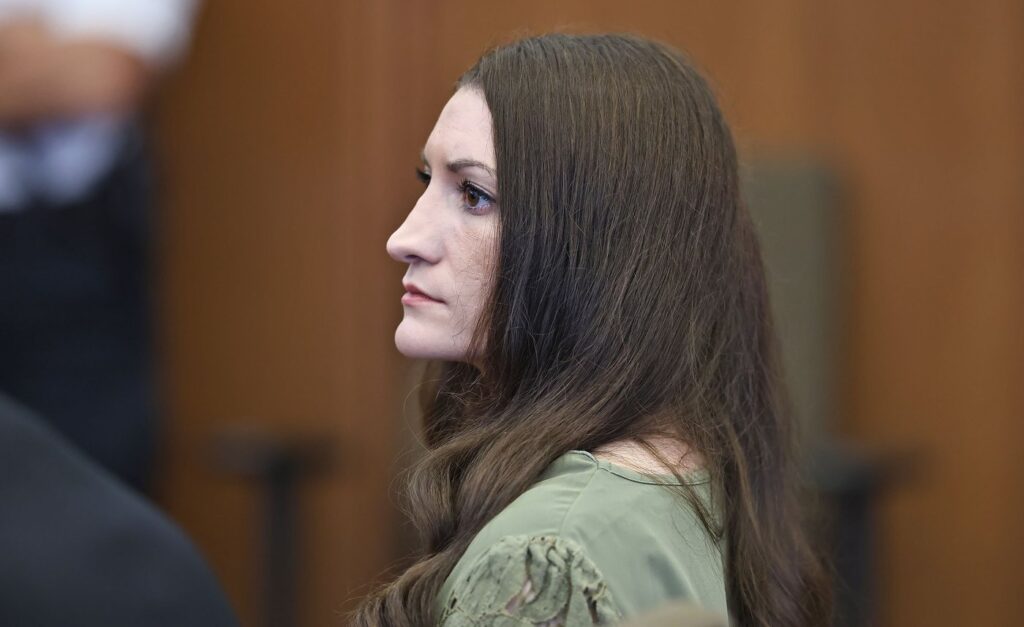
BOSTON (AP) — A lone juror's dissent prevented the acquittal of Lindsay Clancy, despite admitting doubts about her guilt during jury deliberations, as revealed by the jury's foreperson in a recent television interview.
This insight came to light in an NBC10 interview, four days after a judge declared a mistrial. The mistrial was the result of jurors failing to reach a unanimous verdict regarding Clancy's criminal responsibility for the deaths of her three young children in 2023.
Clancy, 36, a former labor and delivery nurse, did not contest the fact that she killed her children. However, her defense argued that she suffered from postpartum psychosis, a rare mental illness associated with extreme stress, hormonal changes, and sleep deprivation following childbirth.
Prosecutors contended that Clancy was aware of her actions and acted with intent when she strangled her five-year-old daughter Cora, her three-year-old son Dawson, and her eight-month-old son Callan using exercise bands. They asserted that Clancy had deliberately orchestrated her husband's absence by sending him out to pick up medication and dinner, setting the stage for the tragic events that followed.
In the NBC10 interview, foreperson Ronni Carlson discussed the jury's deliberations, mentioning that at one point, they believed they had convinced the holdout juror to change his vote to an acquittal. “He admitted he had reasonable doubt. I started filling out the forms, I was so excited. There were three forms I had to fill out, and I started filling them out. I wrote my signature on each one. And then he said, ‘But I’m still not going to say that she’s not guilty by reason of insanity,’” Carlson recounted.
Carlson expressed that evidence presented during the trial demonstrated Clancy's deep love for her children. She highlighted Clancy’s journals and testimony from family members as indicators that Clancy had experienced a severe mental break and did not comprehend her actions at the time of the tragedy.
While the identities of the jurors remain temporarily sealed by the judge, the holdout juror has yet to publicly share his perspective on the deliberation process. Throughout the trial, which spanned over 21 days, jurors received comprehensive testimony regarding Clancy's deteriorating mental health following the birth of her youngest child and insights from healthcare providers who treated her in the months leading up to the incident.
During deliberations, jurors reached out to the judge on three occasions, indicating they could not arrive at a unanimous verdict. The jury foreperson also sent a note expressing frustration that one juror would not adhere to the court’s instructions regarding reasonable doubt. Judge William Sullivan subsequently reminded the jurors of their responsibilities and encouraged them to continue deliberating.
Clancy's attorney, Kevin Reddington, expressed his belief that Clancy would have been acquitted if not for the resolve of a single juror. He remarked that “they were robbed by one man, for whatever his agenda was, who stole seven weeks of the life of these other jurors that were so attentive, so beautiful, so wonderful.”
If convicted of murder, Clancy could have faced a life sentence. Conversely, an acquittal could have led the judge to confine her to a mental health facility until a determination was made regarding her potential danger to the public upon release.
Following the mistrial, the repercussions and implications of this case continue to resonate, as the jury's struggle reflects the complex intersection of mental health, legal responsibility, and societal expectations surrounding tragic crimes.








