

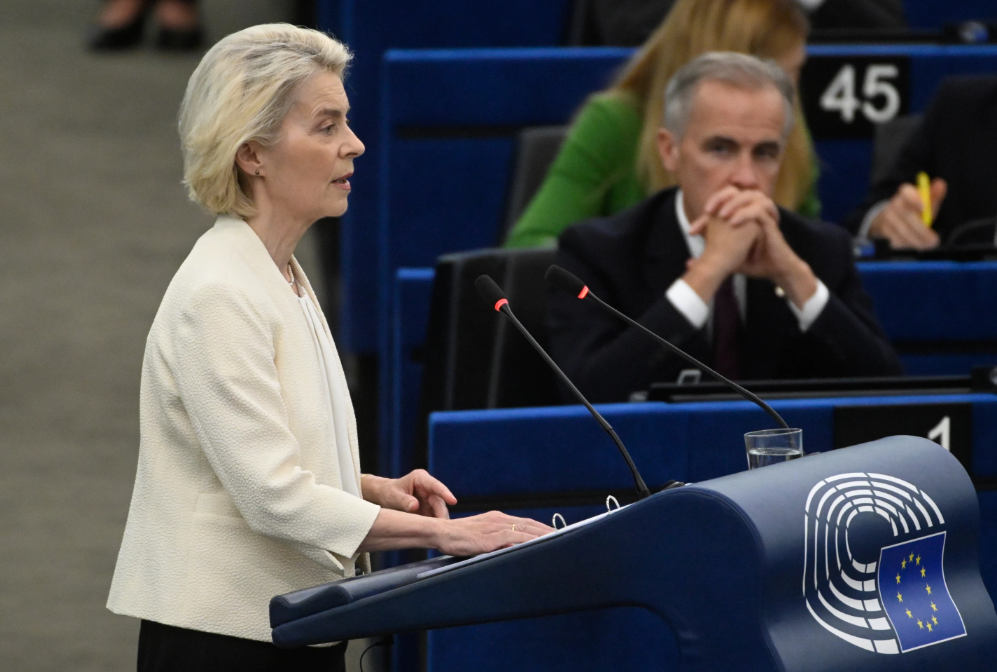
STRASBOURG, France (AP) — European Commission President Ursula von der Leyen has proposed making Canada the European Union’s first associate member, an unexpected move that reflects a shift in diplomatic dynamics driven by U.S. President Donald Trump’s policies. Trump's imposition of tariffs and his provocative suggestions regarding Canada potentially becoming the “51st state” fostered a need for Ottawa to lessen its dependency on the U.S. market, which absorbs about 70% of Canadian exports. In this context, Canadian Prime Minister Mark Carney has signaled the importance of establishing a “unique alliance” with the EU.
In her annual State of the European Union address, von der Leyen noted that Canada and the EU aim to build on their existing free trade agreement, known as CETA, to cultivate a broader “Alliance for the Future.” This initiative is designed to foster economic connectivity and shared welfare underpinned by mutual democratic values.
“Above all, dear Mark, Europe and Canada believe in democracy,” von der Leyen said directly to Carney, who was lauded with a standing ovation from the European Parliament. Following von der Leyen’s remarks, Carney is scheduled to address the Parliament the next day.
A Canadian official familiar with ongoing discussions indicated that Ottawa is in the process of evaluating a strategic partnership with the EU that may not completely align with full membership; the priority would be to create an arrangement permitting Canadian citizens to live and work in Europe visa-free.
Carney’s office expressed approval of von der Leyen’s proposal, underscoring that deepening ties with the EU is pivotal for enhancing Canada’s sovereignty. The collaborative vision goes beyond trade to encompass advanced manufacturing, technology, defense production, the Arctic, energy, critical minerals, and cybersecurity.
Von der Leyen articulated that this expanded partnership is not intended to target other parties but instead aims at fostering collective strength. “In short, we want to bring the relationship with Canada to the highest level possible,” she remarked.
Canada’s potential status as the EU’s first associate member would necessitate navigating uncharted territory, as there currently exists no framework defining what such membership would entail in practical terms. Approval processes for any new EU membership require unanimous consent from all 27 member nations.
The concept of associate membership has been previously suggested for countries such as Ukraine and post-Brexit Britain, but tangible advancements have yet to materialize. Tobias Cremer, a member of the European Parliament from Germany, emphasized the urgency for both parties to progress beyond mere positive rhetoric and to establish more substantial foundations for collaboration.
“Now is the time to stop sending each other love letters and put meat on the bone,” stated Cremer, advocating for an ambitious framework exceeding basic trade or defense agreements. He proposed that existing structures like CETA should be fully utilized and expanded to facilitate a more comprehensive strategic alliance, underscoring that the spur for closer relations is increasingly driven by geopolitical as well as economic factors.
Moreover, Canada’s recent admission as the first non-European nation into the EU's €150 billion ($173 billion) SAFE defense program enables Canadian enterprises to participate in joint defense procurement as Europe seeks to bolster its defense capacity.
Iratxe García Pérez, the president of the Socialists & Democrats group in the European Parliament, praised Carney's courage in confronting Trump and highlighted the need for allies that uphold “sovereignty, solidarity, and international law.” Carney noted that economic integration, previously perceived largely as a benefit, is now used as a tool by some nations to exert influence.
The Canada-EU summit in Montreal, scheduled for late October, is poised to escalate discussions surrounding these emerging partnerships. Through their recent engagements, both Carney and European leaders emphasize the shared importance of middle powers collaborating to strengthen their negotiating positions in the global arena.
Carney has responded aggressively to U.S. tariffs and has denounced trade proposals that would impair Canadian sovereignty. In contrast, the EU has sought a more conciliatory stance toward the U.S., achieving a trade agreement that limits U.S. tariffs on most EU exports and eliminates tariffs on U.S. industrial goods.
This juxtaposition underscores the urgency of Canada’s initiative to advance European ties amid an increasingly complex international backdrop. While Carney advocates for collaboration among middle powers, he warns against the dangers of negotiating from a position of weakness with a dominant actor.
Notably, Carney’s speech at the World Economic Forum in Davos earlier this year intensified scrutiny, resulting in sharp commentary from Trump, highlighting the potential diplomatic tensions that von der Leyen’s proposal could engender.
Barry Andrews, chair of the European Parliament’s Development Committee, referred to Canada as “a perfect ally for Europe,” suggesting that strengthened ties could be especially advantageous for Ireland, given the significant number of Canadians claiming Irish heritage.








