

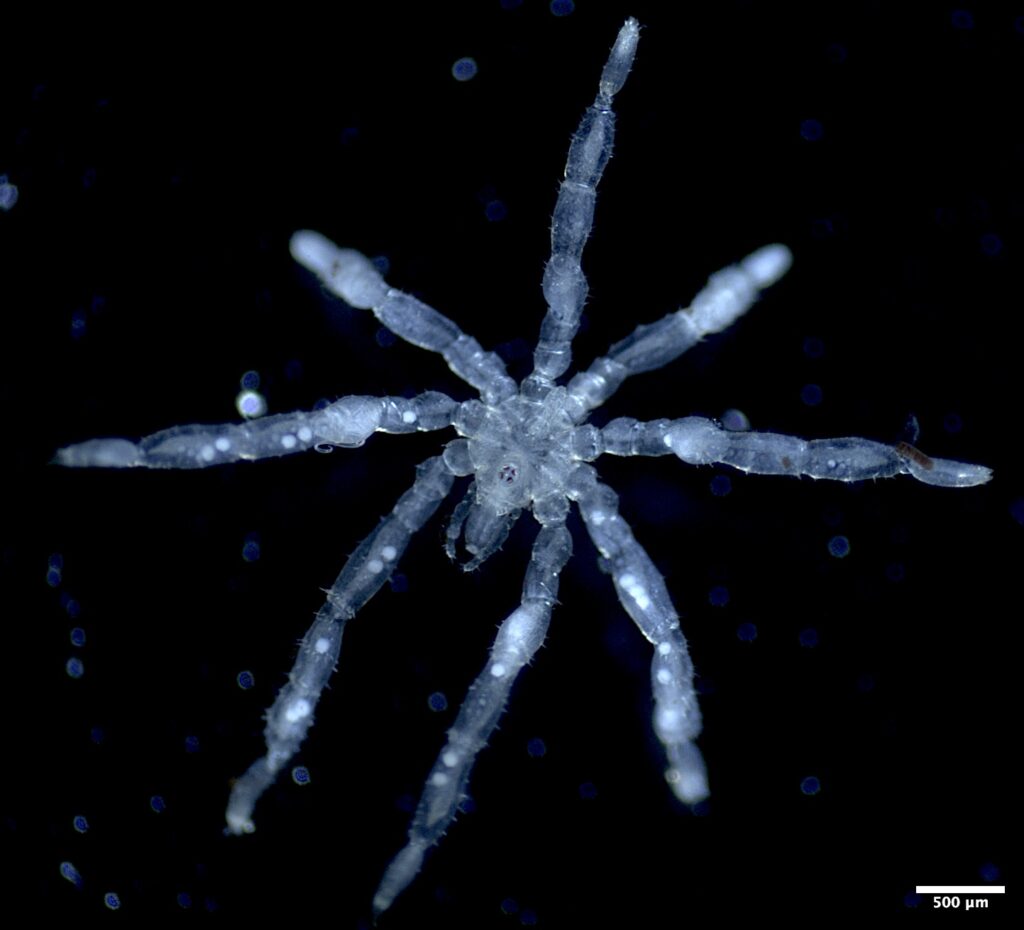
The Salish Sea, off the coast of British Columbia, has unveiled two new species of sea spiders, marking a significant discovery as it is the first documentation of such species in the region in nearly a century. The research was led by Cormac Toler-Scott, a zoologist from the University of British Columbia (UBC), who announced the findings through a press release.
The tiny marine arthropods, commonly referred to as sea spiders, were collected between September 2023 and August 2024 from various locations including Vancouver, Quadra Island, Bamfield, and Victoria. Notably, despite their name, sea spiders are not true arachnids.
One of the newly discovered species is named Callipallene pilosuspedes. The term "pilosuspedes" is derived from Latin, meaning "hairy feet," which aptly describes this creature, featuring long, curved spines that cover its lower legs. UBC highlights that Callipallene pilosuspedes showcases distinct physical traits, such as red eyes, a short proboscis equipped with claws for grasping food, and a triangular, three-lipped mouth adorned with sensory tendrils, likening its appearance to a "tiny marine Sarlacc pit." Moreover, this species possesses specialized appendages utilized for self-grooming.

The second species identified is Tanystylum kiixin, pronounced "kee-hin." This species is named after an ancient Indigenous village located near its discovery site. In contrast to Callipallene pilosuspedes, Tanystylum kiixin is characterized by its small limbs and limited self-grooming abilities, often appearing covered in debris and tiny parasites. Toler-Scott noted that this phenomenon creates "an ecosystem within an ecosystem within an ecosystem."

Sea spiders have a long evolutionary history, dating back approximately 500 million years, and are related to scorpions, spiders, and horseshoe crabs. They can possess up to 12 legs and vary in size from less than a centimeter to over 70 centimeters. Toler-Scott noted that many shallow water species are relatively small and tend to live as parasites on larger organisms, utilizing a specialized proboscis to extract nutrients from their hosts.
The newly identified species have been officially registered in a global database, and Toler-Scott expressed optimism about the potential for discovering even more diversity in the Salish Sea. He remarked, "I only had one field season, but there's definitely more diversity out there that we haven't documented."








