

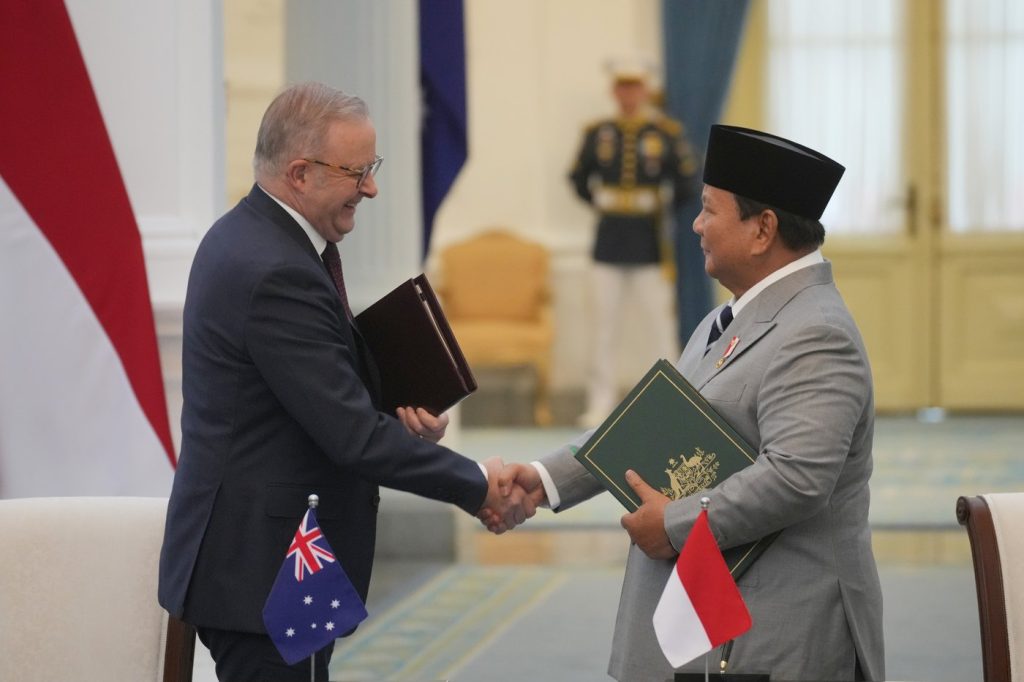
On February 6, 2026, in Jakarta, Indonesia, leaders from Indonesia and Australia formalized a new bilateral security treaty aimed at bolstering the often-fractious relationship between the two nations. This agreement was signed by Australian Prime Minister Anthony Albanese and Indonesian President Prabowo Subianto just three months after they announced the conclusion of negotiations in Sydney. The treaty seeks to build on previous security agreements established in 1995 and 2006.
Prime Minister Albanese described the treaty as a "watershed moment" in Australia’s relations with Indonesia, the country it recognizes as a major regional neighbor. In a statement made prior to his arrival, he expressed that the agreement represents a significant expansion of existing security and defense cooperation, indicating that the bilateral relationship is currently "as strong as it has ever been.” Accompanying him was Foreign Minister Penny Wong, who emphasized the treaty's importance, marking it as the most significant step in their partnership in three decades.
The necessity of the treaty has grown particularly acute for Australia in light of increasing tensions with China in the Asia-Pacific region. While the treaty echoes the sentiments of a previous security agreement signed in 1995, which was later terminated by Indonesia, it aims to fulfill a modern commitment to mutual consultations on security concerns. The 1995 agreement involved consultations on security and a joint response to various challenges, though it was dissolved following Australia's leadership of a peacekeeping mission in East Timor.
The 2006 Lombok Treaty sought to mend the deteriorating security relationship and was subsequently expanded in 2014. However, analysts, such as Susannah Patton from the Lowy Institute, note that the new treaty is more about affirming political consultations rather than establishing a concrete mutual defense framework. Patton referred to the agreement as largely "symbolic," and expressed doubt that it would define Indonesia's obligations to assist Australia in the event of a regional threat, particularly because of Indonesia's non-aligned stance, which avoids entanglements in military alliances.
Despite the treaty's limitations, Patton commended it as a significant achievement for Albanese, noting the improbability of such an accord being established given Indonesia's historical reluctance towards military agreements and the differing worldviews held by the two nations. Furthermore, she highlighted that under President Prabowo, Indonesia appears more open to modernizing its foreign policy and engaging in leader-led agreements.
Albanese's visit to Indonesia, indicated as his fifth official trip, is part of a broader strategy to deepen cooperation not only in security matters but also across trade, investment, education, and development sectors. His schedule includes discussions with Prabowo and other Indonesian officials until his return to Australia.
The relationship between Indonesia and Australia, despite being characterized as one of the most important in the region, has been marked by numerous challenges, including historical tensions such as allegations of Australian surveillance on Indonesian officials, executions of Australian drug smugglers, and issues surrounding people smuggling.








