

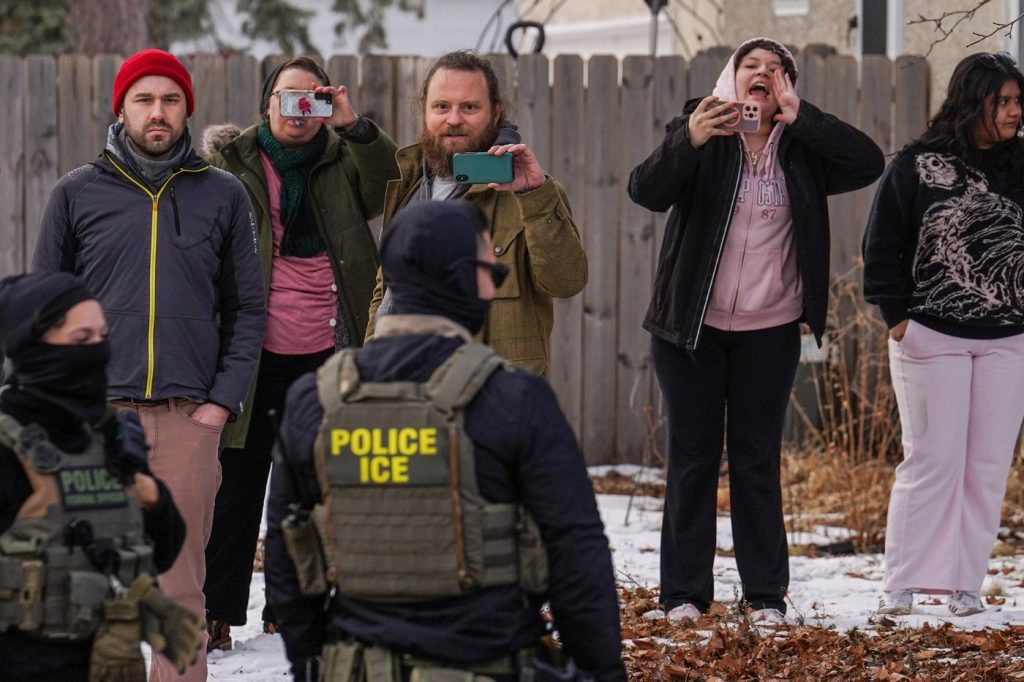
Federal authorities have initiated an investigation into two immigration officers following allegations of untruthful statements made under oath related to a shooting incident in Minneapolis that occurred on January 14, 2026. This investigation arises amid a series of five different shootings in which the accounts provided by immigration officials were later contradicted by video evidence.
Among these incidents were the fatal shootings of Renee Good on January 7, 2026, and Alex Pretti on January 24, 2026, both in Minneapolis. The narratives presented by officials in these cases were quickly challenged by bystander footage. The recent federal probe coincides with the dismissal of felony assault charges against two Venezuelan men, Julio Cesar Sosa-Celis and another unnamed individual, who were accused of attacking an Immigration and Customs Enforcement (ICE) officer. The officer in this incident discharged his weapon, injuring Sosa-Celis.
Initially, federal authorities including Homeland Security Secretary Kristi Noem characterized the January 14th shooting involving Sosa-Celis as an ambush, claiming the officer acted out of fear for his life and referring to the event as an attempted murder of federal law enforcement. However, by the time of a January 21 court hearing, discrepancies in the accounts of the officer and three eyewitnesses suggested inconsistencies with the official narrative. Crucially, video evidence did not corroborate the officer's claims of being attacked.
In the case of Renee Good, her shooting was described by Noem as an act of domestic terrorism, suggesting she attempted to run over ICE officers with her SUV. It was claimed that the immigration agent shot defensively in self-protection. However, subsequent video recordings indicated Good's vehicle was parked, and she was not aggressive. Eyewitness accounts further complicated the established narrative, revealing that moments before the incident, Good had expressed non-hostility to the officers.
Similarly, Alex Pretti’s shooting was initially portrayed by Homeland Security as a situation where Pretti approached Border Patrol officers with a handgun and aggressively resisted efforts to disarm him. Nonetheless, the available bystander videos contradicted this assertion, showing that Pretti was holding his mobile phone, and he did not appear to pose a threat to the officers. An investigation revealed he was retreating during the incident, raising significant questions about the justification for the deadly use of force.
Additionally, the shooting of Silverio Villegas González on September 12, 2025, depicted officials claiming he was pursuing agents aggressively, allegedly dragging one officer with his vehicle. However, body camera footage later showed the officer who shot González exhibiting no sign of serious injury, directly challenging the official narrative of the event being life-threatening. An autopsy ultimately classified González's death as a homicide, making clear that he was shot at close range.
Lastly, the shooting of Marimar Martinez on October 14, 2025, in Chicago was noted as another incident showcasing federal agents labeling her a domestic terrorist. Initially, it was alleged that she chased a Border Patrol vehicle and posed a threat, leading to the officer discharging his weapon multiple times. Yet video evidence surfaced suggesting the officer had provoked the incident by intentionally steering his vehicle into Martinez's truck.
These incidents reflect a troubling trend of conflicting accounts between immigration enforcement actions and the reality depicted by available video evidence, prompting federal authorities to scrutinize the conduct of ICE and Border Patrol officers more closely. The growing number of cases where initial reports by federal agents have been debunked raises significant concerns about transparency and accountability within immigration enforcement agencies.








