

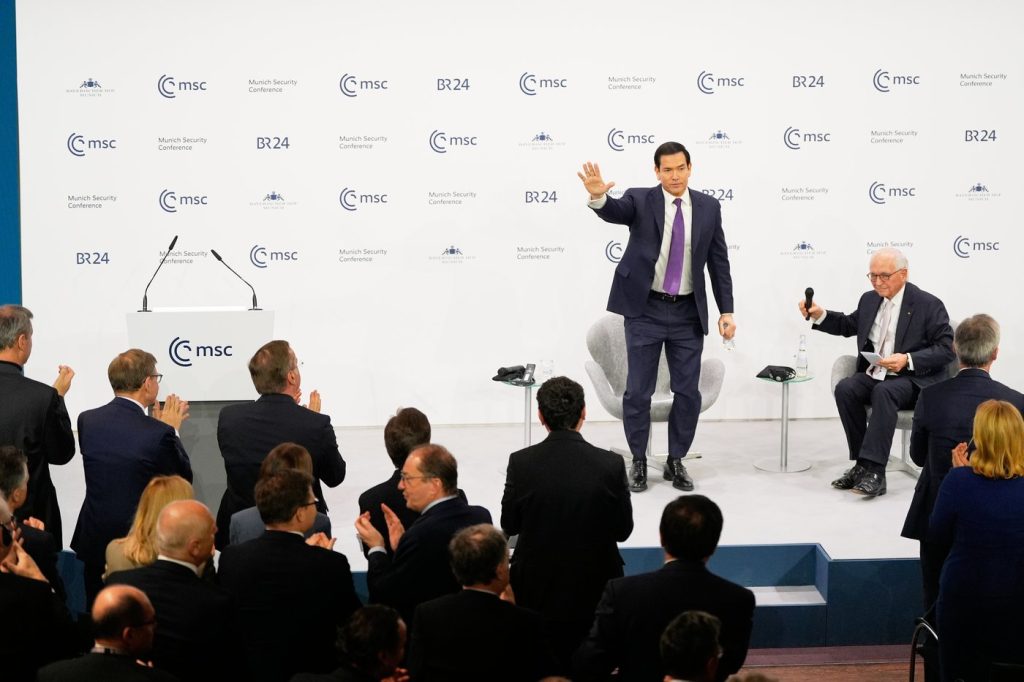
MUNICH (AP) — U.S. Secretary of State Marco Rubio delivered a calm and reassuring message to America's allies at the Munich Security Conference on Saturday, taking a less aggressive but still firm stance regarding the Trump administration's intent to reshape the trans-Atlantic alliance. This followed over a year of President Donald Trump's frequently hostile rhetoric aimed at traditional allies.
Rubio emphasized America's historical ties to Europe, asserting that the United States would remain closely linked to the continent even as it advocates for changes in their relationship and in the international institutions that have supported the post-World War II order. His remarks came a year after Vice President JD Vance shocked the same audience with a harsh critique of European values, following a series of Trump administration statements that targeted allies, including recent threats to impose tariffs on European countries to assert U.S. control over Greenland, a territory of NATO ally Denmark.
The conference opened with German Chancellor Friedrich Merz calling for the United States and Europe to "repair and revive trans-Atlantic trust together." He highlighted that the U.S. is not powerful enough to navigate the complexities of the modern world alone and reaffirmed Europe's stance on free speech and climate change while rejecting any form of protectionism.
Rubio argued that the post-Cold War "euphoria" led to a "dangerous delusion" that the world had reached an endpoint where every nation would become a liberal democracy, potentially overlooking the importance of national identities. "We made these mistakes together and now together we owe it to our people to face those facts and to move forward to rebuild," he said, emphasizing that under Trump, the U.S. would focus on renewal and restoration.
He acknowledged that while Americans can be direct and urgent in their counsel, it is crucial for the U.S. to demand seriousness and reciprocity from its European allies. "In a time of headlines heralding the end of the trans-Atlantic era, let it be known and clear to all that this is neither our goal nor our wish," Rubio stated, reaffirming America's enduring connection to Europe. He noted, "For us Americans, our home may be in the Western hemisphere, but we will always be a child of Europe."
Furthermore, he reflected on the shared history of conflict and reconciliation between the U.S. and Europe, highlighting their joint sacrifices in various global conflicts. "And I'm here today to make it clear that America is charting the path for a new century of prosperity, and that once again, we want to do it together with you, our cherished allies and our oldest friends," he asserted.
Rubio also acknowledged the United Nations as having "tremendous potential," but criticized its inability to address contemporary challenges effectively, stating that it has played virtually no role in pressing global matters. In stark contrast, Chinese Foreign Minister Wang Yi, speaking immediately after Rubio, suggested that the inadequacies of the current international system arise not from the UN itself but from countries that magnify differences and pursue national priorities that disrupt cooperation and trust.
Overall, Rubio's speech sought to reassure European allies of America's commitment to collaboration, while addressing the need for a renewed understanding and partnership amidst the changing geopolitical landscape.








