

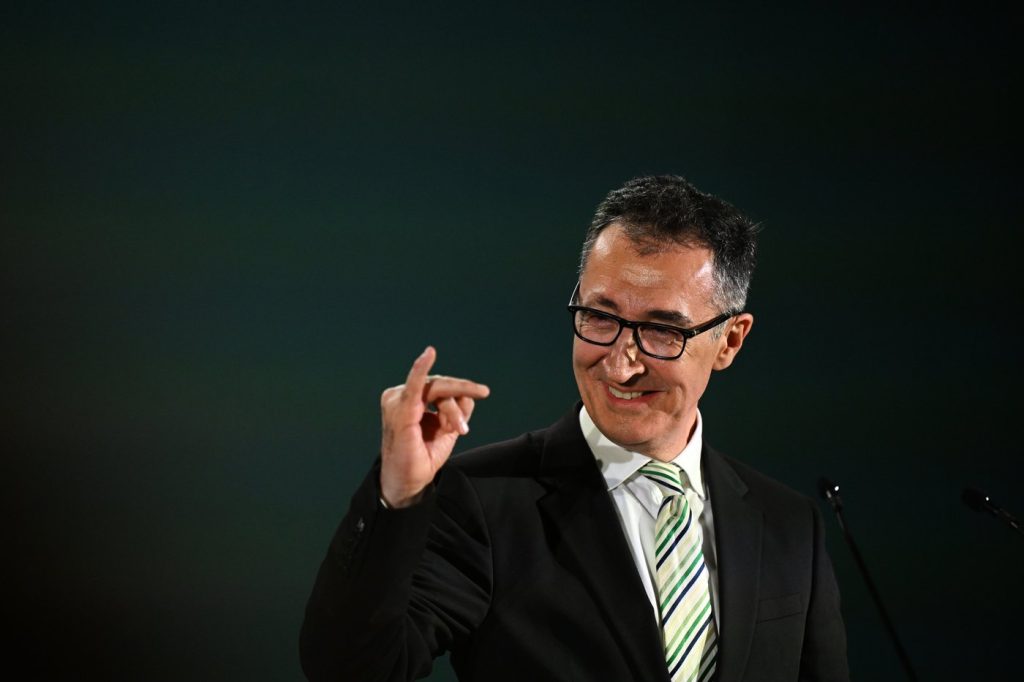
BERLIN - Chancellor Friedrich Merz's party has faced a challenging start in a crucial year filled with German state elections, marked by a narrow defeat in Baden-Württemberg, an important industrial area where the environmentalist Greens, led by Cem Özdemir, managed to secure a surprising victory.
The Christian Democratic Union (CDU), Merz's center-right party, was optimistic about reclaiming the governorship in Baden-Württemberg, a key region with over 11 million residents and home to major automotive companies like Mercedes-Benz and Porsche. This election was particularly significant as the region's first and only Green governor, Winfried Kretschmann, announced his retirement after 15 years of leadership in a traditionally conservative stronghold.
Despite the CDU's initial confidence, heightened competition emerged as the election approached, primarily due to a focused campaign by the Greens. Cem Özdemir, a well-known federal lawmaker and former agriculture minister, became the central figure for the Greens, challenging the CDU's expectations. Final results released on Monday indicated that the Greens received 30.2% of the votes, narrowly edging out the CDU, which garnered 29.7%. While this reflected a gain for the CDU compared to five years ago, it ultimately did not translate into a win. In contrast, the far-right Alternative for Germany (AfD) saw a significant rise in support, doubling to 18.8%, indicating its growing popularity following last year’s national election. The CDU's coalition partner, the Social Democrats, experienced a significant downturn, losing half their support and polling at only 5.5%.
Özdemir emphasized his experience and capitalized on the Greens' relatively moderate stance in Baden-Württemberg, a stark contrast to their more progressive image at the federal level. His opponent, CDU candidate Manuel Hagel, struggled to gain recognition and faced setbacks, including a recently resurfaced video from 2018 in which he made controversial remarks about a young student, further complicating his campaign efforts.
The CDU and Greens are expected to continue their coalition governance in Baden-Württemberg, as they have for the past decade, with Özdemir poised to become Germany’s first state governor of Turkish descent. Following this election, four more state elections are scheduled for 2026, with the next one taking place on March 22 in Rhineland-Palatinate, where the incumbent Social Democrats face stiff competition from the CDU.
Upcoming elections in September will include Berlin and two eastern regions, where the AfD is particularly strong and rumored to be eyeing its first state governorship. Jens Spahn, the parliamentary leader for the conservatives, expressed disappointment at the election outcome, characterizing it as "bitter" while highlighting his party’s slight vote increase. He argued that Özdemir’s victory arose from downplaying his Green affiliation and claimed that recent federal government performance, particularly in foreign policy, had bolstered their position.
Chancellor Merz, who has recently engaged in international diplomacy with visits to Washington and Beijing, has faced scrutiny for his foreign policy focus, which some observers believe detracts from his party’s domestic appeal. Political science professor Uwe Jun noted that while Merz’s international presence is commendable, real gains for the CDU will require noticeable improvements in social and economic policies within Germany.








