

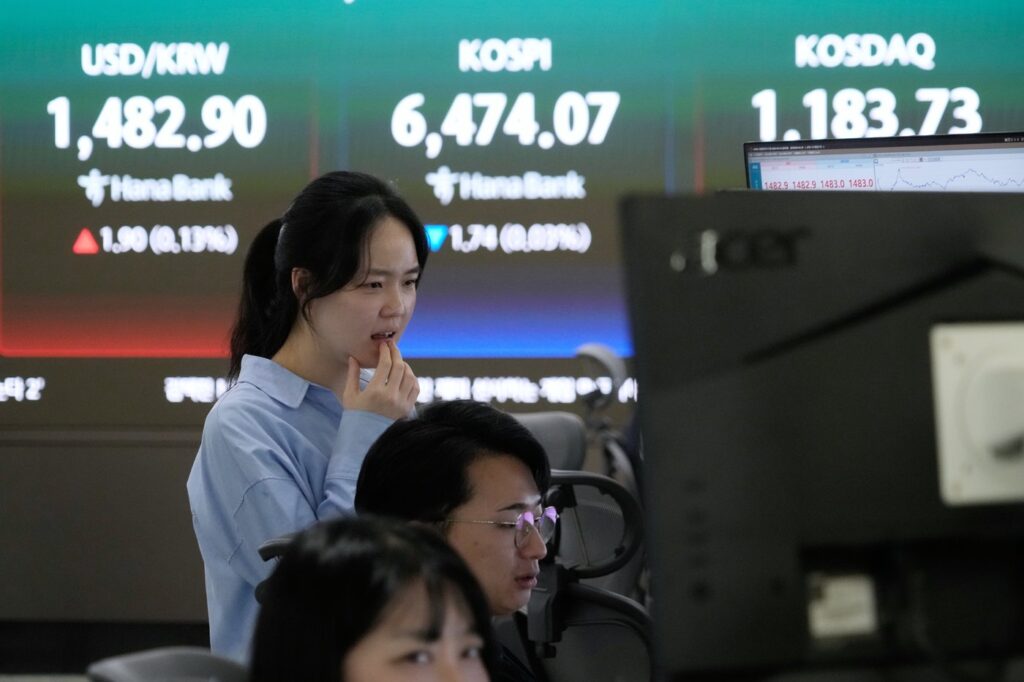
HONG KONG (AP) – Asian stock markets experienced a downturn on Friday, with notable declines in major indices, while oil prices continued to rise amid ongoing tensions related to the U.S.-Iran conflict. Negotiations aimed at achieving a peace agreement between the two nations remain stalled, contributing to an air of uncertainty in the global market.
U.S. futures indicated a slight decline following Wall Street's pullback from its recent all-time highs. The Nikkei 225 in Tokyo rose by 0.6%, closing at 59,504.22, supported by robust buying in technology stocks. This index had previously marked a record intraday high surpassing 60,000. Meanwhile, Hong Kong's Hang Seng index saw a decrease of 0.8% to 25,714.99, and the Shanghai Composite index fell by 0.5%, ending the day at 4,071.52. In South Korea, the Kospi index dropped by 0.4% to close at 6,452.33, while the S&P/ASX 200 in Australia declined by 0.6% to finish at 8,745.00. In contrast, Taiwan's Taiex index achieved a 2.5% increase, buoyed by a strong performance from chipmaker TSMC, which gained over 4%.
Negotiations for peace between the United States and Iran have shown limited progress. On Tuesday, President Donald Trump announced an indefinite extension of a two-week ceasefire with Iran, a day before its deadline. The situation is further complicated by tensions in the Strait of Hormuz, a vital passage for global oil and gas trade that remains largely closed due to a U.S. sea blockade on Iranian ports. In response to this blockade, Iran launched attacks on three ships in the strait, seizing two of them on Wednesday. Trump has since ordered U.S. military forces to intensify mine-clearing operations in the strait and authorized them to respond with lethal force against Iranian boats laying mines.
Since the onset of the conflict on February 28, oil prices have surged significantly. On Thursday, Brent crude for June delivery increased by 3.1% to close at $105.07, briefly exceeding $107 during trading. The July contract, more favored by traders, settled at $99.35 after reaching a high of $101. Early Friday, Brent crude was trading at $99.70 a barrel, up 0.4%, while U.S. benchmark crude saw a 0.6% rise, reaching $96.62 per barrel. The ongoing energy crisis stemming from the Iran conflict has intensified inflation pressures globally and unsettled markets.
Despite these challenges, Wall Street has continued to hit record highs, backed by strong corporate earnings and a glimmer of hope for an eventual resolution to the conflict. Analysts at ING Bank noted that the S&P 500's proximity to record levels has given markets a degree of comfort, allowing for more time for negotiations. On Thursday, however, the S&P 500 slipped by 0.4% to 7,108.40, ending a weeks-long rally. Other indices followed suit: the Dow Jones Industrial Average fell by 0.4% to 49,310.32, and the Nasdaq composite saw a 0.9% decrease, concluding at 24,438.50.
Amid these fluctuations, shares of Tesla experienced a 3.6% drop despite the company reporting stronger-than-expected quarterly results. Investors were concerned about a significant increase in capital expenditures as Tesla shifts its focus towards artificial intelligence and robotics. Additionally, Paramount Skydance shares declined by 4.5% after Warner Bros. Discovery shareholders approved a merger with Paramount, while Warner Bros. Discovery's shares also saw a 1.6% decrease.
On the commodities markets, gold and silver prices both fell, with gold dropping by 0.7% to $4,689.60 per ounce and silver declining by 0.8% to $74.92 an ounce. The U.S. dollar strengthened against the Japanese yen, rising to 159.83 yen from 159.71, while the euro traded at $1.1677, down from $1.1683.








