

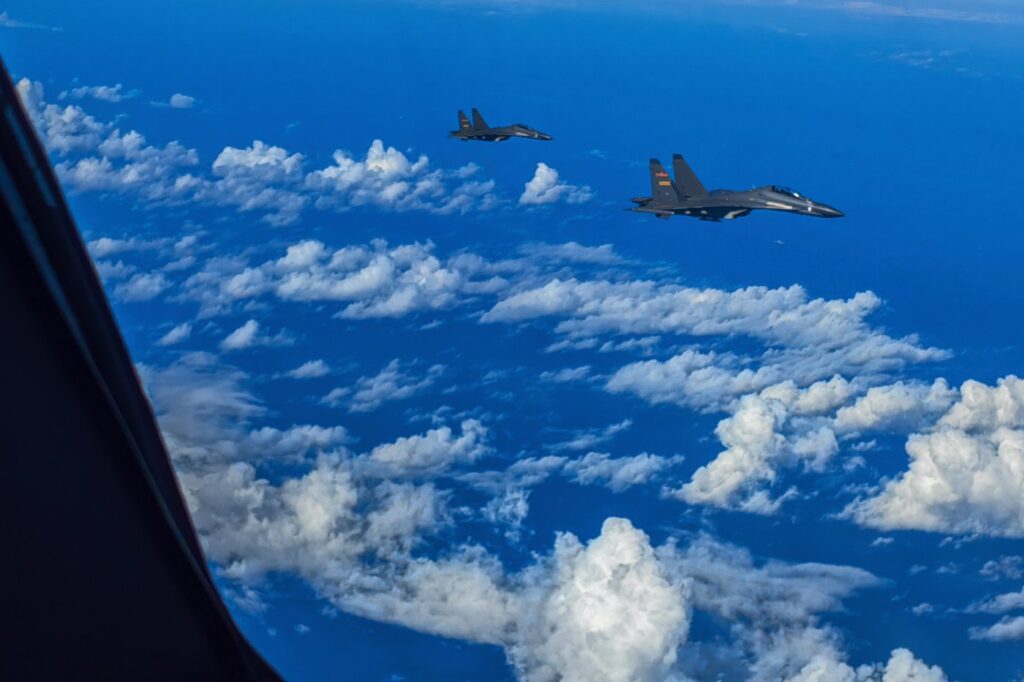
HONG KONG (AP) — Taiwan's defense ministry reported a significant increase in the presence of Chinese military aircraft near the island, with 26 military planes detected on a recent Saturday. Out of these, 16 aircraft entered Taiwan's Air Defense Identification Zone (ADIZ), which encompasses the northern, central, and southwestern regions of the island. Additionally, seven naval vessels were reported in proximity to Taiwan.
This surge in military activity comes on the heels of a notable decline in such flights, which had left analysts pondering the reasons behind the unexpected decrease over the previous two weeks. Notably, Taiwan had not detected any Chinese military aircraft crossing the median line into its airspace for a week, from February 27 to March 5. Following a couple of detected planes on March 6, no flights were reported for the next four days. However, air traffic resumed with small numbers reported between Wednesday and Friday of the same week.
The timing of the drop coincided with China's annual legislative meeting, during which military flights have historically been reduced. However, this year's decline was particularly conspicuous compared to previous years. Analysts suggest that the meeting cannot solely account for the falloff, as there could be broader strategic considerations at play. Some speculate that China might be attempting to ease tensions with Washington just weeks before a scheduled visit by U.S. President Donald Trump, set for March 31 to April 2. While the White House has confirmed Trump's itinerary, Beijing has yet to provide official acknowledgment.
Moreover, observers posited that the decline in military activity might signify a transition to a new phase in China's military training and modernization efforts. This would indicate a potential shift towards developing a different model for joint training within its armed forces. Historically, China has indicated its intentions to reclaim Taiwan, using military force if deemed necessary. Consequently, Beijing has dispatched warplanes and naval ships toward the island with alarming regularity in recent years.
In response to the recent fluctuations, Taiwan's military has maintained a steady defense posture, asserting that it would not alter its strategies due to the temporary decline in Chinese military maneuvers. Defense Minister Wellington Koo emphasized that, while military flights have decreased, China’s navy has continued to be active in nearby waters. This suggests that, despite the variations in air power presence, the overall military activity in the region remains a point of concern for Taiwan.
Since 1949, Taiwan has been governed separately from mainland China, following the rise of the Communist Party in Beijing after a protracted civil war. The defeated Nationalist Party fled to Taiwan, where the island eventually evolved from a period of martial law to a functioning multiparty democracy.








