

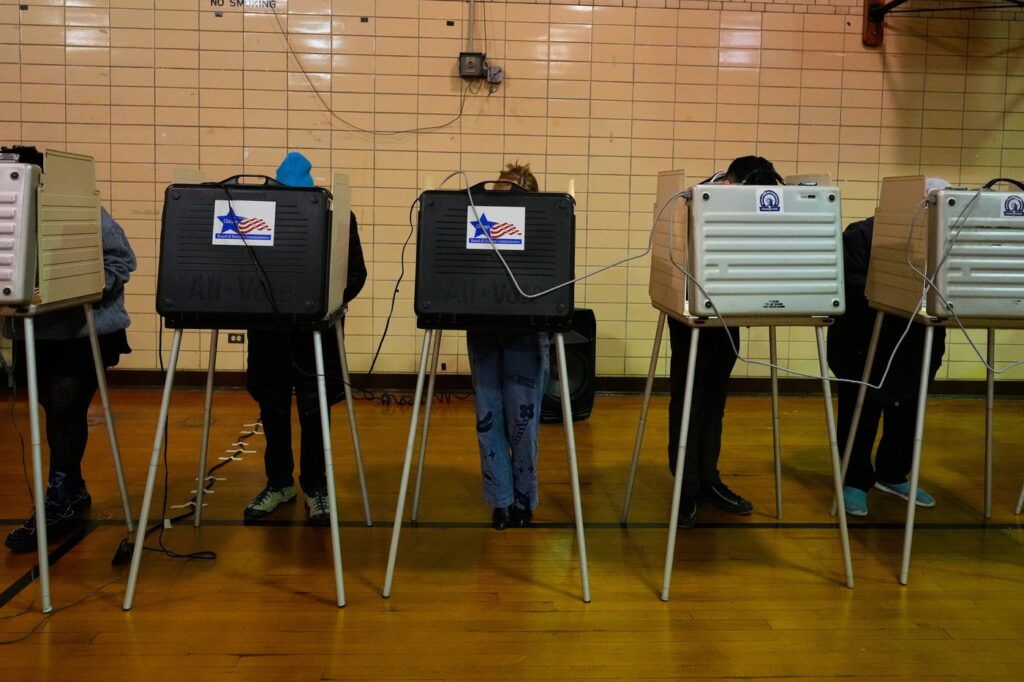
The Senate is currently engaged in a debate regarding the Safeguard American Voter Eligibility Act, also known as the SAVE America Act. As discussions unfold, misinformation about the bill's implications for voter registration is proliferating on social media. This environment has given rise to interpretations from elected officials across the political spectrum.
Senator Tammy Duckworth, a Democrat from Illinois, posted on X, alleging that the SAVE Act prohibits the use of driver’s licenses for voter registration, suggesting that Republicans prefer individuals to purchase passports instead. Duckworth characterized this requirement as a modern-day poll tax, highlighting the financial burden it could impose. In response, Senator Mike Lee, a Republican from Utah, labeled Duckworth's claim as false. He referenced a section of the proposed legislation that mandates states create processes for applicants who lack the necessary proof of U.S. citizenship.
Upon inspection, the truth reveals a more nuanced picture. The assertion that driver’s licenses cannot be used for voter registration is presented without essential context. Under the SAVE America Act, driver’s licenses that verify citizenship, such as Enhanced Driver's Licenses (EDL), may be permissible for voter registration in specific states. With the bill having passed the House, it is now under discussion in the Senate. For individuals lacking such documentation, or those residing in states that do not issue EDLs, alternative proof will be required.
Experts in the field acknowledge the limitations of standard driver’s licenses. Pamela Smith, the president and CEO of Verified Voting, clarifies that "most driver’s licenses, the purpose of it is to license you to drive; it’s not designed to prove your citizenship.” The SAVE America Act stipulates that individuals registering to vote in federal elections must present "documentary proof of United States citizenship." Acceptable forms of proof could include REAL ID-compliant identification that verifies citizenship, a valid U.S. passport, or other government-issued IDs indicating the applicant's birthplace.
While many people can obtain a REAL ID, it is important to note that only a select number of states, specifically Michigan, Minnesota, New York, Vermont, and Washington, issue Enhanced Driver's Licenses. These licenses are compliant with REAL ID standards and can verify both identity and citizenship. Other states are currently assessing the implementation of citizenship markers on their driver's licenses, with states such as Montana, South Dakota, Florida, and Iowa taking steps towards this approach.
Eliza Sweren-Becker, deputy director of the Brennan Center for Justice, emphasizes that for the vast majority of Americans, a REAL ID alone may not suffice for voter registration under the SAVE Act. This limitation arises largely because most REAL IDs do not explicitly indicate U.S. citizenship, a requirement outlined in the bill.
The SAVE America Act has drawn sharp debate, with proponents arguing that it seeks to eradicate instances of noncitizen voting, which is already prohibited in federal elections and can result in severe penalties for offenders. However, critics insist that the law's citizenship proof requirements could impose unnecessary burdens on voters, particularly due to the costs associated with obtaining a passport and potential delays in processing essential documents like birth or marriage certificates. Recent findings indicate that over 21 million voting-age Americans may struggle to access the documentation required to prove their citizenship readily.
As lawmakers continue to grapple with the specifics of the SAVE America Act, the ongoing discourse highlights significant divides over the implications of voter registration procedures and citizenship verification standards. With both houses of Congress engaged in this contentious debate, the future of the bill remains uncertain.








